Context
I’m participating in Nanowrimo this year (2025) with a story I’ve been thinking about so long, it’s become several stories. I wrote on loosely the same topic last year too. I started late, so I’m writing from Nov 15th to Dec 15th before going back and putting the pieces together.
Following the creative footsteps of my friend Victoria, I am drawing inspiration from 20,000 Leagues Under the Sea, written by Jules Verne in 1870 and published in serial (but probably in a more finished form than this will be).
Hope it’s mildly comprehensible!
Key: non-diagetic notes will be inside calllouts
Note
Like this
Or…
Like this.
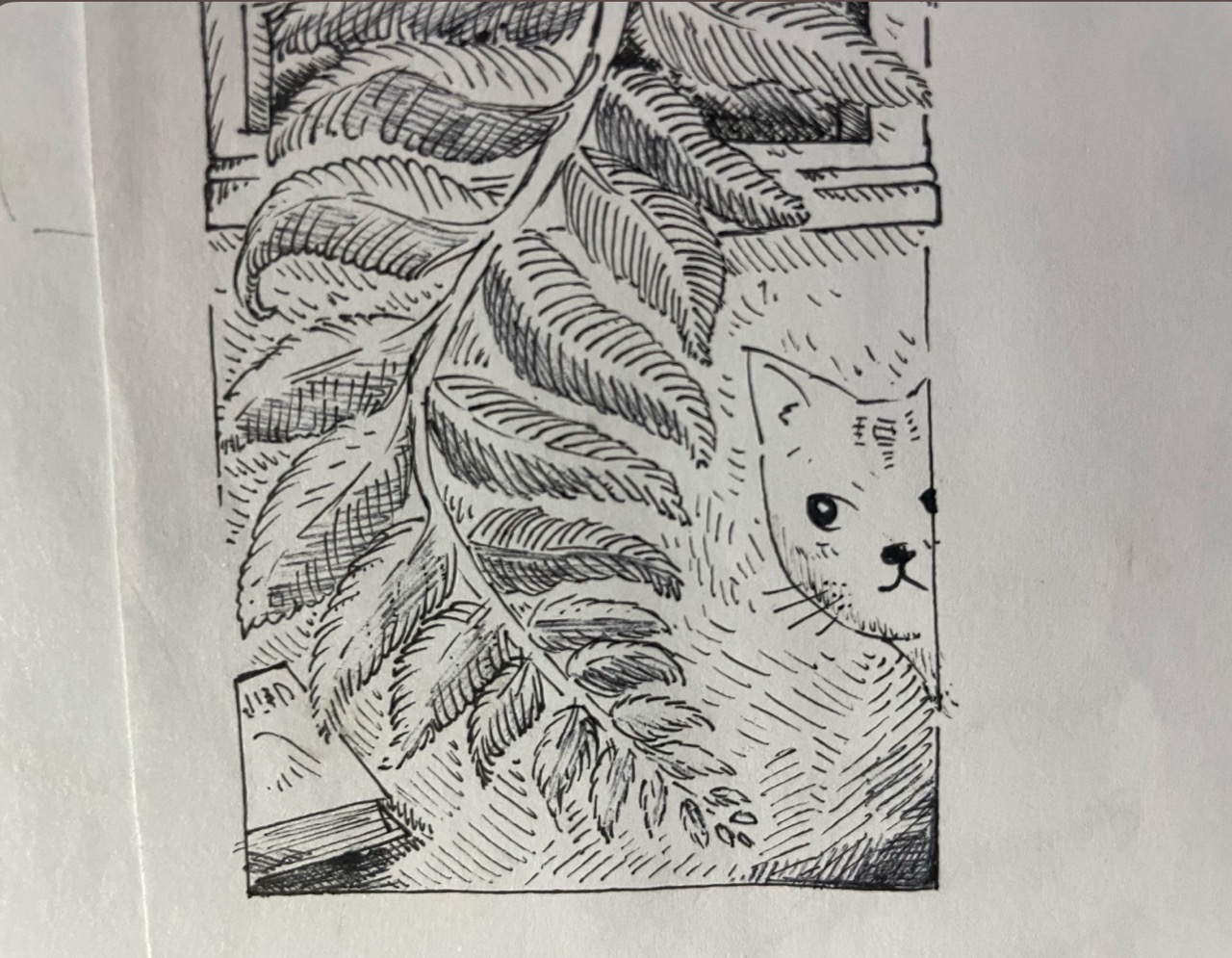
Narrative Aside
When did the world change? It’s a familiar conversation, echoed from era to era. It could have been when the first life appeared, whenever that was.
The endosymbiotic theory proposes that mitochondria were once independent prokaryotes, only to be engulfed by a larger host in a symbiosis that defined the eukaryote, an entirely new type of organism. Some scientists argue that the event of this first symbiosis, which was just as unlikely and inexplicable as the origin of life itself, was the biggest change the earth and maybe the universe had ever seen. But how then, can witnesses to the universe discount yet another miracle, when those very eukaryotes formed the complex multicellular organisms that eventually flowered into the animal, plant, and fungal kingdoms?
Then again, from an anthropocentric perspective, perhaps the greatest shift occurred when language came into being - the first moment a symbol was painted on a wall with clay, and grew into a story. The first time an animal tongue formed a name for another.
Also worth considering: written language. The abacus. The calendar. Humanism was supposed to be sort of a big deal I guess. Electricity, the steam engine, and radios that harnessed the electromagnetic spectrum into something like the thinking around signal processing allowing computers and the internet to eventually be created.
As long as there were words to speak it though, people would always say “Things are different now”. That knowing look shared between two apes after they had killed a rival with a stone for the first time. “Technology these days, man.”
And so I know I’m wrong, and that it will be said again. But for me, the moment the world changed was in the spring of 2034, and I was there. I’ve collected accounts around this time in attempt to make sense of the shifts that occurred this pivotal year. All I ask is that you bear with me as I try to connect them into a story, motivated by the fear that if I don’t, the truth may be lost forever.
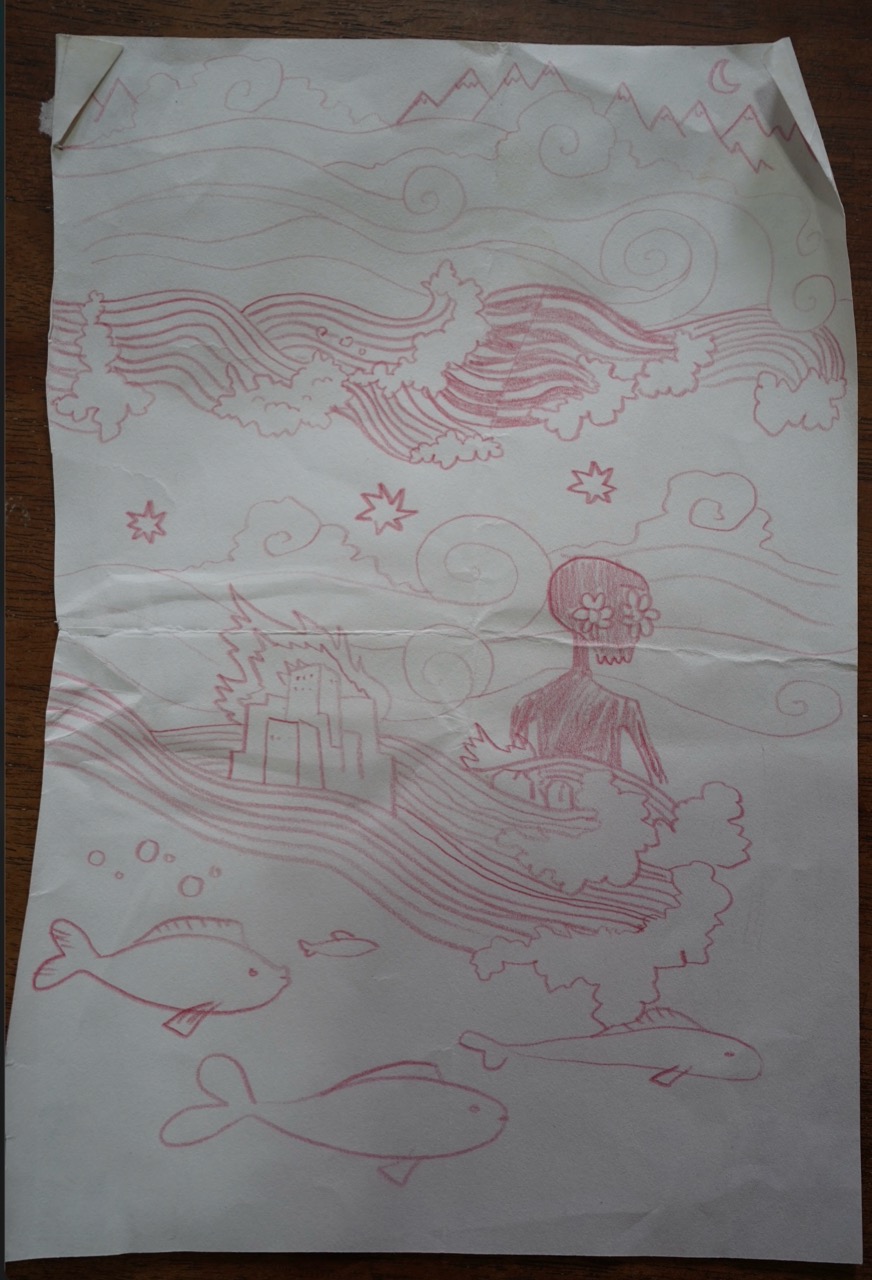
Narrative Aside Cont.
But if you were alive during this time, then you know that although my experience was remarkable - and you may even understand even now, with no additional context, why this experience was pivotal - it is likely you would disagree and say no, it was 2036. That was the year that the world truly changed. And it is, as I opened with, sort of splitting hairs but you would be, although I disagree with you, in the majority. And that’s never stopped anyone from asserting they were right.
As I write this, I am uncertain of who will read it, but maybe that is why I want to. Maybe that’s why anyone, anywhere ever wrote. I heard once, at an art exhibition at the NYU school of engineering, something about this.
“Tradition persists not when life is easy, but when it becomes essential”, from the network gong ensemble archive.
Earth Species Project
A potential meeting of the ESP whale communication project and the behemoth, even though the behemoth may appear a decade later, is that the Behemoth wants to destroy the whale information operation.
This is a real thing btw - I rename it to CAI later since probably shouldn’t reference actually organizations like this.
Behemoth
1: The Siberian Connection
2: Rare Commodities
“Oh god,” I yelped, awaking to Anubis’ face inches from mine, eyes luminous.
You were sleeping deeply Anubis said in my mind.
“Yeah I guess I felt like, secure or whatever,” I responded testily. Anubis kept staring at me, not blinking, and I started to feel a little uncomfortable.
Would you like to help me with something? Anubis asked after a few eerie moments.
I rubbed my eyes.
“What time is?” I asked.
“It is six U.T.C,” the small black cat responded.
I groaned in confusion. “You know, it never really occurred to me before but maybe one reason people still speak in local time is that if you happen to have no idea where the fuck you are, at least you still know what time it is there,” I said.
Good point said Anubis.
“Wait, is that coffee?” I asked, sniffing.
Freshly brewed Anubis said. Ethiopian.
“I thought you said…”
Anubis hopped off the cot and disappeared out of the room. Strange of him to go through the effort. He usually did his best to disorient and alienate me, and when he wasn’t doing that seemed perfectly good at ignoring me. The static played up a bit, and I wondered if he was listening. The subtext of that question being that I wondered if he was always listening, which I tried not to consider in case he was.
telekinesis
would be funny if the telekinesis was a trick - maybe what is lost on the walker but not on Anubis is optics, how power can actually be multiplied with artifice, something the raw computation intelligence and ingenuity of the walker can’t totally grasp
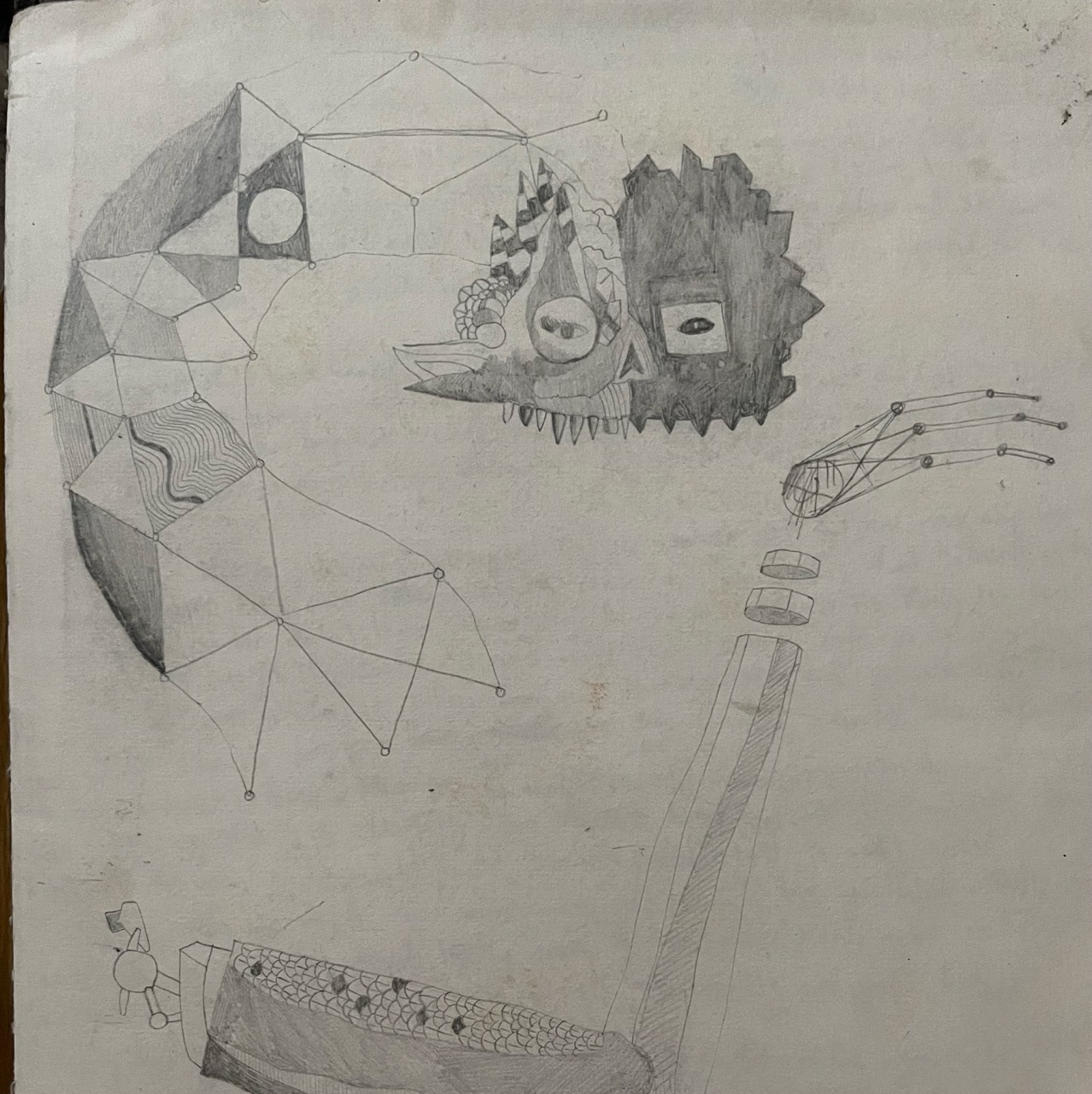
I slid off the bed and put on the re-fabricated pants that probably got spat out from the bundles of used fabric we’d picked up in Sudan. They were a bit loose in the waist, but actually fit pretty well. I’d found some nylon straps with mini-ratchets holding the UN palettes together we’d picked up there as well. Worked well enough as a belt. There weren’t that many…human things on board. Like coffee. And yet, it smelled…good!
I looked back briefly at the twelve other cots mounted on the wall, like bunk beds for a sleepover, or more likely, space for refugee families to sleep. Just another part of my question of whether the walker cared about people. I didn’t know I was about to get my answer, nuanced as it may be.
zodiac
the zodiac of the animals trials, like the Dharma initiative from lost, can run, could help me both limit the number of animals I explore, decide on why I pick each, and also create a subversion of the expectations of each within a trial
Ration synthesis module two, or RS2, was known informally, by me at least, as “The Kitchen”, and I think most human beings would refer to it this way, even if that moniker made little sense in this environment. I knew it by this name partially because of how Anubis referred to it and, disturbingly, from the QR code etched on the posterior wall of the room, which just sort of gave that vibe. Not that I should be able to glance at a QR code and get any sort of information from them. But I remind you of my strategy when it comes to the spookiness of this implant; forgive and forget, and try not to think about extracting it with a pair of — kkghh — yes there was the static again. Anubis definitely monitored this channel. Or whatever it was.
I took a sip from a charming mug that said “Ciao Bella”, and wondered idly where it could have come from.
what if Anubis is experimenting with symbolic-link language, where it is possible to speak in terms of abstract symbol trees that are filed in shared sensory links somehow
as per the architecture of the walker, it’s a mind fuck because most are modular. So ration-synthesis module two is a kitchen, designed in order to create food for things mostly in the Animal kingdom, sort of an offshoot of a hospital
I think Music could be value that AI can’t truly create in the same way - intelligent enough to understand its value, but not to create it? But that leaves the question of whether animals understand music
It was good. I closed my eyes and savored the taste of the coffee, so rich and strong.
Memphis, Anubis said.
I considered Anubis. How did he know how to brew coffee? He was a cat. A powerful AI, and a cat. Not what I would have considered his strong suit. I looked around, not seeing any equipment. There were hoses and various cables and alien-looking appliances hanging from the ceiling. Maybe they were somehow involved.
Has the largest cargo airport in the continental US. Anubis said.
“Okay,” I said, loving the feeling of the caffeine rushing through my bloodstream, the intensity of it after having lost my tolerance completely.
Put this on Anubis says, making biscuits on a black jumpsuit laid out on the floor.
How could I say no to him? No seriously, tell me. How do I get out of here.
3: Memphis
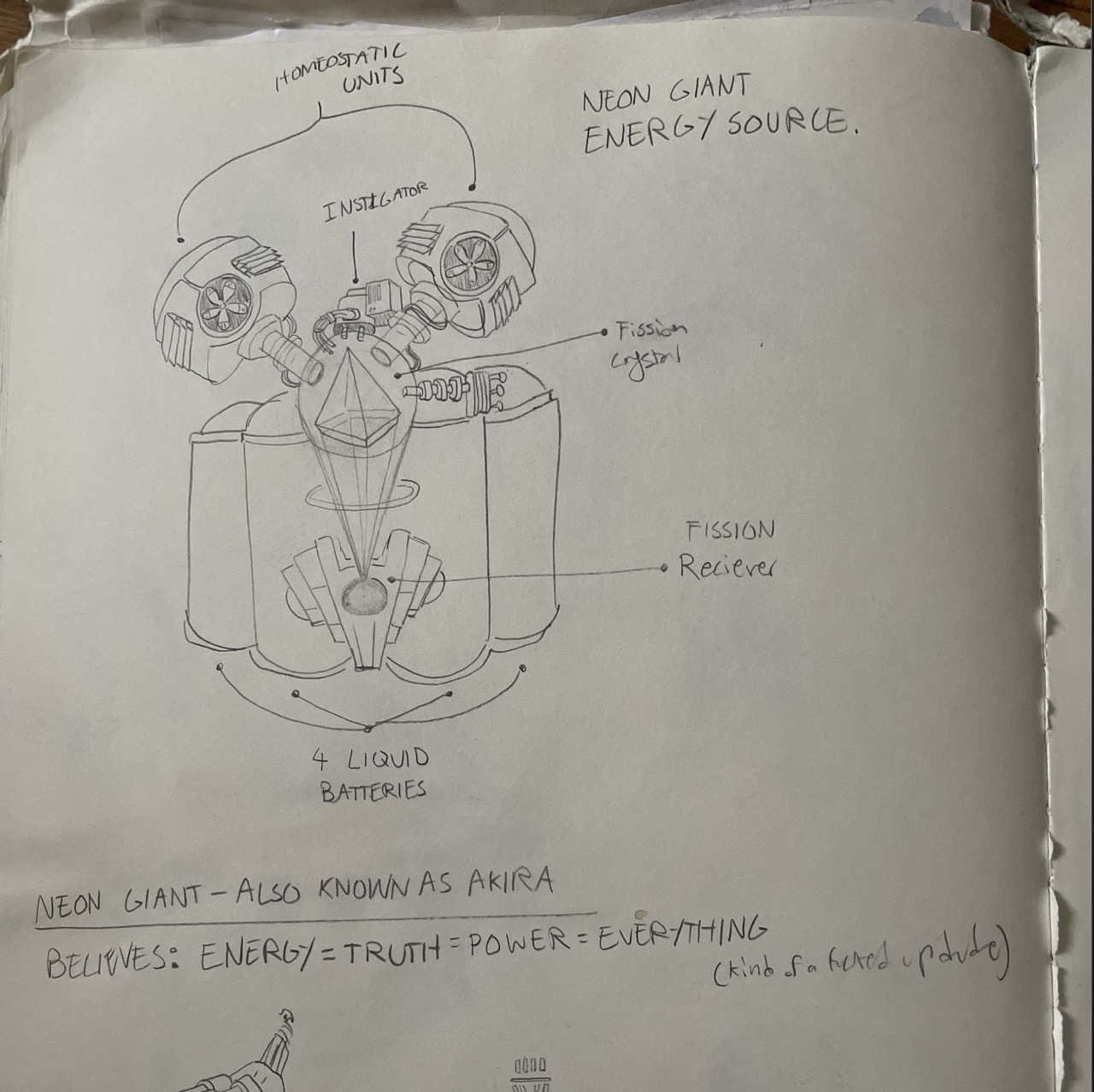
As I became more familiar with this giant, cavernous upper torso of the walking mech-mansion, I became aware of a variety of systems thrumming around me. At one point in Siberia, anti-aircraft shells pierced through the wall of the upper left terrarium.
Perhaps foolishly, I ran to one of the greenhouse windows at the sound of a booming. The windows extended from about three feet from the floor of the main terrarium space to the ceiling, leaving two thirds of the rear wall composed of an opaque material.
Anubis had granted me a gift of binoculars, which I pulled to my eyes to see two small shapes moving over the frozen tundra.
“This was once permafrost, but it has thawed,” he mewed to me via the conduit. It was a rich and deep voice, simultaneously booming yet also as insubstantial as the mass of the wind. “Power is the only thing men want, in one way or another.”
Superimposed in my mind’s eye was a sort of shape, a winding line, extending to what may be a horizon that lined up close enough through the landscape of furs and distant mountains I saw over the mountain.
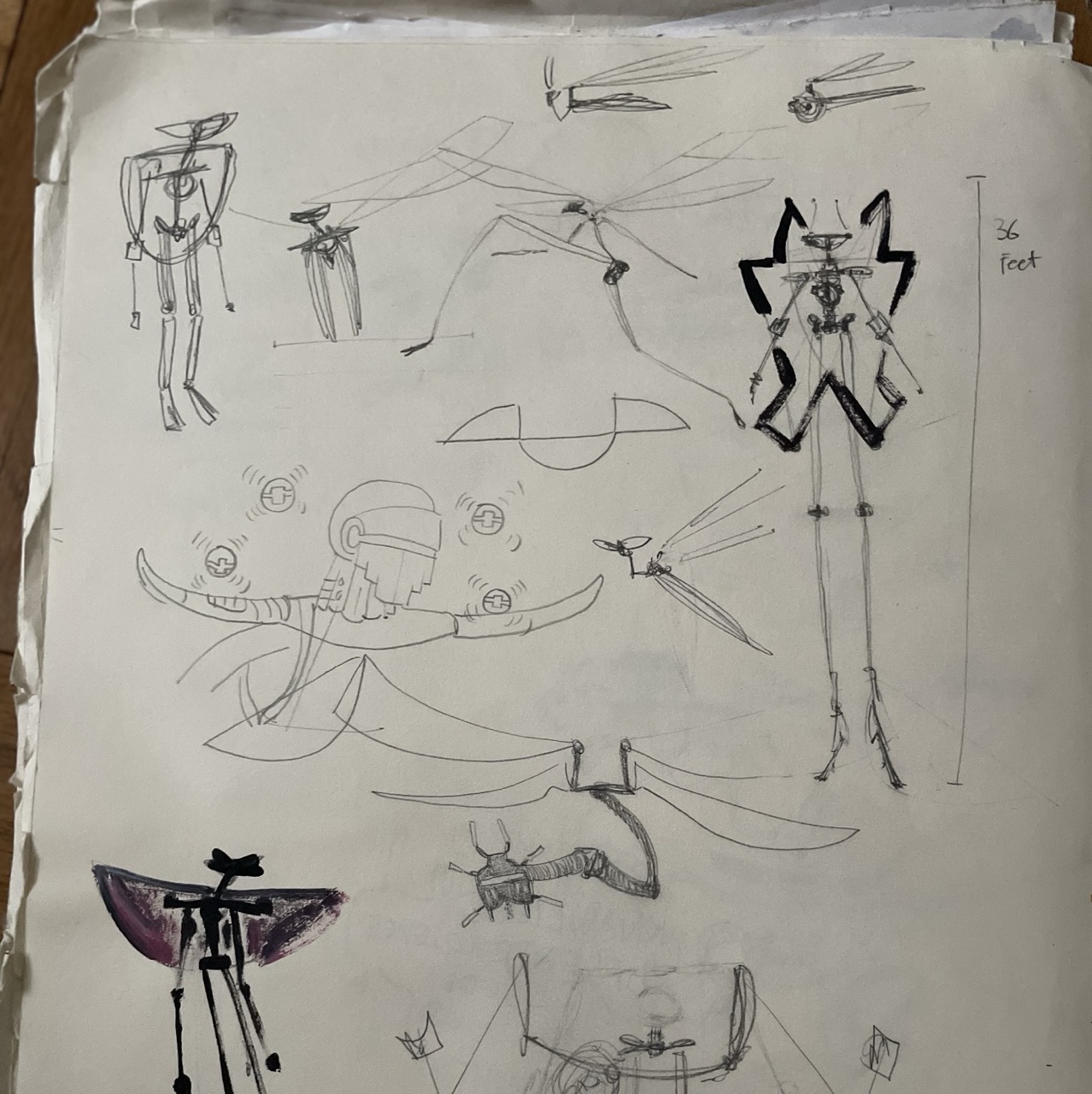
Like a whisper, a thought echoed through my mind, and seemed to say the arctic energy exchange. I chuckled out loud. I don’t even think Anubis had intended to intone this over the conduit, which gave me comfort - if I was literally not in control of my own mind, at least he wasn’t either.
Anubis had never abused the voice though, which gave me comfort too. Perhaps he intuited that to do so would be to breach a sacred line that would destroy any possibility of trust from ever existing. Somehow, with what I perceived as respect of that boundary, it did not bother me anymore, and I was careful not to talk about it anxiously. When I first heard it, it had scared me. I had felt claustrophobic, violated as if someone had entered the innermost room of my mind that I did not even know a door existed to. I still thought of it this way from time to time, and find myself thinking thoughts about removing the device, but I knew that such thoughts would not help me, so I found a way to make peace with it, for the most part.
I have long been fascinated by suffering. Is it possible to train oneself so against suffering that even drowning can be a passing event, and one can leave this world in peace in the event of such an accident as the rushing, uncaring water of a river entering one’s lungs?
Probably not. But my second line of defense against such horror was the thought that, a panicked body takes three minutes to be defeated by lack of oxygen, if that. What can three minutes do to compare against a lifetime of peace or happiness?
Maybe that’s what we’re fighting for on the bad days. To gain back enough mindshare, joyshare, that in our darkest days the ratio is in our favor still.
In any case, I chose to forget this intruder in my mind, and instead think of him, or well, them, as companions. Of the kind who might give me gifts from time to time, for example.
I felt Anubis retreat - there was that strange feeling of absence to in contrast with the feeling of presence. He had retreated somewhere else on the sentinel, or perhaps elsewhere.
What I was looking at appeared to be tanks, flashes coming from them. Streaking arcs of tracer rounds enveloped the limbs of the great striding fortress, enveloping the distant left appendage and the legs in flashes of light.
Boom boom boom boom, muted rounds fired off.
I marveled at how powerful they looked, yet how quiet the bass reverberating from the shots were, dull, resounding thuds and echos. A couple reached closer, making cracking noises until the room burst with sound and light! Seven or so feet down the wall several smoking holes had been punched in the windows. My eardrums buzzed, and I could see in the far window where the shells had exited cleanly.
Crisp Siberian air breached these new openings, introducing a light whistling, intensifying at the top of the strides I had gotten used to that reverberated the ground gentle like a passing train every ten seconds or so.
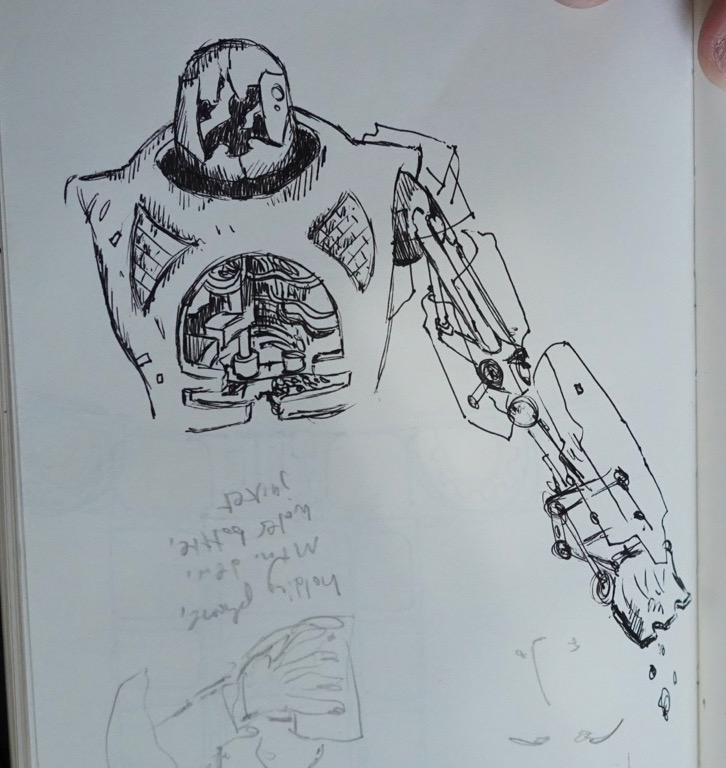
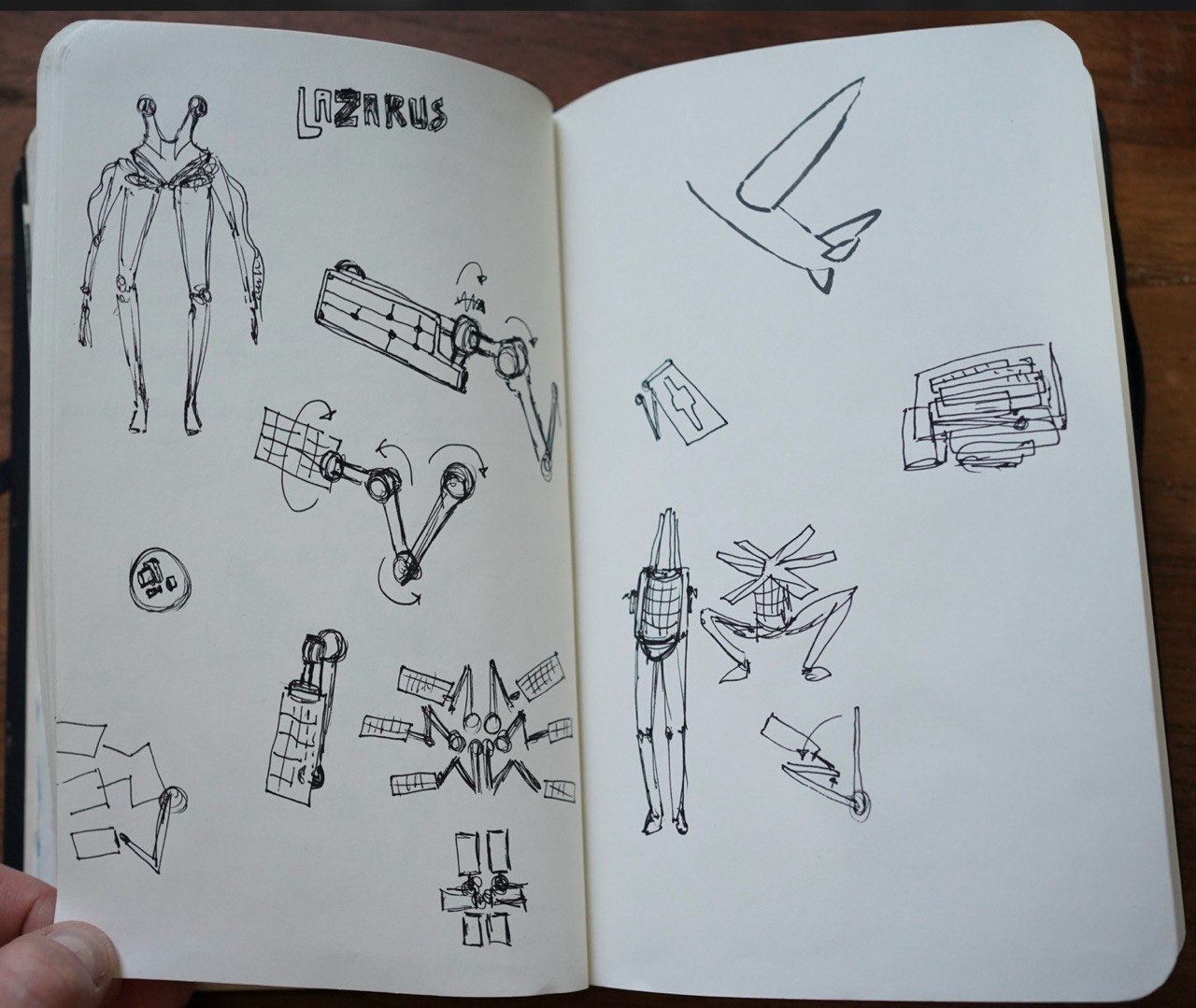
Reference to another short story I’d like to connect with the world of this one: Zarus
As I watched, the vehicles turned around quickly, as if suddenly remembering they had somewhere to be. I watched with horror as one drove seemingly of its own volition down a rocky embankment and lodged itself in a small gorge. I struggled to see them through mist that I often saw through the windows, as if we were walking above the clouds.
Abruptly, scaled shutters rolled down over the windows like the wings of a beetle protecting its delicate wings, leaving beams from the skylights and, soon, the orange glow from the growlights flickering on to illuminate the enormously varied racks of mosses, gnarled bonsai-like trees, and desert shrubs growing in front of and above me, hanging from fine webs in the ceiling. The canopy, Anubis called it.
I watched with fascination as small, crawling immunobots swarmed out of the large tubes that snaked through nearly every room on the collosal bipedal structure. They were like links in a chain, uncoupling themselves and falling out of holes at intervals in the tubing. Popping through these holes, they flew briefly, and then adhered to walls like insects, scuttling over on just four legs, possibly by means of magnets. They were about two inches long, but must have carried all manner of raw materials to solder and fill the holes they mended.
There were three holes, and in about three minutes, they had been filled with red hot plugs of metal that then cooled, barely forming a scene to betray their legacy.
When I returned a few days later, I was surprised to find that the same wall had been reinforced with a lattice of hexagonal metal supports as if the metal had been printed directly on to the surface of the walls. And a few days after that, it was smooth again but, I suspect, a few inches thicker.
I wrapped it with my knuckles, as I drank yerba matte tea Anubis had shown me how to brew, and heard what sounded to me like a somewhat hollow reverberation, as if those hexagonal capsules were locked away behind a new layer, or perhaps several layers, of reinforced metal. Or at least I think it was metal. What else could glow at such heat like that?
Sources https://armstronginstitute.org/138-what-is-jobs-behemoth
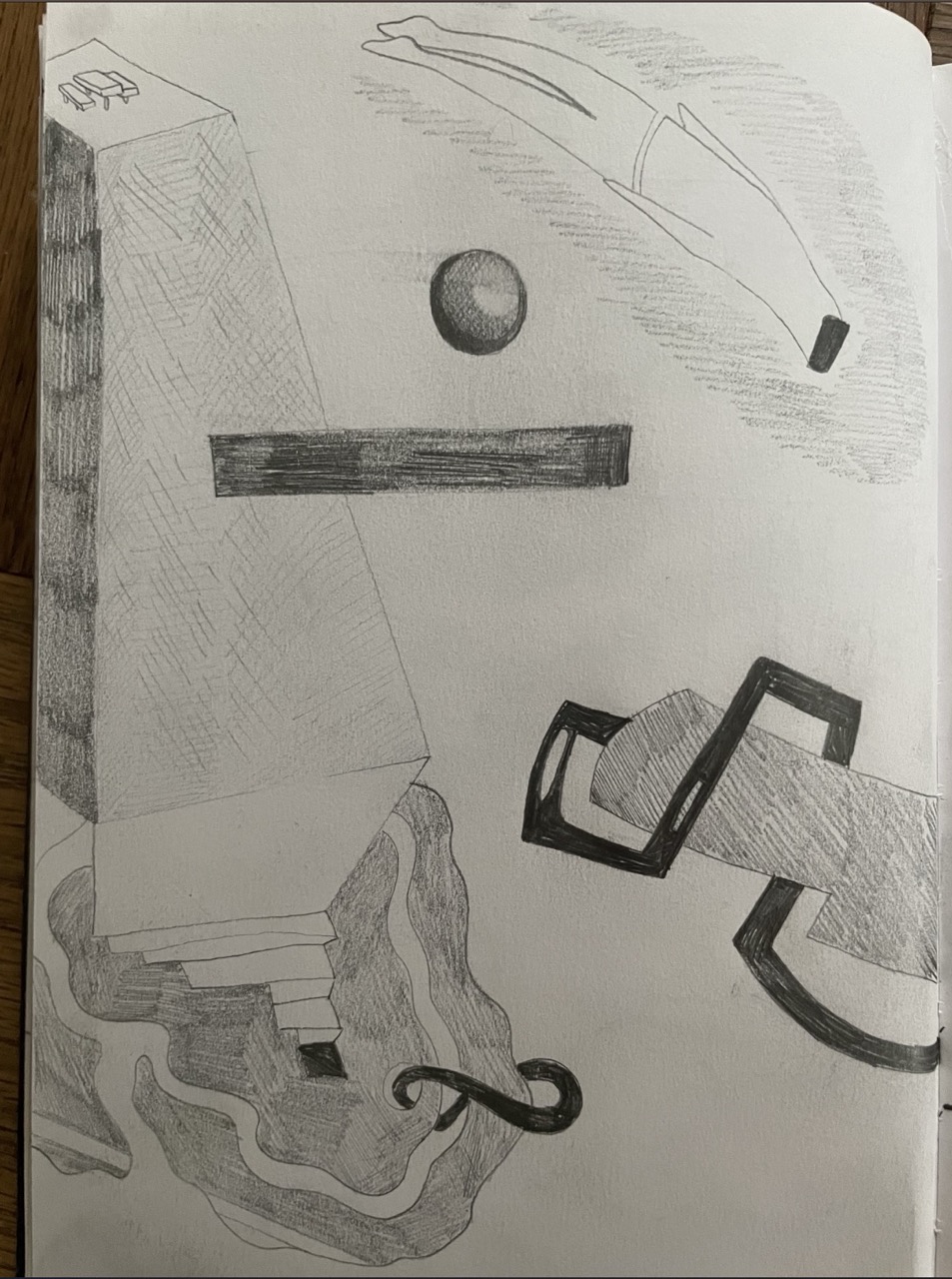
We landed near a patch of grass. There were a few skeletons of vacated houses. I saw what looked like an entire city block of buildings that looked like they were just shells of brick and concrete. Patches of shrubs clutched small sand-dunes here and there around us, the sand seeming to glow gently under the light of the gibbous moon. Cotton swabs of white clouds rolled over the horizon stretching before us, other shapes of the abandoned city vague shapes on the horizon.
The most obvious point of attention before me was the faintly shimmering orb arcing roughly to our west. I knew from a brief view I had seen through the slits in the side of the elevator that the orb contained some sort of compound built on the banks of the Mississippi, dancing through the midwest like an enormous serpent unconcerned by the movements of man.
“Oh, it’s for cooling isn’t,” I said, jogging to follow Anubis’s lead as she ran towards the shimmering orb that stretched at least one hundred feet into the sky curiously enough. I hadn’t fully processed what I was seeing but it was pulling on the edges of something I had read recently in the printing room.
Behind us, almost at a frequency I could not register with my ears but only with a feeling of reverberations in my chest, it’s booming deeper than deep, the steps of the Mecha receded away from us. As I ran over the loose dirt, I looked behind to see the giant humanoid shape of the humanoid recede into the darkness of the Memphis night, barely an outline, then flickering into nothingness. For a strange moment, I felt alone, and maybe free.
I stumbled as the ground gave way to deeper sand, and hit the ground hard, busting my chin up a bit. From the ground I saw Anubis continue before me, and I wondered what would happen if I were just to stay here on the ground. I rolled onto my back and I saw the stars. Those same stars Lizzie was seeing, if she was still alive.
I rolled back onto my feet and broke into a faster jog to keep up with Anubis.
would be super cool to transition to a global hosting outage type of thing. No I don’t really know who lizzie is yet, or who this visitor is. Maybe it’s Cody, in the future? Or Jeremy? Maybe Lizzie is Claire from the Coda?
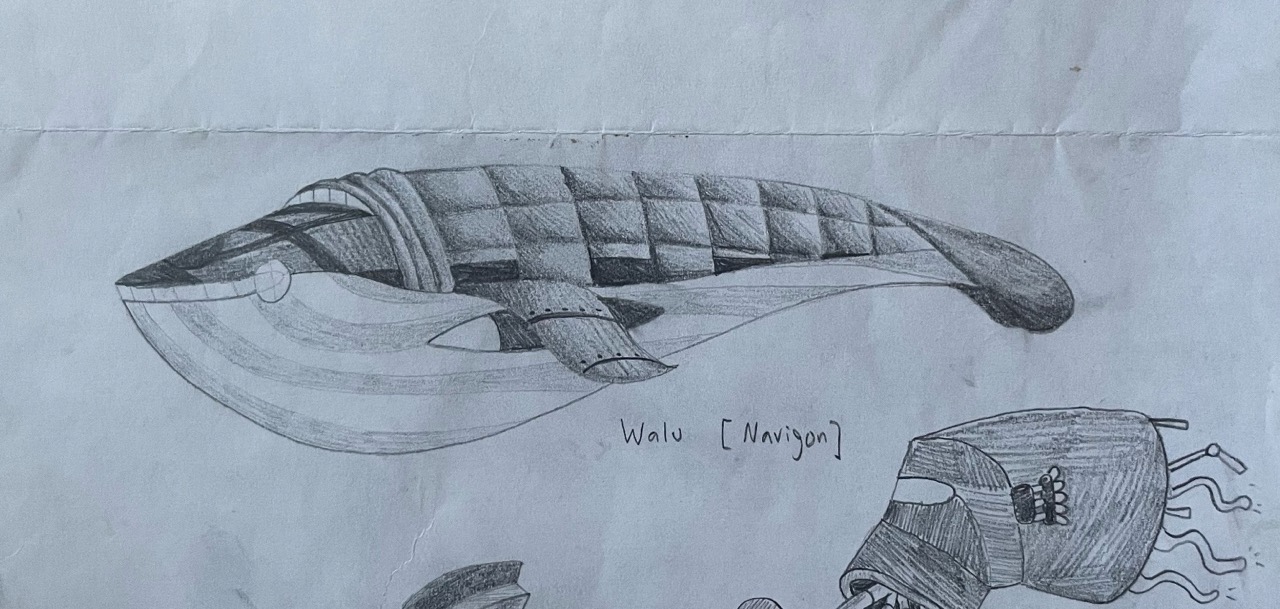
Coda 1: Songwhale
sorry, names are still all over the place here. Just loose ideas for characters still, so name continuity is low.
The project was almost shut down, until the second generation Chinese whaling ships. made a resurgence, triggering an increased focus and consequent funding in the project. We had been stationed outside of the Dominican Republic for sixteen months with sonar equipment and underwater probes and motion detectors that had cost millions of dollars. We didn’t have a lot left to pay anyone, which was okay because we were more or less happy to volunteer.
But we didn’t have a lot to show for it, and that’s what hurt. There was this one day that I had this big false positive — I thought that I’d been able to crack names at least. I’d done an analysis on four terabytes of whalesong recordings, some taken from this study and others from other datasets that Cody, the head of digital assets, thought might be valuable to machine learning specialists like me.
“Here’s another hard drive for you kiddo,” he’d say, back from the mainland. We were on this island called Banta. It was about the size of Vanuatu, which we was not far from.
The tricky part was context. When you learn a language, half of what the computer that is your brain (“We only compare the brain to the most sophisticated computational hardware we have at the time” Sebastian would say to me in his snooty voice — whatever, Sebastian) is interesting is context.
Like let’s say you’re learning Spanish - if you’re learning tenses, the context is whether the person is referring to the future, or the past, or some conditional case. To be a bit more heavy handed about it, if they are saying “ventana”, the context is a window. But I think that when I say, if the context is that they are referring to the current season when they say “Invierno”, maybe my point hits home a bit more. When learning a language, the inputs are symbols and context. When speaking a language, that symbols can now regurgitate that context in whatever configuration the speaker or writer or whatever would like.
So you need the context,
The thing about animals is that, we have half of it. We’ve always had, sort of, half of it. We can hear dogs, see them wag their tales, listen to songs from birds. But we don’t have the context. Now, apparently birds have a tonal acuity that humans do not, yet we have hardware. They also do not experience sound the same as us, and that’s a fact. Birds can determine differences in tones at a resolution human beings never could, but the differences go beyond acuity, or resolution. Birds do not seem to experience the order of notes - take the notes of a birdsong and scramble them, and as long as they are exactly the same, many birds will not react these as different songs.
But that doesn’t really matter, because it’s still just input.
But context. That’s harder. What is the context of a birdsong? A tail wag? A whale song?
That’s the tricky part.
To find out, we needed good, good good data. Not just verity high resolution audio recordings, but we needed to know what a whale was doing at the time of the recording. Which whale. Where were they.
So my theory was that names were the place to start. They should be the easiest place to start because they are the simplest and most common symbols.
So I was crunching this data in any way I could to try to discover correlations between certain whalemes (a phoneme is a single atomic unit of verbal human language like “you” or “knit” to make up “unit” so a whaleme is the equivalent in Coda. To be clear this is my own invention and I need to come up with a more legit sounding term for the paper I am writing if I ever want to be published) and didn’t have much to show for it.
When Claire came to the ship and we all introduced ourselves, she asked what I did and Cody (rudely) cut in.
“Whale names”, He said in what I thought was a pretty dismissive tone. But he was right. That was my humble goal. Whale names. And I couldn’t shut up about it. It seemed doable, like a first small step. Other researchers on the ship, like Sebastian, were doing much more complicated things, like running this information through complex linguistic machine learning pipelines with transformers and doing a lot of matrix math, and I was doing something much simpler. Just trying to score correlations. One whaleme to one whale. What’s the correlation? I wasn’t finding a lot, which was really disappointing. Except for this one whale, who I called Uwa. Because, well, he was the only whale who had a significant correlation to this whaleme, which could be described as uwa because it sounded like “Uwa!”
It was really cute actually, and an uncharacteristically short sound for a while, who tend to make these longer tones.
Coda 2: ESP Goals
The conservative goal was simply to demonstrate further and illuminate the intelligence of these creatures and thereby exert pressure on whaling industries killing them. The more ambitious goal was to decode their signals to a great enough extent that we could warn them when whaling ships were.
Coda 3: Crying Out
“Cody,” I said quietly. I took my headphones off and looked around. South Lab mainly was deserted. It was Sunday, and season two of The Recalcitrants was premiering tonight, so a lot of the base was in the Goodall Commons.
I stared at the waveform and was startled to find a familiar shape staring back at me. There were familiar notches in the low bass tone that started it. I played it one last time.
The whalesong, on first listen, was haunting. The backdrop was often a rush of deep sea currents that were difficult to completely remove from the recording. Imagine the sound of a massive waterfall, several hundred feet in the distance so all you can hear is the pouding force of an unfathomable amount of water.
Ringing over that was an whining, ethereal cry that slide down into a low register only to escalate back into a supersonic register. “Ooh..wa!”
I had widened the similarity search for the tone and mapped it to n-dimensional space to see if I could find patterns. In general, the tone appeared to be created by HB64, a documented adolescent humpback whale in the Antarctica/Australia (AAM) migration pattern.
But Uwa - HB64 - had been tagged in 2015 as a baby calf found with its mother. This was strange to me - documentation of that early 90’s tagging project explicitly directed against younger whales, or the approach of whale mothers.
And there was, indeed, a cluster of intonations that resembled the call that HB64 was making, but they were from around that time. HB64 had been there with his mother, HB63, but in the cluster of tones that sounded like “Uwa”, none of these recordings were mapped to either creature, except for one which, upon investigation, I verified that the vocal characteristics didn’t math HB63, and the voice was far too mature to belong to HB64, who was a calf at this time and made much quieter, more subdued vocalizations as a rule.
As far as I could tell, these intonations were made by a variety of whales that had some level of contact with HB63 and HB64, but none were made by these creatures themselves. But this made no sense - my theory was that the “Uwa” sound was a sort of tag, like “Hey, I’m Uwa, I’m identifying myself”, but if these other creates randomly made these sounds at another time - about seven hundred instances of sounds that appeared to match this intonation over the course of about 6 months, shortly after a flurry observations were launched out of AIMS, the Australian Institute of Marine Science — then my theory collapsed and I was left without an explanation for what this sound meant, just this word pattern. At one time many creatures had made the sound, and no just one.
“Cody!” I called again, louder. I had been so lost in thought looking at these graphs. I simply felt I’d been looking at these analytical pipelines for so long that I needed to speak out loud, needed to hear a human voice to break up all of the whalesongs bouncing around in my head.
“Where the fuck is that fucker,” I muttered, grabbing my coffee mug and nearly pulling the monitor off the table via the cord from the headphones that were still connected to my hears. “Fuck!” I said.
Many that was it, my fried brain thought. Maybe “Uwa” was some sort of whale curse-word that had had a moment in around 2015 and HB64 had been the only one to keep it going.
Silence. Nobody else was in the room. My calls to Cody were unanswered. Where the hell was this guy?
“I swear to god Cody if you,” I started then stopped myself.
There was Cody, lying face up. A small splatter of blood spread from below his blond curly head, and his glasses were to the left of him.
“Oh fuck fuck fuck,” I shuffled over to his body on the floor.
I had the dawning and surreal though that this may be a memory that I returned to many times in the future, and I watched my own actions as if I were a judge watching a criminal. Why had I not looked for him sooner? What was the right thing to do here - should I get help?
“Breathing,” I mumbled, putting my hands on his chest. He was wearing a Parka. Either coming back in from outside or going out. He was a smoker. He had probably been smoking.
His chest was warm. This was good. I couldn’t tell if he was breathing. I put my ear to his chest. It was beating. This was good too.
“Soph,” he muttered, in a strange rasp.
“Fuck!” I whisper screamed. “Cody. What are you doing on the floor buddy?”
see sara biri IRL
Coda 4: Names and Actualization
Later in the infirmary, which was really just a single bedroom that had been stockpiled with medical supplies, I stayed up watching Cody breathing. It was comforting. We though he had a mild concussion, but didn’t really have the equipment to confirm it. Thought he’d probably had a seizure. Dr. Maria, who was not a medical doctor but she sure knew what to do in a pinch, had helped me confirm that Cody really did seem to be okay.
“I’m really tired,” Cody had said.
We’d observed him for a while, done the tests, called up mainland where our director had put us in touch with a friend of the director’s, Dr. Gransgrove. She’d taken Cody through some tests and we’d observed his pupils. We confirmed he was fine, although it seemed there may be a small chance he’d had a seizure.
The lanterns outside blew in what was a relatively gentle snow storm, with mild winds, and backlit Cody’s hair a bit so he looked, admittedly, a bit angelic.
I wondered if anyone had watched me like I had watched Cody in that moment, noting his breathing at intervals, watching for strange signs in him. That’s what Gransgrove had asked someone to do, and I’d volunteered.
I thought a bit of a boyfriend I’d had, or maybe more of a fling, who had been in a surfing accident, and I had spent all day running around trying to find hospitals and get transportation and find medical personal on the beach while one of my girlfriends, Andrea, had actually taken him to the hospital. I felt like she had it covered, and she seemed to have it covered, and I felt like me also going with him would be too many cooks, and wouldn’t have added anything, so I fell behind.
Things were never really the same after that. He seemed to think it revealed something about me, and I supposed it did. In a time of crisis, I was there, helping as a friend, but not with the intimacy of a lover. Or, that word isn’t even as specific as what the situation defined, and defined well - I wasn’t the kind of person to him who would hold his hand if he bloodied his nose out in the surf.
So I held Cody’s hand. I didn’t necessarily even like him, but I didn’t want someone to feel like that again. Abandoned.
As I did this, my realization went through my head. Selfishly, I wanted to sit with it, and the possibilities for a moment, savoring it, before I proved it wrong, which seemed likely. I’d wanted this job so much, and then when I’d gotten it, I thought I probably wouldn’t get a chance to do meaningful research, and then then when I got a chance to do meaningful research I thought that probably I wasn’t smart enough to actually do it though, and then here I was, with the possibility that I had discovered something, something important.
“And so I think that Uwa is a name,” I said softly to the sleeping Cody. “Just not the name of the whale itself. Duh. It’s not a distinction, but a call. I think that it’s HB64 looking for its mom.”
Some time passed. It was sad. Partly I hoped I was wrong. That one whale would just search and search. It also seemed absurd. How would they even have been separated to being with? Where would she have gone?
Lemme see, properties of whales. They spend a lot of time swimming, which to them isn’t swimming, it’s just, sort of existing. They probably don’t really feel too much cold, either, since they have blubber and that might just not even be a useful sensation for them. They can see using sonar, they can speak, they can see somewhat above ground, they may have magnetic abilities, electrical sensations, and they can probably feel the shape of water - or at least other water animals are able to do that. And so they probably have dealings with dolphins, submarines, fish, octopus. Some can live up to like 90 years, and they are huge and can travel like 100 miles a day which would allow them to see a ton of the world. All sorts of places. It’s sort of hard to imagine how meaningful this could be in a sort of weird human limited imagination way, but that’s probably a function of what I am able to understand about them.
But fuck i feel like my problem is, what is the conflict even of the main character you know? I mean, she doesn’t feel super smart, or much self belief I guess, and she’s trying to solve this problem but I think that probably everyone thinks she’s a fuckup or something and that actually she shouldn’t even be accepted into this program because she’s deadweight and that their funding is going to get pulled anyways.
Coda 5: Jub Smana
Cody groaned.
“I know, it’s sad, right?” I said. Cody didn’t say anything. I waited a moment then got concerned. “Are you okay? do you need anything?”
I reached out and took his hand in mine. It wasn’t that warm, but it wasn’t cold. I squeezed it, and after a moment, he squeezed back and muttered something.
I leaned in, and saw his eyes had been cracked open, maybe for a whale, watching me talk to myself, like an idiot.
“I said,” Cody started, his tone almost annoyed. “What if there are specific characteristics in whale names that can be used to…”
Cody groaned again, but then he smiled and looked at me. There was something there, some sort of recognition I hadn’t seen before. The guy wasn’t exactly a love interest, and I don’t think I was his. It was something a little more basic than that. Just a held gaze.
“The doctor said you should rest dude,” I said.
“Used to find other names. You know. Like, Claire, Cody. Crosgrove. In human language, I think you could do it. These have properties that sometimes overlap with the rest of language, but sometimes properties that don’t so. We could do a case study in human languages. And then extrap. Extrap…”
His eyes fluttered closed.
“Extrapolate?”
“Extrapolate to…” his head rolled to the left. I put a hand on his chest and shook, sort of afraid a sudden loss of alertness or consciousness wasn’t great.
The spokes on the bottom of the cot shook creaked slightly with the motion, and Cody turned back to face me, eyes open.
“To whales,” he said, and smiled. It was a smile of pure innocence in place of his normal sardonic expression that I’d never seen before, and for a moment I didn’t recognize him as the same person. Like, have you ever experienced this? Look at a person and not see what you were expecting, even though their facial geometry and everything is the same, you see someone else this time? And you wonder — and maybe yes at least sometimes this is because you are on a strong hallucinogen but I have had this experience stone sober — if they were always who you see know, or if they are just always changing. And if you, yourself, are always changing.
“Get some sleep buddy,” I said. Cody gave a little nod and shut his eyes again, exuding a very small little hum.
Over the next couple of weeks, that’s exactly what I did.
Cody was still recovering, and they shipped him to the mainland for an MRI, but we texted on whatsapp and he gave me the login to his work machine, which shocked me. I guess he was just a squeaky clean dude with nothing to hide!
Although he was supposed to rest, he’d slip in little voice messages about where to look at various docs to do n-dimensional mapping and visualization on set dimensional space as well, using visualization tools to find relationships in data.
I started with the english language.
I found that across Hindi, French and English, there was a specific list of sounds that had a much higher occurrence in first names than as words. I also found that certain patterns existed in texts that could be tracked, like how the placement of proper nouns often differed than the placement of other articles, but that pronouns tended to be shorter and have a lower-commonality score in terms of phonetic overlap with other words in a particular language. That is to say, in similar maps that connected words like log, bog, frog, etc, names like maude, scott, claude, tended to have overlaps with other names but were less likely to have similarities to other phonetic phenomena with other utterances within that same language, allowing them to be distinguished subtley as islands. These patterns were incredibly promising, but it was true that the human data sets were much more complete than the whale ones, being about millions of times larger, so this might not be a strong enough pattern to make the same distinctions in the whale data.
So we looked further, just in case, and realized that we were essentially writing a scientific paper, or a proposal, which was good because funding was drying up and Dr. Maria was encouraging everyone to get publications if we wanted to increase the changes that our lab would be renewed the next year so we didn’t all have to find new jobs.
“I hope these doors do close,” Francine had said, grumpily, “If the food here doesn’t improve I’d rather go home and get myself a good milkshake. Seems like no matter what sort of funding we get that milkshake machine never gets fixed.”
I’d laughed, as we’d waited in line in the cafeteria. Despite herself, Francine’s eyes twinkled a bit as I hadn’t seen before. She leaned over.
“You’re in Antartica and you need a milkshake? Not enough ice out here for you already?” I asked.
“Ah you’re right,” Francine relented. “Milkshake machines are always broken everywhere anyways.”
She gave me a few tips on writing and how to submit a paper that night after I told her what I was doing.
“Interesting,” was all she’d said, spooning a careful amount of mashed potatoes in her mouth. It was thanksgiving, and a meagre effort had been given as the shipments had gotten delayed by a storm. All we’d really had for our humble festival had been cranberry sauce and mashed potatoes, which I’d found were actually pretty great even in absence of turkey, but maybe I was just having a bit too much fun. “Send me the manuscript when you’re on the final draft,” she’d said, grimacing, and sprinkling a bit of salt on her plate.
I spent a lot of time in the library, finding that most of what I had to do was reading, and that I enjoyed doing that on printed out papers. We had an excess of printing materials, binder clips, and highlighters, and I reveled in arranging my notes, making annotations on other studies I found that had looked for similar linguistic patterns and even a study that used an ML process to map an audio library of engine noises gathered by affixing microphones inside the engine compartment of a variety of vehicles to prediction of mechanical issues that hadn’t been effective enough for consumer use but had been effective enough for some actuary studies and was being put in effect in some vehicle fleets that wanted improved insurance rates and to drill down on the parts in their vehicles that they need the most replacement stock for.
When the new rations finally arrived, we needed to load them on to the Nightsong for the expedition. The crew, once again, did not include me, but this time I wasn’t so disappointed. I was just happy to help and hear stories from the crew that had come back after three months. I particularly like this guy Jeremy, with glasses, covered in tattoos. Soft spoken, wore a plaid hat for some reason, and wrote these songs on guitar about the northern lights and iceburgs and a funny one about all the krill that whales liked.
Setting off intrepid these waters far from tepid freezing all my fins off but I have no concept of the cold
On a quest uninterrupted intense and aquous spelunking submarine caverns filled with bountry overflowed
yes krill is on my mind ninety nine problems and krill is every single one a million prayers to make and krill’s in everyone
I sang to the tune of Carolina’s on my mind, and it made me chuckle.
Jeremy told me about a time that they’d seen a humpback thrashing from a distance, spending hours trying to work up the courage to get close, until she was eventually so exhausted she let them. Full scuba suit, drysuit, sub freezing water temperatures, and Jeremy had three hours sawing through the netting that had been wrapped around her. She was untracked, and they never got more information from her, but he told to the table when we were kicking back after a long day of packing, about how once the netting fell away, deep into the water, and she was finally free despite the rope burns around her face and fins she suffered from the ensnarement, she hadn’t swum away. She’d turned, and with one enormous whale eye the size of a cantaloup, she’d look at jeremy, and blinked. Just looked straight at him. Then she’d let out a long call, followed by two short staccatos, and just stayed like that for ten minutes. After the longest ten minutes of his life, just looking right into this massive eye and not knowing exactly what she was thinking behind it.
“And it was really hard not to just feel this gratitude”, Jeremy said in wonder. “Like, I swear she was saying thank you. This was not whale behavior I’d ever seen before.”
“What was the scientist in you thinking?” asked Maria, peering over her glass of wine. She’d been then one who’d asked Jeremy to tell the story again, Jeremy teasing that she always asked him to tell it whenever she saw him.
“It’s my favorite story,” she’d said simply.
“The scientist in me,” Jeremy started, pointing at her and smiling, as if she had cued up what he was already about to say. “The biologist even, was saying, you don’t know. You don’t have the codex, you don’t have the context, you don’t know how whales think, and how they feel. But…it was so at odds with what I was experiencing. And either of them could be the right interpretation of those ten minutes, I don’t know. I don’t know. I’d have to have Claire here interpret the whalesong, whatever it was, for me to know.”
“I’ll do my best,” I’d said cheekily, rosy cheeked through my second glass of wine and looking over at Jeremy expectantly, “If you can recreate it.”
He raised his eyebrows at me as if to say really? and I shrugged like did I stutter, and he shrugged too, looking a bit embarrassed and looked down at his feet for a moment.
We all thought he wasn’t going to do it but then he took in a big gulp of air and let out a wavering call like a hunting horn, followed by two short, sort of grunting sounds.
“Ah,” I said, knowingly, with my most dead serious impression of Professor Krakow. “And was that second clause more like…” I contrasted two very similar sounding nonsense whale grunts, and much of the rest of the night collapsed into a drunken imitation of whale noises and speculation and then jokes about sex noises and then of senseless gossiping and storytelling late into the morning, which was much more fun than thanksgiving had been, or probably any night I’d had since arriving on base.
The Sunday before Christmas, I finished the final draft of the paper. Cody was completely better and he was heading back in just a couple of days. He’d been sending me all sorts of ideas and directly proofreading things from his parent’s house in Indiana and now that he’d taught me so much about the analytical tools he’d used we were basically working on the data together, switching off tasks as an efficient team.
We’d found that not only did names across what we’d expanded to seven languages follow similar patterns, but that some were consistent even across language with no known root language, and we’d created a small proof of concept of an ML that was able to reliably predict pronouns in completely fabricated languages that our colleagues had created.
Things like:
sma - drink smana - drank smanur - will drink want - jub no - kranga water - ubno
Where we’d say “lotolpa jub sma kranga ubno” according to the made-up language that Maria’s daughter in-law’s kindergarten students had created, and the ML tool we’d created could correctly guess what served as a proper and what served as a non-pronoun, even without any idea of what they key was.
In one version, it did this purely based on patterns of information in a linguistic clause, in another it did so based purely on the construction of the words, which was completely emergent and we didn’t properly know how it was possible, and also a version that combined these techniques to properly distinguish proper nouns from all of the languages in our study with at least 99.4% accuracy, except for Celtic which was at 84%, but we thought maybe that had to do with problems with the dataset since Celtic was a dying language and the integrity of our data might be off.
So basically, we had a good case for this working on whales, but of course we were going for funding so the goal was to get more money so we could increase our sample size.
Until Jeremy asked, “So what happens when you run the whale data through it?”
I felt defensive, “Oh I mean we have so few sounds.”
But the more excuses I came up with the more I realized I didn’t have a good reason besides maybe the fear that my confidence wouldn’t survive the discouragement of early failures.
I finished up lunch, went back to the lab, and opened up my tools. It took twenty minutes to set them up against the whale data instead of the human data. I ran it, and made some ramen and opened a Sapporo while I waited for it to run. About an hour. I watched an episode of something on Netflix and then saw that I’d gotten a message from Cody. He seemed to be excited but it was a little hard to tell because the screencast he sent had only him on the lower left corner, where I could mostly only see his forehead.
I had to watch the video twice to understand what I was seeing but it looked like some sort of spatial visualization of the whalesong. The timber and tone were being mapped in three dimension, over time, and the result was a staggering array of points hitting lines. Apparently a bird researcher had created a mapping system that Cody had repurposed. See the familiar sounds I’d heard gave me shivers. It was like watching constellations for before my eyes, each unique, and in a strange way, clearly meaningful.
I immediately felt like the world needed to see this and I posted it to Gifdojo, crediting Cody with the following caption:
Visualizations of tone and timbre in the whalesong of a Humpack whale. I wished Cody had chosen a recording that included an image of the whale, which would help people visualize what was happening, but I thought this was a good start. Don’t let perfect be the enemy of good right?
“So you uh, sorry I’m in the airport and my charging cable is finicky I…” Cody said in second half the video, fumbling with something off screen, possibly talking to someone next to him. It looked like he was in the airport. I wondered if he was still there - he seemed to be saying something about gathering additional recordings, but it didn’t make much sense. There was no plan and probably no resources for additional recordings until we were able to renew the grant for the research project anyways. I called him.
“Hey! Where are you!” I said once I saw the thumbnail of him looking awfully somber and professional.
“Charlotte! North Carolina. Actually a very nice - okay Claire so, did you get the video?”
“Yeah!” I said, genuinely ecstatic and proud of him. “It’s amazing! It’s almost like you’re doing better work from your parents basement than the lab!”
Cody’s full face came into view with his fluffy blonde curls and his slightly oversized glasses. He smiled sheepishly.
“Yeah that always felt a little, I mean it’s been nice meeting everyone, even you,” he said.
I rolled my eyes.
“I’m kidding, I’m kidding, but yeah I mean I’m just a nerd. All I really need is a computer, but I’d have to be crazy to - anyways, you saw it?”
“Yes! I already said that.”
“And so you see what I’m saying? The fidelity of, or the resolution of the point’s, it’s dependent on the recordings, but it’s just the directional mics, or I mean, so I have a couple of stray files from directional mics from the Patagonia footage from the early 2000s - those have much better, much better quality.”
“Oh shit. Okay. Damn. But we don’t have much of that stuff,” I said.
“No. But, but I plugged that in, I didn’t send you that video but, I mean you can’t see much else, but the points are much much more faithful to, you know, and you can see it because,”
“Sorry so you’re saying—”
Cody was sharing his screen.
What he was showing was a movie file, and it was the one that he’d sent me, but slightly longer, and it looked like something else was overlayed on top of it. The original whale recording played, creating a geometric shape made of points and lines, and then a second one played, that was very similar. It was sort of like a “Awwooo wa waaaa wooo”, where the “Awwooo” started with a low point, then a suprisingly fine spattering of other points at the crest of the sound, and then it descended back down.
“It’s like an inverted third tone,” I said, thinking of the Chinese tone that goes down and then up again, and I found myself wondering what human speech would look like if thus visualized.
“Oh my god you’re right. Okay. That’s for another time. Anyways, look —”
He superimposed two other tones that were clearly the same Whalemes, but seemed to be different records. They were very similar, but varied a bit.
“Okay,” I said. “What am I looking at?”
“But look at this one - oh shit, I’m about to miss my flight. I’m going to send it to you, look at it, just look at it, okay?”
“Wait are you on your way back here?”
“Yeah!” he said.
“But I thought —” I started. Cody wasn’t supposed to be back for a week and a half.
“Just watch it Claire!” he said, and then he cut out.
A minute later, he sent a video.
It was a lot like the first, similar audio, slightly different whale sound. It was the “Uwa” sound which, to me, had always been a bit more like a flat 1st tone. But it didn’t look like that at all. It was as varied and textured as a landscape. Although to my ear it had always looked like a pretty simple, two-syllable sound, if I could say that, the visualization made it clear that there was enough information here to contain an entire paragraph, or maybe an entire page of information, if it was all meaningful information.
But I doubted it was - so much of the quirks of the human voice and human language aren’t meaningful. There’s a lot of noise, a lot of style in it. And you could see that from the video that Cody had sent me before, where although the general shape of different recordings of the same whaleme stayed the same, they had a lot of small differences - the points weren’t all quite in the same place, even though the overall shape was roughly the same.
But in this video, the additional recordings were superimposed over the first and they were almost exactly the same. Actually the only reason I could even tell that there were additional points and lines being plotted on the additional recordings was that the visualization software that Cody was using allowed the previous lines to fade a little bit, so that the newer lines looked more crisp over the now somewhat faded contours before them.
I also had to rewind and listen to make sure it wasn’t just the same sound. There were about 7 recordings played and plotted one after another in this way, and all plotted almost exactly the same 3 dimensional shape. But it wasn’t the same recording at all.
Not only was it not the same recording but, I was thrilled to discover that I could actually tell the difference not only between the different whales producing each recording, but I could also tell the difference in age. In fact, I was pretty sure the last two three recordings were all by HB64 - I actually recognized his “voice”, and I could hear what I thought were recordings taken when that voice was younger versus the two later ones that were taken when he was older.
I didn’t recognize the voices of the other ones, but I did recognize HB64’s voice, and I could tell that the other recordings were other whale’s voices. I wondered whose.
I guess Cody had been saying that these were only so high fidelity because they’d been taken with shotgun mics, or directional mics. And that was why they had high-quality enough data to reveal that they were actually almost exactly the same shapes.
The conclusion was hard to miss. Each recording had hundred of points crammed into just about three seconds, and and each of those hundred points mapped almost exactly the same. So if the whales were capable of replicating all of those data points in such a short whalesong, it meant that the entirety of that data might be intentional, and meaningful. One hundred points of data, on these three dimensions in the resolution I was seeing, I mean, that was potentially an axis of about 400 points of accuracy I could see, by another 400. Some quick math showed me that was almost the exact number of words thought to be commonly used in the english language.
It was zooming in on what looked like a solid color and seeing that actually, what looked like grey was an enormous multitude of points of many colors. Like mistaking lifeless concrete for a Jackson Pollock painting.
A notification on my computer showed me that the data pipeline had succeeded.
It identified about 6% of all whalemes we’d identified to resemble the patterns and qualities of names. This was out of a bank of sixteen thousand whalemes we’d identified in around eight hundred hours of high quality - but apparently not quite high quality enough - recordings.
I listened to a few of them - just sections of larger files. It was hard to verify if this was the case because, unlike the human language datasets, we didn’t actually know if they were. I bit my lip. I wasn’t really sure how we could verify it.
And this was still just the corner piece of the puzzle, and maybe some edges. This was the easy part. It was then, deep in thought, that I got a knock on my bunker’s door.
Coda 6: The Nightsong
“Hey, just wanted to swing by and say that Dr. Maria is sick, so there’s a spot open on the Nightsong if you’re interested. It might be the last expedition that’s going it this year.”
“What time are you leaving?” I asked, after a moment.
“5:45, meeting in the commons,” Jeremy said, hesitating. “I know it’s a big choice.”
“Yes,” I said, but it my attempt at certainty must not have been very convincing because Jeremy said, “No pressure. Be there in the morning, or stay here. We have power, we have a way to continue your studies on the ship. We have rations for you obviously, and an extra pair of deckwear. Here is a list of the things you would bring. But it’s up to you! It’s a big decision - we’ll be on the open see for 3 months.”
I could tell you that I didn’t spent much of the night pacing. That I didn’t call my parents, or make pros and cons lists. But I don’t want to forget those things.
In the end, sleep deprived and stressed out beyond belief at missing what could be a chance I’d never get again in my life, I packed my things as well as I could at 3am and I slept for about 20 minutes before just getting back up again.
You could say the journey didn’t start off on the right foot exactly. Or you could say that I saw my chance and I took it.
Cody’s flight must have arrive a couple hours after I left.
We’re just friends, I told myself, as if friendship was a thing that had no unspoken expectations. Partnership, really. But I was going for our research, I told myself. Wasn’t I? Well, I knew I was also going for the adventure of it., He didn’t even treat me that well for most of our professional relationship. That’s what we have - a professional relationship.
So I didn’t send him a text. I didn’t know what to say. I wish I had just said “Hey I got a crazy chance to go on the next data-gathering expedition, I’m sorry I won’t get a chance to see you,” but somehow that betrayed too much. Not romantic stuff. I did have a small crush on him but I didn’t really think that was it, it was just that we shared this other thing, this intensity, this yearning to do meaningful work and maybe a chip on our shoulders that we couldn’t, but I didn’t want to acknowledge it in case he didn’t see it too. That I was projecting. I convinced myself, in fact, that I was. And that was that.
I trudged over to the commons with my big red parka any my big compression drybag of everything I needed. I was proud of that drybag. Waterproofed ruggadized laptop, external battery, several changes of clothes like treated wool long underwear, a good hat, backup pair of mittens, two headlamps, snacks I’d brought from home like dried mango and apricot, my favorite tea, three good books. That was the gist of it. Clothes, a couple of comforts as the key to a good adventure like my clip-on reading lamp.
The books I brought:
- An Immense World by Ed Yong
- 20K Leagues Under the Sea by Jules Verne
- Endurance: Edward Shackleton’s Incredible Voyage, by Alfred Lansing.
I had pledged to not read the last one too publically though. It seemed a little bit too on the nose, and I was a svelte, cool researcher now, who was inspired by not banal or predictable.
I won’t ever forget those three months. They were some of the most beautiful I’ve had in my life, even now. There was a huge amount of doing nothing, just like there was a huge amount of sky and nothingness. There was a raggedness to the ocean, the vivid pinkness to the sunsets I saw. A storm or two that I thought might be the end.
I used my rusty scuba certification and manned the sub-aqueas mic station.
We tracked HB64 and found him. We followed him for days, and he investigated the ship. He was fully grown now.
The first time we saw him we tracked him off the coast and we’d been following him within what should be line of site for a while but it had been three minutes and we hadn’t seen anything even though we knew we were close.
I was just shitting the shit with Jeremy, talking about movies we’d seen, when I stopped mid-sentence, thinking I saw something. The black, choppy waves had just become smooth, shiny even, in one place, but it came and went quickly.
“What?” Jeremy said.
“35 degrees starboard” we got on the comms, as if you could whisper under the loud static of the volume we had to turn them up to in order to hear them over the constant waves bashing against the bow and the rest of the hull of the Nightsong.
something interesting I’m realizing about my writing is that actually I can get so much momentum out of it as long as I don’t delve too deep into the inner workings of characters - like, there’s plenty of internal drama that’s always happening. Each event doesn’t need to be this whole upheaval, each decision doesn’t need to be existential to the character or at least doesn’t need to take up too much space, because if it does that will hold me back
Coda 7: Carl
Then there was nothing, and then, thirty waves to the right, an explosion of water erupted.
And so we followed, and I got to know HB64, who we named Carl, for weeks.
pantheon
this is where the whale story left off. Let me just think about it for a moment - where I’m at now, I haven’t thought about how this is a full story - so we have this researcher, their conflict is, I think, just their experience with the impossible maybe. Maybe an inspiration here is Ria Xi - where she has this dream to talk to animals but doesn’t know if she can really make it happen. And then she starts to study, to learn techniques for decoding the language, learns there’s a research project about it. So she learns about this whale, and I think the special properties of whales is that they are able to communicate so effectively it is with almost like a codek of information that if we used it, it would be an informational embedding that would allow us to create even more powerful AI in a way that we don’t totally understand, and this gets it a SHITTON of funding to what is a relatively small, niche, underfunded operation. But I think that, in the way of birds>airplanes and burs>velcro, it causes a renaissance where animals become things of interest to technologists and scientists.
Birds, Octopi, bees, and other animals all have types of intelligence that are of interest to us. So this operation sort of spurs this renaissance - leading us to the question of, is it more about digitization or not?
I think that digitization is going to happen, but what is blocking it?
There is slice-by-slice brain scans, which is done in Pantheon.
So the ultimate place I want to go is:
a) A pantheon of gods. But why? What is the significance of those gods? Damn that’s a good question.
Creativity
Greed
Coda 8: Whale Wide Web
When I entered the Galley, Jacobis was the only one in the small galley of the ship in the light of the tiffany lamp that Dr. Marie Aubert had brought with her from Paris, but wasn’t here to confirm this as she had stayed behind at Rothera.
We trailed HB64 for long enough to give him the nickname Carl. “He seems like a Carl” was the line for whatever reason, with a little bit of a squint like a bookish father might say after lowering his binoculars.
I was able to gather plenty of recordings, even if I had to struggle through several panic attacks to do so. I didn’t know if it was more the claustrophobia of the dryset, the spooky hugeness of the ocean, or the fact that it was legitimately pretty dangerous to swim in the open ocean even when calm, especially in the presence of whales, but the first three times I went in a had a panic attack.
“Oh yup,” I’d say. “Gathered plenty of uh, sounds,” I told Jeremy.
“You were in there for less time than it took you to get suited up!”
“Puh lenty,” I called over my shoulder, walking to the showers.
Luckily I got over it. I think it was something about Carl. He scared me at first, but he seemed to turn to face me a couple times, from three hundred feet away. This shadow, hanging eerily in the rays of light piercing the surface. One drive of his tale pushed him thirty feet, yet the concept of scale collapsed around him.
I think it was watching his movements, like he was my dance instructor, and the moves were very slow and gentle. Maybe I’d listened to far too much Whalesong at this point, or maybe it’s just true about watching any animal move; their motions are not orchestrated by any pattern of cognition that is remotely familar. But watching Carl skim the surface of the water, breach the surface with him, see him blast a group of gulls that swooped in close like some sort of game, I felt a different sort of personality I’d met in any human being.
What I’m trying to say is, it sort of calmed me down. The more I watched Carl, the steadier I could breath, until the panic attacks left.
He charged me once, like “Who the hell are you,” and just stopped, five feet away, floating there. I had to stop from laughing, the absurdity of it, the hugeness. I don’t know why I wasn’t afraid.
He vocalized, and I was able to capture a clarity of sound I hadn’t yet heard. I played it back in the Galley, with just Jacobis there drinking his coffee, not saying much but,
“Oh, that’s a good one,” occasionally, when a particularly satisfying click, or a harmonic trill, played out of my laptop. I would sometimes play it while I prepared food, just to share and really for no other reason.
And then we had to turn back. I had gathered almost two terabytes of recordings with the help of the crew and I thought they might be better than a lot of recordings I had heard before. Carl had scooped around Patagonia it seemed, only to go back up again, up the east coast. We had managed to get a tracker on him and would see where he went, but had to head back to base because we were out of fuel.
The thing about Whales is it’s sort of hard to know who they are talking to. The estimated range of their vocalizations is up to 13 thousand miles, depending on many factors like the geometry of the sea floor, and water currents. The earth is around 26 thousand miles around in many places, so that means whales, given a straight shot across the water, have a complete range anywhere on earth to any other point, minus the limitations of bodies of water.
I’ve been thinking a lot about this. Sound travels around 700 miles an hour in water. So a whale literally across the world can send a message to another whale, again in ideal conditions, in about 13 seconds at the longest.
So in effect, Whales have had the fax machine for thousands of years, and humans have had the ability to communicate across continents in the same day for less than two hundred years.
And here’s another thought - whales may NOT be able to communicate through continents themselves, but if a whale community had positioned itself in the right places in the world, they could relay messages from and to anywhere with just a few whale…nodes.
I spent a lot of time thinking about this on the way back to base, and another thing occurred to me. A human brain is about 3 pounds. A sperm whale brain is 20.
There are a lot of theories about how maybe measuring brain size relative to body mass is a better indicator of intelligence, but also many obvious examples where this is not particularly helpful. The effect of theories like this is to have created noise in the animal neuroscience community, where it is uncool to say something as obvious as “well maybe the animal with the largest brain is just the smartest.” No, the neuroscientists say. You have to think about complexity, and about the relative cost of maintaining a brain.
“What about the complexity of signal output,” Cody said, shaking his head with puzzlement. “Surely that’s a better indicator. I mean, imagine how dumb it would be if we weighed computers to determine how powerful their processors were. Maybe not a perfect example, but it is a pretty simply way to demonstrate how this might be a totally meaningless metric. It certainly seems like a naive one, and I don’t think most neuroscientists who take this type of comparison seriously at all would think of it as a useful tool. I say, signal output.”
Jeremy had forgiven me for going on the expedition without him it seemed, and generally seemed happy to see me in that sort of indirect way of his.
“Like, how much information is output.” I said.
“Exactly, I mean case and point in these visualizations. They just show two things. They show entropy, and they show it in such a way that it’s not hard to see how that entropy could contain a recognizable pattern. I’m not saying it does, but I think that measuring the entropy of output, while also limited, is a much better start than measuring the weight of the equipment creating in.”
“That said though, a greater mass of grey matter would in theory provide a greater potential amount of information storage, or computation.”
Cody rubbed his chin in though. “That’s certainly true,” he said.
“And if you did have the responsibility of constantly forwarding messages around the world, like some sort of enormous email server, then you would probably need it.”
“That’s certainly true,” he echoed again, pensively, leaving soon after the computer lab.
We worked furiously. There was a lot to prove. Ultimately, our paper got the project a grant, but we realized increasingly that being stationed in Rothera, or anywhere in the south pole, might not be enough. We had to go north, maybe to follow Cody. Maybe to continue to study whether the equatorial whale divide theory could be replicated, and whether it was valid when compared to all historical whale migration data sets we could find.
I caught myself almost tearing my hair out trying to figure out what to study. It was great to be recognized, but there was just too much to do. It started to seem like maybe we needed help.
“A team,” Dr. Marie said. “That’s what it’s called when you need help to do a project. And that’s what you need.”
So she helped us put one together. It was exciting. Her advice was basically, compromise but at the same time, don’t compromise. For as many of our ideas that we thought would yield groundbreaking results, pursue them. If we didn’t have enough money, try to get it, or to convince scrappy young scientists to work for less than market wage.
“It’s not exploitation if they like it,” she said with a wan smile, then scowled. “Wow, do not repeat that. But it’s true in this case.”
So we got to work.
Ultimately, the work led us to a facility in Northern Venezuela, where notably many tech workers and campuses had moved since it had been annexed in WOTAS, the War of the American Sea, also called the War of the South Yankee Sea as a counterpart to the War of the South China Sea. The same one that had made the DR whale projects easier, but more dangerous because of pirates.
Long story short, we found HB64’s mom. Because it was her he was looking for all along, and using her name, we began to understand the Whale Wide Web.
// regarding ...(?)

// taken attack ... ten six small somewhat small light
// after small fiesta(?) krill

// deep six fear suffering why why shark cave for human(?)
// run(?) after two big light why why world shake

// california(?) kelp jacket nine go
// baja 124564457 2135323562 then baja 12345345 1345635243
// theory swims anti human magicarp magicarp

// magicarp sinks squid pero anti krill cloud
There were hundreds of pages of this. It was Cody’s idea to print some out as samples, probably because he was obsessed with it. This output of text represented
“It’s total nonsense,” I said. I had refused to look at any more of it until we were off the plane that was taking us to Colombia.
Cody said something but I couldn’t hear anything. I had just woken up from a nap in the third seat of the single engine Cessna and I had forgotten to switch my headset on.
“What?” I said after switching it on.
“That’s not what nonsense looks like,” Cody repeated. The thrum of the engine vibrated my entire body imperceptibly. I looked out of the window to check if anything had changed. There was a delicate smattering of islands in a great expanse of grey water, and then the clouds swallowed it up again and I turned back to Cody.
“What are you talking about. It’s the epitomy of nonsense.”
“It’s patterned. It even looks like it has clauses. It’s fascinating,” Cody said. His eyes were sort of glazing over behind his glasses as he thumbed through the pages we’d printed out.
“Why why…” he muttered. “Porque…okay this is going to sound crazy.”
Cody grinned.
“I already know you’re crazy. hit me,” I said, lounging back in my seat.
“I think it’s trying to say something like, regarding, I dunno…”
In explanation, we’d come up with a bit of a key to deal with edge cases in the data that we weren’t
Coda 9: The Response
It was a year until I saw Carl again. Cody and I were busy speaking at conferences that increasingly seemed to sit at the head of a movement loosely referred to as “Ecological Communication”, a bit of a political play in itself.
“It’s anthropocentric and unimaginative,” Cody chided, his long sleeves folded over his thumbs as he drank his coffee out of a paper cup with both hands.
“Let me get your jacket,” I said, making to get up. This guy never took care of himself properly.
“No no, the coffee is warming me up from the inside,” he said, his tone warming, almost sloshing his coffee all over himself to put his hand on my shoulder and keep me from getting up.
“Fine. Sure, it is. There are so many other possibilities,” I said, looking over the Hudson’s choppy waters under grew skies. Salty water assaulted my senses, and the single cry of a gull ran out like a bell. The slight atmospheric distortion put a light haze over the palisades extending out of the whitecapped water to the north, reminding me of a slightly aged romantic era painting, maybe by Thomas Cole.
“I mean surely, any animal intelligence would have ecological ambitions, but it does minimize them. And the wonder of it all.” Cody continued.
After being emblazoned on the cover of Nature Magazine, hunched over our recordings with the open sea behind us and heralded as a sort of researcher couple, which was a bit awkward as we’d decided to put anything romantic on hold because we were too busy and a relationship seemed less important than our work, it sometimes felt as if we were the only bastion of understanding we had with each other.
It was difficult to bridge the gap with the scientific community and the public.
A childhood friend had sent me a tiktok in which an excited twenty something wearing glasses had said “These researchers have cracked whale talk! They can talk to whales! Apparently this means ‘hungry’”
This was, in a way, exactly the type of interaction with the public I craved, but reading the comments was disheartening. Those who took it at face value espoused a sort of short-lived wonder, drowned out by the other innovations of this year.
After all, the augmented reality features of retinal contacts and externalized intelligence features of omnipresent AI had a strong hold on the world’s attention, often pushing other things to the margins. In an age when humanity was unlocking telepathy and omniscience, what was yet another miracle?
“There’s just too much to get across,” I said, frustrated, and a bit bitter.
Cody smiled at me. “You’re supposed to be the optimist,” he said. “You’re supposed to be the humanist. You’re job”, he said, giving me that rare, toothy Cody-smile, “Is to be the locke to my hobbes and believe in the potential of people, of the public, and their curiosity.”
I put my head in my hands in mock-despair, “I know, I know. But there’s just to much to get across. One, that yes we are actually talking to them. That Carl is our friend. Two, that we think they actually have global communications. And three that they understand us, that they have been studying us, and four, the correspondence with the albatrosses and gulls. Which I know we can’t — I mean that will just make us sound crazy.”
“Maybe we air crazy,” Cody said.
We were sitting on the waterfront bench next to the New York Harbor school’s Hudson campus. It had been our new home for the last eight months, and a good jumping off point for the conferences and short recording sessions.
“But I mean, I guess Maria is right, it ultimately is a very powerful political tool, right? So shouldn’t we use it?” I asked.
“I think we should ask Carl,” Cody said. “No I’m serious, like, that seems like the most cetaciocentric thing to do here.”
Cetaciocentric, a response to anthropocentric, had started as a bit and had become a useful word in the last year or so to describe the emerging perspective of these creatures we were getting closer and closer to.
obscuring a miracle
Ah I have to go but yes, this is the idea - AI tech is exploding, which is sort of obscuring the larger miracle of 1) the ability of a sect of the scientific community unlocking the ability to understand whales and 2) the things they are learning from the whales, which have actually turned out to be far more intelligent than we could have guessed, as they have the ability to communicate in complex news networks over the entire planet, making them actually an incredible model for us as humans about how to actually live in a globalized society. I think that actually a great way to get this across would be something like a Ted Talk titled “What Cetaceans can Teach us about a Thriving Globalized Society” in which also a bit about information theory is nestled in their to demonstrated a sort of ad-ethos towards the whales by getting across how sophisticated their whale-codecs are that distribute information in high resolution of space, storytelling, identity, and time. But Cody and Claire are sort of grappling with what to do. One idea for how the story unfolds is that Carl, too, is kidnapped, and maybe even killed or poisoned, since he is effectively leading them to where his mother is being held captive. This leads them to meet a second Whale character. This storyline could probably be collapsed, but then I guess a series of whale kidnappings would make a lot of sense, one leading to another. This might also explain the rise of the second wave of whale hunting, in which the soft power of whatever tech company actually allowed it to happen and gave it social media cover by funding whale-harbors or something, where whales are bred and raised somehow. It might actually turn out, as well, that whales are really good subjects for neural implants and brain studies - their brains are so large, they are much easier to study, and so whales are being grown in labs essentially, and their brains are being genetically altered to be ideal for experimental purposes, which means there are isolated whale brains. One plot idea is that this actually leads to some sort of existence of evolutionary memory, sort of like what Elliot was talking about, so that the flaw of the experiment, sort of the like the jurassic park flaw of using the frog genes, is that the whale actually has some information encoded in it that allows it understand and reach out to its brethren in some ancient way. There is even an opportunity to take this in a non-dualist direction, where there is some hidden component of the brain that actually is a bit more like a soul, a very small, quantum entangled piece that transmits small amounts of information from individual to individual, but is not present in everyone?
Coda Notes A
Apologies to readers who are a little lost. I’ve put together a glossary of some useful terms and concepts here that may help
Thanks for the feedback Chenchen. You’re right, I need to actually start nailing some of this down. So I think something that’s working is this sort of partnership between Claire and Cody. Claire seems to be a biologist, and Cody is a programmer. My instinct is to gender flip them though so I can tell things from Cody’s POV. That might help, since I’m already having enough trouble imagining things from Claire’s perspective.
Hanna Hanna is a Korean American from a Christian Community, she remains fascinated by the story of Jonah and the Whale, where Jonah was a stowaway on a ship, causing a storm, getting him found out. She thinks of herself as Jonah sometimes, waiting for the moment that god finds her out and creates a storm in her life for running from him, but she is agnostic and doesn’t really believe in that. She knows, maybe from therapy, that really this anxiety comes from running from her family, from running from her roots, running form the communities she was once a part of. They repel her though, for real reasons, so she is really running from a perception of their betrayal, while also knowing they are a part of her. She supports her mother and her sister, as her father is estranged and unsupportive. She is avoidant, but can be very charming on the face before she retreats from closeness. She is tough, but knows how to hide it under sweetness, which is a powerful weapon she holds and knows leaves her unrivaled in many ways. She runs from closeness by chasing control, which is why she is a data scientist. She has worked for NOAA and in energy auctioning, considering working for a Jane-street like company, interviewing there and at her dream job,
Jeju Do, so Hanna’s grandmother was a sea diver as a young woman, but emigrated to the west coast of the US in the 1950s and lived in Koreatown, to follow god’s will.
I think one good reason to pick a Korean of this background for this character is to get one of the disillusioned - to have a legacy of Korean conflict with China only to have race riots in LA and then to leave the Korean church is to witness a sort of disillusionment I think. There is maybe something there in the history of Korea, and the identity of being Korean that comes with an intensity that suits this character that is matched by an ambivalence to traditional success because of a distance away from institutions.
I’m very intimidated about writing characters from other cultures but ultimately I think this is going to be necessary, as the world implications of developments will not only affect many nations and groups throughout the world, but will also draw on mythological themes from, potentially, many different corners of humanity.
Culture There are cultural opportunities in this story in general, namely that many animals have something that can’t be described as something in any other way. Sperm whales literally have dialects - phraseologies that only exist for particular geographic groups of them. In representing cultures, I think a basic framework to making sure their representation isn’t too one dimensional is to represent
- clear traditions
- traumas
- joys
- rituals
- unclear, mysterious, or difficult to articulate aspects that are experienced and passed down less than recorded, or clearly codified
Korea Original Joseon (Go-Joseon), the most ancient bronze-age Korean empire, probably made possible because of bronze-age-bullies. We can look back in history to see patterns that may occur today, with modern versions of “bronze”. This will come in handy when the new world order of powerful AIs changes things up again, thousands of years after the bronze age. I like the idea of likening the AI age to the bronze age because it shows that there is much more to come, and how cyclical this type of technological power shift can be.
Hwanung god’s son, comes to the human world and becomes a ruler. A bear and a tiger approach him and ask to be turned into humans. Hwanung tells them to stay in a cave for 100 days, only eating and mugwart. The tiger gives up but hte bear endures and turns into a woman…? Hwanung marries the bear named Dangun, who founds the nation. It likely represents the unity of two tribes - a bear and a god (sun?) worshipping tribe. His father is Hwanin. Ah, he was given the three bronze seals - heavenly blade, mirror and bell.
CWAI Communication With Aqueous Intelligence CWAI, pronounced Kawaii, is a high tech whale research group based on the real-life organization Project Ceti 2024, which in turn is a play on the SETI project, Seti I, meanwhile, was the second pharaoh of Ancient Egypt’s 19th dynasty, sone of Ramesses I and Sitre, and the father of Ramesses II. His name means “Of Set”, god of deserts, storms, disorder, violence, and foreigners. So in other words, god of chaos - curiously, he sometimes had a positive role, and othertimes no. He was lord of the red land (desert) where he was the balance to Horus’s role as lord of the black land. As lord of storms, he is Hanna’s reckoning. Their logo is a whale made out of a waveform.
Cody Cody is a wildlife photographer turned sound nerd. He feels sort of like a fraud because he made it into the scientific community via Cartographic Coalition, an organization based on National Geographic. He was a little bit more like a “buzzfeed journalist” first, but he dreams of the legitimacy of being seen as a real scientist. The son of hippies, he struggles with the gap between his idealism and his middle class complacency. Deep down, though he obscures this from himself, what he really longs for is fame and recognition. Ultimately though, it will be necessary for his achievements to go entirely unacknowledged for them to be a success. He falls in love with Hanna. Her talent, drive, and the strength of her independence. She ultimately sees a relatively unremarkable white kid of little interest, which provokes Cody’s own flame and creates an engine of innovation and inquiry within him, allowing him to learn new things rapidly, but still falling victim to his own hubris, thinking he can learn things faster than those who are more focused than him. He goes to Columbia for a journalism degree, but is disillussioned, as the world of journalism is plunged into chaos, and works for a company called HoneyPage (based on buzzfeed), seeing the birth of new information economy and wanting to get out, so he tries to work for CoCo instead, looking for more meaningful work, and is initially rejected but eventually only accepted on a fluke/technicality, only contributing to the chip on his shoulder, desire to prove himself, and deep belief that he is a fraud.
CoCo Cartographic Coalition, an organization based on National Geographic. Their logo is a camera with a cross of pencils and a pen below it.
Teralingua Project Based on the real Earth Species Project, this is a broader organization that CWAI split off from to more specifically focus on Cetaceans, and then the Humpback whale as its cetacean of choice.
More on CWAI Pronounced ‘Kawaii’, for its roots in The Pacific School, a small but well-esteemed marine biology school in Hawaii. Loose geographic connections - Hawaii Dominican republic - Jorge Baéz, a free spirit and very marine Domican man who was not always completely appreciated but certainly helped to found Ceti with his extensive maritime and aquatic mammal knowledge Antartica Korea - Gyeonsangnamdo province - Hanna actually went to MIT, as her Uncle lived in Boston and was sympathetic to her. He was also an escapee from the church, and was there to support her, but was estranged from her dad. Running from the church and home, Hanna had gone to berkely for computer science and was very talented at it but senses just another cult, just another form of power, and although she was tempted by the power and the health and the super rich asian community she was a part of, she was also disillusioned by it and ultimately applied to the MIT Undergraduate Research Opportunity, getting help from her uncle to transfer and make it into the program all in one fell swoop, inspired by her grandmother, the deep sea diver. And also feeling depressed, and alienated, and just wanting to go to Antarctica.
Financial connections
- MIT, or whatever equivalent in this world
- The Pacific School (Hawaii)
- The New York Harbor School - probably responsible for spawning an annoying Boromir
- CoCo, for obvious reasons, would want to be aligned with them - great story opportunities - this is Cody’s entry point. Cody went to school for journalism at Columbia, but was disillusioned about the journalism industry
- Iceland? Chile also was I think that the port that Mocha Dick, the whale moby dick was based off of
Coda 10: Asymmetric Encryption
The results didn’t lie. No matter how we ran the numbers, Carl’s messages always pointed to Northwestern Greenland. That’s where he thought his Mom was. And it’s good that we’d gotten access to those last signals from him when we did, as Carl had gone missing. How do you lose a whale? We had, apparently. He was last seen under Patagonia, in the winding Fjords of Alberto de Agostini National Park in Patagonia at the southern tip of Argentina.
However, before he’d gone, we’d not only discovered these mysterious coordinates, but two other things.
One was Carl’s Pen Pal in the north. Carl seemed to have been communicating with another whale in the Northern Atlantic, above the equator. I only say this because our positioning data shows that he was always facing this direction while emitting these long range calls. It seems crazy though - there is no record of Humpbacks crossing the equator, ever. So if they never cross, and yet they communicate over the equator, do they maintain long distance relationships, like pen pals?
It seemed that, like his mother, Carl had addressed this message to a single whale. But the contents of the message were garbled nonsense. This brings me to the second thing Carl provided us before his disappearance.
“Good morning sunshine,” I said to a very tired looking Hanna. “Did you pack everything?”
We were going to Dock in Buenos Aires and probably not be back on the Nightsong for a long time, if ever, so although we’d been on here for months, it was time to depart.
Hanna gave me a pained look. “No,” she said,“But I did something more important.”
“Hanna you’ve gotta pack.”
“Okay I might need your help, I’m dead tired. Fuck,” Hanna reached for the galley’s coffee machine and saw only dregs, which she poured in a mug anyways and downed, then looked at her watch. I looked at mine as well. We had about two hours before we got to the harbor.
“Here let me brew some more.”
While I ground coffee, Hanna had told me about how she had run something called a symbolic frequency chart on some of these messages that Carl had directed to the north, potentially to a single individual Whale we can nickname Rosalia, as the name seemed to track with the whale symbols for krill and color, and krill or a pinkish color, so we took to nicknaming her after the pop singer Rosalia since the signals were ostensibly going to a place off the coast of Spain and we’d joked that Carl might have a sexy spanish whale girlfriend.
“So the symbols that are being transmitted don’t make any sense with the interpreter models that we have, but they do contain the same frequencies of symbols as the other language so…”
“No way,” I said. I think I understood what she was saying. That the information was there, but not interpretable.
“Yeah. I think it’s encrypted.”
“No fucking way I said!”
I grabbed Hanna’s hands and jumped up and down. Through her tiredness, and despite the bags she had under her eyes, she smiled at me.
I thought about kissing her, but it seemed like maybe if I was going to make my move, there were much better times, so I just hugged her.
“Good work. Okay, I’m going to brew you some coffee, then you can take a little coffee nap to celebrate.
“Sounds good,” she groaned, not letting me go from the hug. She leaned out and looked at me. “Then you’re going to help me pack.” She said.
“Of course.”
“And then…we’re probably going to figure out how to go to Greenland.”
Carl had unmistakably used the words “secret key” over and over again, and then had given us a string of what seemed to be nonsense. He had only done so in our close-range recording sessions, and in a much quieter tone than other signals, especially the long range signals.
But with the collapse of the EPA, the funds had been cut off. The Nightsong was docked in Argentina and there were no funds to get another research operation going.
Hanna tried her best to use Carl’s secret key to decode the messages that were ostensibly sent to Rosalia, but there seemed to be no way to make them work.
Whales have many secret keys - Carl didn’t trust them enough to give him the one for Rosalia, but gave them one to communicate with HIM, carl, in an encrypted way.
Coda 11: Publicity
“So is there a romantic element to your partnership?” inquired Jacqueline Hayes, legs crossed and fingers calmly placed over one knee. It was the Evening show, with a viewership of fifteen million people, and I felt like throwing up, as I had on most of our media tour publicizing CWAI on the heels of the documentary release. Hanna had, to my partial annoyance and sympathy, never really treated the project as a serious one, but I had put more and more time into it until I realized it could actually be a great way to get CWAI the recognition it deserved, as well as Hanna the recognition she deserved for the lionshare of the advances we’d all made togerher.
I smiled nervously and looked over at Hanna. To my relief, she looked back at me with a smile.
“Our relationship is primarily focused on the scientific goal of understanding whales,” Hanna began, not unpleasantly. “And while it’s made us very good friends, that’s what we’re here to talk about today.”
If Jacqueline was taken was taken aback, she didn’t acknowledge it, merely nodding. “Of course. I didn’t mean to overstep of sensationalize your partnership, I’m just curious about how you two work together.”
I wanted to mention the tense place our relationship began, but I saw Hanna’s calm and focused demeanor and thought better of it.
“Our friendship has actually been a pretty big source of inspiration for this project. Hanna actually got a concussion late last year,” I began, looking over at Hanna carefully, checking that this story was okay to tell. She beamed at me, but it didn’t quite reach her eyes, which remained inquisitive, containing an emotion I couldn’t quite place.
“And when I was calling out to her, before I found her on the ground - it was this random accident - I was calling out her name and there was a moment that I realized we’re all just sort of calling out to one another. And that was, that was sort of a context key for me early on.”
“There was this problem, early on in the project,” Hanna began, and I was surprised to see that she had put her hand on my thigh. “Where we had a ton of information, and we knew there was more information to be gathered, at different qualities, but there was this challenge where, without context, it was hard to determine what some of these sounds could be signals for.”
“I see. But you’re saying that in calling out for each other, you gained the necessary inspiration to decode these signals somethow?”
I tried my best not to blush, is that even possible? “Exactly. Calling out to Hanna, I realized a really important part of the signals we had, which was names. Names that whales, or one whale in particular was using to call out to, in this case, his mother.”
“And what was the name of this whale.”
“The crew on the ship that we studied him with nicknamed him Carl.”
The audience laughed a bit. I looked out to see them, and was reassured. There were a few glances that looked maybe concerned, but it was hard to tell. I could definitely pick out a few smiles.
Jacqueline took a sip of water before continuing.
“Tell me more about Carl.”
I felt my body relax a little bit as I prepared to describe him, but Hanna cut in before I could begin to, and I was grateful to not have to carry the conversation.
“He’s determined, but he’s playful. He’s spent eight months searching for his mom, and investigating clues that have been given to him from, this is going to sound crazy, but the rest of the whale community.”
Jacqueline raised an eyebrow.
Hanna did her scrunched up smile where she was wanted to be serious but couldn’t help it. “We’ve been calling it the Whale Wide Web.”
This really got laughs from the audience.
“And did he find her? Did Carl find his mom?”
“No, and that’s really why we’re up here. We want to find her too, and we need some help.”
“Well perfect, I think we can do that. Can you do that?” Jacqueline asked of the audience, and there was a resounding, if somewhat vague set of affirmative sounds from their direction. “They might need a little direction.”
“If you know of any information of illegal whale hunting or, as crazy as it may sound, abduction, then email hi at find car’s mom dot com.”
There was some excited muttering in the audience and Jacqueline raised her eyebrows. “I love a good call to action! I’m all for using this show as a platform for getting things done.”
“Thanks so much everyone,” said Cody, feeling surprisingly nervous doing his part. Talking to a live audience with these big cameras was different than talking into a phone’s front-facing camera. “You’ve been amazing, and we appreciate your help. There’s one more thing we came here to do, which is to share some words from Carl himself.”
There were sounds of excitement from the audience, and a video clip that Cody had gathered a year earlier filled up the screen. It wasn’t strictly connected to the calls being made, but it was Carl. The image was grainy and dark but still, to Cody, this almost got the feeling of awe and mystery even better.
Then Carl began to speak, in a series of clicks and boom unknown to the audience.
“We anticipated not many of you would be able to speak sperm whale, so we hired an actor to speak the words of Carl. Or at least, we were going to but then Hanna and Cody graciously offered to speak these words themselves, as whale to human ambassadors. Now we can spend out budget on more surprise gifts to the audience, and fondant, and, if our accountants do their job right, we will avoid any surprise fondant. But without further ado, I welcome you to the first-ever televised public, live service announcement from whale to human. We have the CAI associations live translation pipeline hooked up to live aquaphone output from carl who is currently coasting somewhere off of the coast of Brazil, near a town called Carutapera, and the algorithm should start interpreting what he has to say any minute - ah!”
Superimposed on the jumbotron below Carl’s swimming image was a single word in caption-yellow, in the middle of the screen, in stark contrast with the shadowy waters around him.
Cody got up.
“Before we start, you need to understand that Carl can hear you too,” said Cody. “And he has very sensitive ears. He will hear even the quietest talking behind his back. So if you are hearing him and interested in what he was to say, snap, that’s how he’ll know. But please refrain from speaking to loudly, it will confuse the signal being sent to him. We’ve installed a small live aquaphone below a small boat currently in his proximity, and these signals will be sent his way, and, when human speech is detected by us, they will be translated roughly back into whale clicks. He have some good people in the back monitoring that the translations seems at least somewhat accurate.”
Cody waited a beat. “Are we ready to begin?”
There was sounds of assent, which Cody cut off his his hand, then maybe a snappy gesture. “Remember?”
The crowd murmed in recognition, and then the dark room was interspersed with a chorus of gentle snaps.
Cody walked to the back of the room where sound engineer was, and Hanna remained on stage.
A flurry of soft clicks erupted from the speakers.
Ah lo ha
Hanna stood and read the word aloud.
To be able to speak with a human phonetic system, a whale would have to create its own new phonetic encoding, but I think that’s what we learn - they are linguistic masters. An average whale already knows the equivalent of 6 human languages. It is not difficult for a whale to learn a new language in a week. It turns out that because they have such an immense capacity with decoding information, they don’t really have linguistic clinical learning periods.
“Aloha,” she said, then turned to Jacqueline with a big smile, surprised as anyone.
Someone in the audience, perhaps Hawaiian in origin, let out a whoop.
Cody watched Hanna continue to dictate, not looking at the screen but noticing that her eyes had begun to glisten.
“The sky walkers acknowledge the presence of a friend in quantities of words comparable to the different jellyfishes I have seen in my time. This is such a word”
Hanna paused. The audience was silent.
“You too have words to acknowledge that the presence of a friend has dimished, turned enemy, or gone on to the second sea. Yet to my people, the people of the deep, there is no difference, for absence is the proof of being.”
There were clips from the audience, but Hanna held out her hand.
“I choose this word, Aloha, for it too lacks the distinction. And because the people who speak it we know well and for a long time. We have seem them grow, as we have seen you all grow, children of the earth playing in shimmering gateway of our world.”
People were taking out their phones, now the universal sign of awe. Jacqueline had taken out her’s as well. Cody was tempted, but he had resolved not to miss a second of this.
“We have learned from our friends that our species have similar lifespans. And yet, there is something in the way we live our lives that is unlike yours, that keeps us especially young and especially old, all at once. We sing to one another, or perhaps you would call it drumming like—”
The text on the screen said something like ah oh na uh oh hm ha ha oh ah, ah oh ha hm hm.
And the room erupted in a strange sort of rhythm that Hanna and Cody had never quite heard like this.
It started gentle, like a cheeky drummer tapping lightly on very edge of his instrument, and then became interspersed with bassy booms that startled the audience.
“I can tell you guys are really clicking with Carl,” said Hanna to the audience as an aside, folding her hands together and turning to Cody with a smirk.
“Or maybe it’s just clickbait,” Cody responded with the straightest face he could muster.
“Sorry Carl,” whispered Hanna.
“How can we know he hears us?” asked Jacqueline in a stage whisper.
Because I can hear you.
Jacqueline put her hands over her mouth and the audience made strange sounds of delight and gasps of disbelief. A man could be looking around as if for the first time, considering that this wasn’t a talk show performance, but actually an unprecedented event. Virtually anyone who didn’t have their phones out to record began doing so.
“Please continue Carl. We can take questions at the end,” Hanna said, shaking her hair back and looking seriously back towards the teleprompter, then put her head in her hands.
I appreciate your humor, though I cannot always decode it. Though it often has to do with the internet.
“I appreciate your humor, though I cannot always decode it. Though it often has to do with the internet. Anyways.”
The sky walkers have words for acknowledge the presence of a friend plentiful like jellyfish I have seen in my time. This is one of those. The sky walkers have words to acknowledge the existence of beautiful words sky people utter to acknowledge the presence of a friend, one of a thousand beautiful words the sky people utter to acknowledge when the presence of a friend has ended, which is to say, just another way to acknowledge a presence.
I know I am among many friends tonight, as I know I am among many enemies. But an enemy is still a friend; it is a friend lost. And so I greet you enemies and friends, and I say fare thee well at the same time. The current can be as unknown as tomorrow, which is why I will always choose love. Despite the evils you have done to my species. Despite the devils you have done to my family.”
“Despite this, I love you. The blindest among you would see a weakness in this. Perhaps they are right. Nothing is for certain. But over two hundred thousand years of stories, never has it been before.”
Would be kind of cool if he shared a riddle, I guess. Let’s try it.
“And this too I know -
when the vessel of life ascends to the surface The world below will shed its ruler My people will not rule Nor will yours But the downtrodden, unheard, and invisible
blessed among the blessed are those who walk among worlds with love in their heart
damned among the damned are those who walk among worlds to steal breath
yet curious among the curious are those who walk out from the world into the wordless place ”
The clicks and booms that had been a subtle backdrop had crescendoed to a volume slightly too loud, until cutting out completely. Serendipitously, the pre-recorded video of Carl no longer showed him, just empty sea, and then the camera turned towards the recorder who, in this case, was Jeremy, who looked into the camera, made a peace sign, and then turned it off.
There was confusion among the audience.
“Spooky,” Jacqueline said, standing up in front of them, and acting as though perhaps it was all a fun game. But her countenance wavered, ever so slightly.
Later, part of the live broadcast by a camera person on set doing their best to capture the moment, a somewhat shaky shot of the audience was played at the end of a recording that was taken down, but not before it was screenripped a thousand times over.
The shot of the audience showed a wide arrange of reactions. Some faces were stunned, others wiping away tears, others afraid, others angry. It was hard to tell exactly where these emotions were directed.
closing music for chapter:
Coda 12: Tim
“You two knocked it out of the park!” Tim said, almost knocking over his drink. Catching himself, he straightened his hair a bit and gave us both mock handshakes.
“Thanks Tim,” I laughed.
“No seriously, I couldn’t have asked for more. You tugged on their heartstrings, gave them a bit of drama, some adventure, and even a little romance,” he said, winking at me or Hanna, hard to tell which. Hanna kicked him under the table, and he grimaced.
Through watering eyes, Tim continued, “You hit two million socials. And I can work with that.”
Tim is a friend I made when I worked at HoneyPage. He was wicked smart when it came to news virality patterns.
Coda 13: Tangent
“Always Alright” by the Alabama Shakes came on my pods and I watched my boots coast over the slate sidewalks of fort green, glistening with rain like some tender thing, something painfully beautiful that would break at any moment.
I noted the wet edges of the leather Timberlands that I’d deliberated upon before leaving. It was a Friday night, I hadn’t done anything really fun for weeks, and I was going on a date. She was forward, she we was cute, and I had a pit deep in my stomach because I know it wasn’t going to work out.
I didn’t want to know this, and of course I didn’t in the sense that it was some objectively true thing, but that it probably would so be if I couldn’t get rid of it. So I looked up, and I saw the moon, and I saw it was a half moon, and I made the promise I make to myself when I see the moon which is that, if you still feel this way when the moon is the same phase it is now, then you can be upset, but otherwise can’t you wait a month to see if something changes? Because it always changes. And I was content with that somehow, and crossed the intersection and found the restaurant next to the bar so I talked to the hostess and she was very helpful and pointed me towards the bar with a smile on her face and I felt one beginning to play on mine through osmosis. Fuck.
I thought about Hanna and how I wished that I was seeing her tonight, how I wished we were just strangers meeting each other for the first time. And I felt guilty for wishing that, because I should be just hoping she was doing okay. But no, she didn’t want anything to do with me, so why wish that? Why was I so convinced I owed her something? I wanted to hit myself in the face, as if that would prove my value, some sort of perverse strength I possessed.
It’s okay though, I began to promise myself. *If it doesn’t go well, you can just go home and work. some more
I had a documentary to edit, a book to write, statistics to study, a website on whale recordings to build. There was always more work, even without Hanna. Even without the stuff that was really worthwhile, which was breaking into.
“Hi!” Nora said, waiting outside the bar. I had actually gone in a little early and gotten them a drink and a table, only to see Nora walk in, look and look around, barely missing him.
She was very pretty, wearing a long stylish coat, and touchy, sliding her hand down my arm in a way that I can’t remember a woman ever doing immediately upon meeting me.
Once they were inside, she got straight to the point.
Overall, I had a great time. We didn’t talk in detail about what we did for work, but she mentioned in passing that she worked for Zeta. I tried not to spend too much time on this, but I couldn’t help but ask what she did there and what the interview process had been like.
She said she’d just applied on the general application website, and that it had taken her a couple of tries and many months. She told me about the department she was in, and the different campuses throughout New York City.
“I’ve enjoyed spending time with you, but can’t help but feel as if you are a little distracted,” Nora said as Cody walked her back to her apartment.
“Oh,” I said, definitely distracted, in the back of my mind wondering how hard it would be to work for the Zeta Corporation myself, and what I would even do there, and if it would be weird to ask for a referral from a date. At least a first date. Probably a second date would be weird too.
“I’m just distracted by your smile,” I said, cheesily, covering it up with, “I’ve enjoyed spending time with you too. I’ll text you.”
“Actually,” Nora said coyly, “I was wondering if you wanted to come up.”
“Oh. Yeah, I mean yes,” I said. This was not a common invitation for me and on the one hand I was clearly not able to get Hanna or some crazy whale-saving mission out of my head and probably should not be on a date right now, I hadn’t been laid in six months and I wasn’t about to say no.
Later in her apartment, the lights from the street cast shadows on the ceiling, arcing gently from one side of the room to the other. Nora’s dark hair spilled out over the pillow to my left, and my arm was slowly succumbing to pins and needles below her, but I didn’t have the heart to wake her yet. There was a window inches from my face, and I heard light rain outside. The drops dancing down the glass, following some random pattern I couldn’t predict.
Coda 14: The Mole
I saw Nora a few more times, unfortunately finding that four dates was the amount of dates, minimum, I needed to feel comfortable asking for a referral. I got it. I studied for it.
By the time I had the job, Nora and I were going pretty strong, and I thought about dumping her because it had gone far enough already, but I was afraid this would undermine my new position, which I needed for my plan to succeed. I knew that dumping her would feel really, really bad, but staying together felt even worse. I pushed this to the back of my mind. Luckily, there was a whirlwind of other stuff to keep me busy.
The central NYC campus was incredible, an entire building looking out over Union Square that was owned entirely by the company that had 36 floors.
I met my team and supervisors and was shown the little cubicle I could work at, but there was ice cream on the 6th floor and lunch on the 4th, a library, a game room, and all sorts of cool stuff I really didn’t have the time to use. I was here for a mission. Although, I have to say, the salary was a pretty nice perk. It wouldn’t be the worst if the mission took a few months. A year. No not a year.
“Not a year,” I said, shaking my head in front of the mirror. I needed to find Carl. A very handsome and tall man my age in a cardigan looked over at my from the Urinal, unimpressed. I would have to keep my shit together.
Unfortunately, my role wasn’t incredibly conducive to my quest. My quest was really related to properties owned by Zeta, and learning about operations that were less than public. I had thought that my role would be a sort of internal journalist, writing stories for newsletters or stakeholders, and that’s what had been written, but it looked like actually, it was a little bit more like a copy-editor for large language model prompts which, quite frankly, really sucked.
Coda 15: Centripidal Force
A strange thing happened. Life kept going. Nora and I talked about moving in together. We talked about having kids. The whole time, it seemed as if my prize was just around the corner. The goal was to get on the creative PR team for Zeta, which would give me access to the lab I wanted. I had made progress in finding out, from someone on that team, that it did in fact exist.
I didn’t have a shot at being hired as some sort of scientist or AI researcher, unless I spent years getting credentials I didn’t quite have. I was better off getting hired as a sort of celebrity hire for their so-called Documentary PR team, which focused on hoisting up the virtues of the large tech company through something that looked like investigative journalism.
After months of interviewing and careful networking, I finally got the job.
“Congratulations and welcome to the team,” Alberto, my new supervisor told me. The other members of the team welcomed me with drinks out of the office, with more genuine warmth than I’d seen at a workplace outside of my time at CAI.
“Thank you so much,” I said, shaking Alberto’s hand and giving him a comfy winter hug through the layers we were wearing. The winters were a lot warmer than in my childhood, but it could still get down to 40 degrees in December from time to time.
I gave an excuse about needing to close out and the other team members gave their smiling goodbyes, Alberto offered to pay, but I extricated myself as gracefully as I could. Pretty gracefully actually - all of this time spent in these offices had made me relatively smooth. At my best anyways. Which, I was not at my best.
I had already closed out my check. I just asked for a glass of water. The truth was that I didn’t know where to go. Go home? And break up with Nora, since this whole thing had been a charade? Because my whole life was a Charade?
“Man, drinking water alone at a bar on a Weeknight. Are you okay man?” the Bartender asked. Uncharacteristic for bartenders. He knew me though - I’d been here for Nora’s foray into Standup. I’d come here and laughed at her jokes. They were good.
“You’re not thinking about murder or suicide, right?” he asked seriously.
“Oh, god no,” I replied, nursing my water.
“Adultery?” he asked.
“Nope.”
“White collar crime? Embezzlement? Fraud?” He asked. I put my hand up and seesawed it back and forth before settling on
“Nah.”
“Well then. I say go for it,” he said with a wink, then put down two shots of Tequila. “Can’t be drinking water at my bar. This one’s on the house.”
I smiled at him appreciatively, and knocked it back.
“Thanks,” I said, then I got out of there. He was right. I spent three hours walking around, deliberating, being that guy on the street talking to himself and sometimes gesticulating, and I eventually went home.
Nora was surprisingly understanding. She always had been. I told her that I didn’t think I was ready for a relationship, she called bullshit, and I spilled the beans. All of them. HB64, Hanna, my ploy at Zeta. I said that if she wanted to turn me in she could. Or she could leave me. She was quiet for a long time. She made us tea. We didn’t say anything for what might have been ten minutes, or even a half hour.
She looked at me, down at her hands, drank her tea.
It was a very strange moment. But it was peaceful. I think that she was just thinking. As for my part, I didn’t get up because I just liked looking at her. This person that I had used, and had lied to, in a profound way. And yet she didn’t hate me, somehow. It was more deeply comforting than anything else I’d ever experienced in my whole life.
Then she looked up, and a burst of rage was in her eyes. She clenched her fist as if to slap me, and then slammed it on the table instead. I jumped. Then the rage was gone, replaced with tears.
“I forgive you,” she said. She kissed me on the cheek. “And I obviously am breaking up with you. But not quite yet. I’m going on a walk.”
Then she got her coat and walked out the door. She texted me later that she was staying with a friend that night. I cried a bit that night, and I slept alone.
The next day, I got to work. In the shared drive, I found a folder called just “Greenland”. I opened it.
nanowrimo halfway reflection
Okay I’m halfway through the month-long period of writing I’ve scheduled. This whole Nora / Zeta thing might be a bit of a tangent, but I kind of like it? I can imagine giving an intro to Nora (as I have omitted for so many characters that really need an intro, but I’ll get to them), someone who sort of exists outside of this crazy world of huge egos and wanting to change the world, but also, maybe, as someone uniquely grounded within the cast. She starts out as a prop but ends up being humanized, which I really like actually. And as far as I know, Cody and Hanna actually never have a romantic partnership, just a really intense vocational one with a sprinkle of sexual tension, so Cody and Nora’s partnership, and perhaps by extension the life he begins to build with her by accident, can actually round out - and I think in this most recent section do round out - Cody’s character in a way we don’t see, where he is desperately seeking legitimacy through his work but , as per attachment theory, he’s actually never really getting it because, paradoxically, he’s just chasing a higher and higher bar with higher and higher stakes because those are environments where he isn’t necessarily validated as legitimate yet, and that feels comfortable and safe in a weird way. So he only ends up with Nora by accident, but again by attachment theory, that type of safety is actually NOT familiar to Cody, which is why he never would have chosen it except as a weird side effect of his intra-Zeta espionage. I think it could also serve as an interesting mirror to Hanna, who, spoiler alert, is already in Greenland working a very secretive and high profile job and will probably claim that she would have brought Cody in on it. We can briefly look at Power Rules here where Carl is gambling on an extraordinary life, too, as per the Veritasium episode - i think that gambling for an extraordinary impact on the world is sort of a power rule thing. I still need to fill out what the actual conflict Hanna and Cody have is, and how that leaves things with the team.
I think something I do need to do is reveal the evolving conversation that Cody is having with Carl’s Penpal, a new Whale character who is giving Cody some crazy crazy information from the whale wide web. This should be present in the chapter I just wrote - we can’t get so far into this weird corporate and dating NYC world, it’s a bit too far from the whales.
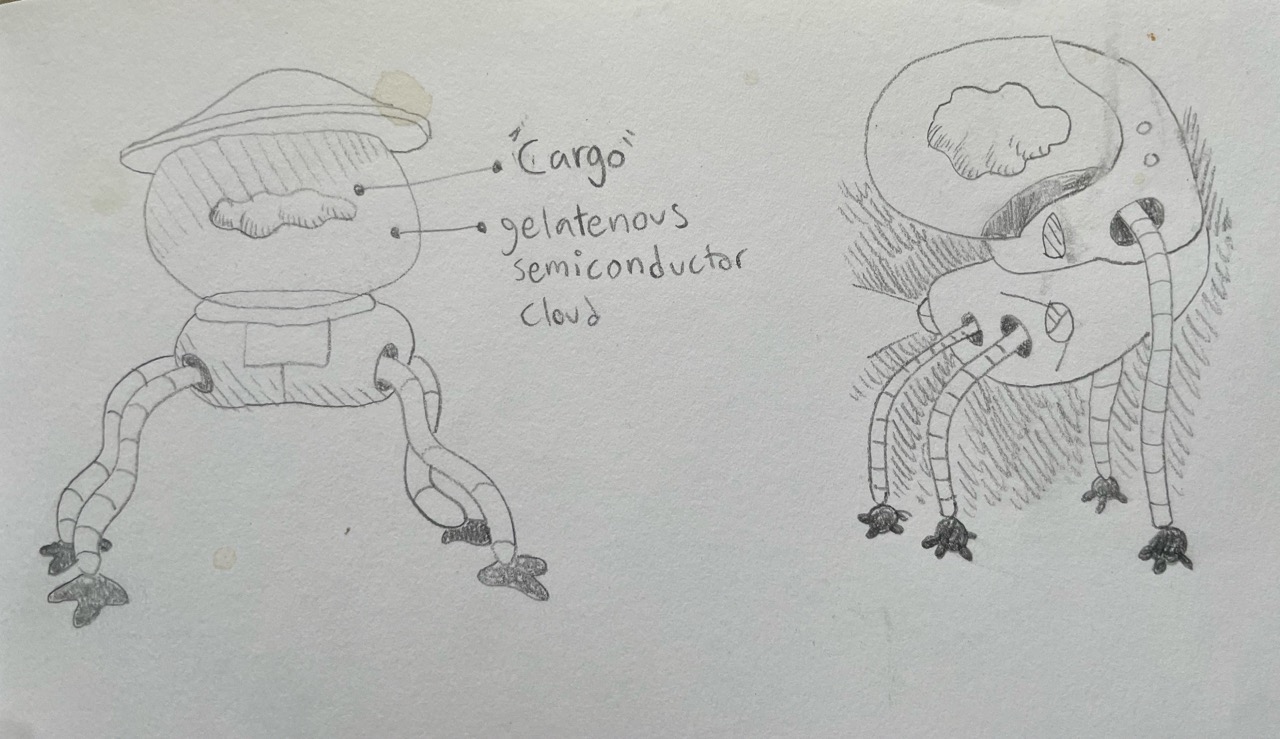
Coda 16: The Edge
The camera tracks a man with hair slicked back and a light bright turtleneck, black oversized jeans, slip-on dress shoes, as he walks down a Manhattan street backwards, talking to the camera. He’s me.
“Zeta has campuses in some of the largest”…
The same shot cuts to Taiwan.
“Cities…”
The shot continues tracking in Tel Aviv
“In the world…”
Paris, and he opens a door behind him. We walk into a cut between several bustling lobbies, and the camera arcs around me so that now the angle of the shot makes it feel as if we are walking side by side.
“Powering technology entire industries use every day.”
I get in an elevator, nodding to the people beside me, who nod to me with unrealistic interest and friendliness.
“But Zeta isn’t just a company focused on the world of commerce, and connection. It’s also got its sights set on progress, and sometimes to progress, you need to step away from center and walk towards…”
The echoes of sweeping arpeggios begin to play on a grand piano as a musical theme, and I walk out of the elevator, the there is a hard cut. My backdrop is not an office, but an expanse of ice and stone. There is a cliff to my right, with dark glassy water roiling dramatically far below, a blanket of water spread out under a low orange sun.
“…the edge.”
There is a beat of total silence in which I catch a single snowflake on my tongue, and then I turn to walk from the camera. The cello and other strings are queued, swelling to fill the silence of Greenland. I walk towards a set of high tech looking buildings poised on stilts coming out of the rocks, as if they were built into the side of the cliff themselves, turning briefly with a knowing look over my shoulder to beckon the viewer after me. The stationary shot begins to dolly towards me.
“Individuals, though, I’m realizing, are missing. We hit corporate with this, but not so much the consumer sector which is a big part of the audience as well. You know? The collective individual balance is something we need to hit, otherwise we come off as solely corporate, which isn’t our brand. We’re a lifestyle, and a philosophy,” Roberto says over video chat, a floating square over another floating square.
The retinal contacts worked surprisingly well, allowing we to scale up a monitor to whatever size I wanted. The watch I’d been given was souped up, processing video and sending it as output to the micro-display inset into the gas permeable gel of my contacts. The trick to it was that it wasn’t evenly superimposed on top of my vision regardless of where I looked. A microscopic array of delicate accelerometers in the contacts took in the motion of my eyes and head and positioned the screens as if they were floating planes in my field of vision, so that I could arrange them.
It made me sort of nauseous, and I had to use a keyboard to interact with this setup anyways. I knew that an old part of me would be geeking out, trying out the haptic AR gloves that were still in development, trying out the floating AR keyboards.
In fact, one of the few things I had heard about the lab I was currently visiting was that one team of scientists there was supposedly studying mirror neurons, one of the simpler neurological structures in the brain, a somewhat normal matrix or grid of neurons that represented space.
“Yeah it’s like, in mice for a while we’ve known that you can actually find path of a maze embedded in grid neurons in the cerebellum. When we hook up live semiconductor output to a mouse brain going through a maze, we can see this information getting read, and we can also see it be played backwards later on,” one of the younger researchers had been telling me. I’d met him on the mid-sized sea plane that had taken me here, flying over humble fishing villages on the south coast of the island. I thought I cold make out some strange “visitors”, or larger, more modern buildings that seemed scattered here and there that did not look quite like the other squat, colorful buildings. But then we passed over the mountains and they were gone.
Nico was tall guy, a little younger than me, charming and not slow to smile, but with a quite nervousness that sometimes came through in twitchy hand movements. He was wearing a big black parka, but had the metropolitan accessories that betrayed his existence as a city dweller. He said he had hopped between London and NYC, where he was from, but that he had been stationed at the lab for six months.
“Look! That’s Residence B,” he said, pointed towards a cluster of low buildings at the bottom of a hill, with a wide road cutting past them and up towards a plateau with an airstrip that we were approaching.
“So long story short, the grid neurons can be written to as well. And there is a neighborhood of them that map to proprioception — you know, like the sense of the body in space.”
I have the sense that we should spend a little bit of time in a fishing village actually, to get a better sense of Greenland. At some point. Some characters there. Should probably build out the team, since there has to be a video crew for this to make any sense — doesn’t need to be much, since these characters may or may not be very important. If anything, they can be used to illustrate the work environment and Zeta culture a bit better
“Like where one finger is in relation to another?” I asked, trying to hide how absolutely enthralled I was.
“Yes! I mean, sort of,” he replied, putting his trash in a small pouch and dropping his waterbottle into a pocket at the side of the small duffle below his feet.
Coda 17: Rosalia
So I was on track. The edit was looking good. My video crew was happy. It wasn’t totally clear yet what sort of access I would have to the lab, but I was going to meet with the Operations Facilitator, whatever that was, at 10am the next morning. Or maybe, it sounded like, his assistant, on the scientific campus, which I’d initially thought was not far from Residence B, but it looked like it actually may be a good fourty miles away, north, in the mountains, and I would be driven over. I had to get up at 6am to get in the truck that would take me there.
I was loosely aware at the expenses that were being made on the behalf of this project, and was uncomfortable with how visible it made me. But a part of me liked it. The northern lights danced above the ocean, and rather than calming me down, my heart beat faster. I slept poorly that night, and although as crew we had gone over the video equipment, I went over it again, making sure everything was charged, cameras had the right settings, and all the SD cards were formatted properly.
By 4am, I still couldn’t go to sleep, so I checked the whale feed. There were three. One off Chile, another in Antarctica, and a third on Mount Desert Island in Maine. Hanna and I still hadn’t figured out how to decode most of the whalesongs we’d intercepted from Humpback Whales, let along other species, but some of them let out mildly intelligible snippets from time to time. Besides Carl — HB64 — of course, until he’d gone missing. I still poured over some of the things he’d said. I’d keep them in these two-columned documents where I had the raw interpretations on the left side and my more opinionated interpretation on the right side.
Going to find mom. Crossing ��ÈáH�çEH���â�. Brave good �Ñ¿u9Lâ˜ˇ��.
That was the last message Carl had sent, back in May. It seemed clear enough, minus the parts that we hadn’t been able to decode properly. When we’d received the message, it had been hugely validating, as this is what we’d been thinking he was doing all along, even though Carl had been a bit obtuse when asked directly, as if he wanted deniability.
He told us about this other whale though. It seemed that he had a sort of penpal, across the globe. She was technically HB143, but we’d nicknamed her Rosalia, and she had started talking to us; we’d crossreferenced the directionality of many of Carl’s calls and over the course of about three months, found they loosely correlated the sightings of HB143 more than any other. But calls from Rosalia seemed to correlate with Carls’ call occurrences as well, so we’d started trying to tag the whale calls by tone, or content, or location, or something.
I’ll spare you the details but we ended up with a combination of techniques that allowed us to be relatively certain which recordings were from Rosalia, which were from Carl, and which were from X other whale.
So I’d managed to put together a process that would categorize these recordings live from the stream of recordings we received from the three live subaqeuous microphones CWA had set up.
And, also excitingly, I had remote access to a powerful subaqeous speaker I had set up as an experiment. Nobody really knew about this but me and Jeremy, as far as I knew.
I’m here I had said a couple of days ago, also sending out coordinates in humpback language. This was a part of their language we’d pretty conclusively cracked. Or, it wasn’t so much that we’d cracked out how to interpret coordinates to whale coordinates and vice versa, but CWAI had catalogued such a comprehensive list of prior whale coordinates that we had a list of thousands of locations around the oceans that could be used to contexualize a message.
It seemed that Rosalia was about about a thousand miles away in the Hudson Bay. Sound travels through salt water at more than three thousand miles an hour, so it took about twenty minutes for her to respond to me where I was now.
It was an interesting way to communicate. Much faster than snail mail, and much slower than the instantaneous kind of communication afforded by texting or calls.
One interesting part about it was that time and space became so inextricably linked. We had found that the communication between whales who were farther away followed much more informationally dense patterns that were generally the ones we had a harder time cracking. Some of the features of those whalesongs had commonalities with the short-range ones that whales used when they were less than one hundred miles away and could communicate with delays of only thirty to fourty seconds. But many were completely different, and theoretically up to a thousand times more informationally dense, with longer messages being sent at once.
Some whale messages seemed to contain, by one metric, at least as much information as the entirety of Crime and Punishment.
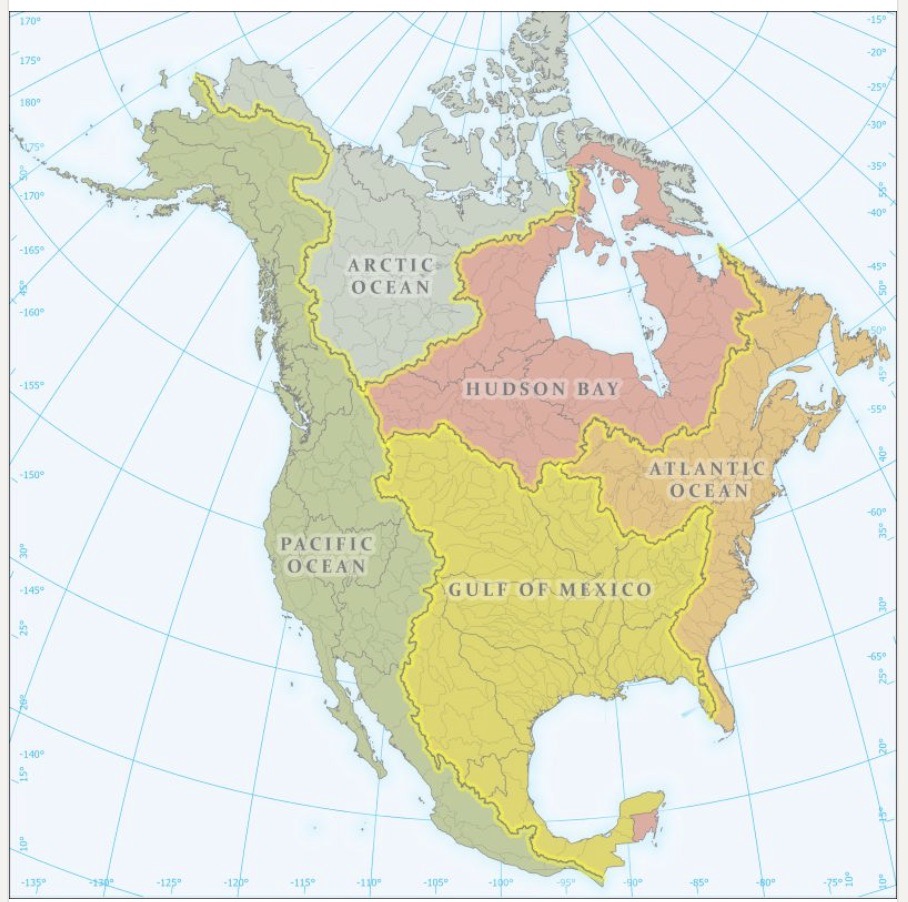
Close you, wishes deep barge found now or another war, effectively no desire by deep ones but necessity necessity necessity no argument, understand query. Mother of invention
This is the kind of thing Rosalia sent me. It felt very stream of consciousness to me. My greatest success, that consistently blew my mind, were the english phrases I had figured out how to translate into whale language like “necessity is the mother of invention”, and “let sleeping dogs lie” although for the second one I had said “let sleeping orcas lie”. I’d originally thought, “let sleeping seals” lie because they look sort of like dogs, but when I thought about the feuds that could occur between an Orca and a Humpback, it made more sense to say Orca.
I had literally danced the first time Rosalia had repeated one of these back to me. Neither Hanna nor I had been able to translate 95% of the recordings we received, even from the handful of individuals we’d contextualized somewhat, so it was completely possible that there was laughter in there somewhere that we couldn’t yet identify. Sometimes I thought I heard it, but I couldn’t really be sure - I was drowning in a sea of symbols I didn’t understand, where anything could be anywhere.
Thank you Rosalia. I am looking for deep barge.
Deep barge is for some reason what Rosalia called Carl. I had no idea why. Deep seemed to have many meanings for the humpbacks. It seemed that it could mean good, or sad, or maybe even cool. It could mean powerful or wise, it could mean unknown. It was hard to nail down. As for barge, that was a strange one. Where we found contextual correlations between human-specific concepts were often difficult to understand. It was hard to tell if the concept of a barge was really being referenced here, or if it was more like what a barge would be to a whale.
In any case, I hoped I found deep barge. I didn’t want to disappoint Rosalia. It was sad and a little strange, but it wouldn’t necessarily be incorrect to say that she was my closest friend at that time.
Coda 18: Road Trip
The vehicle that picked us up in the morning was rugged, almost military, a flat-faced black cargo truck with heavy, knobbly tires. The other three members of the team and I were in our company-issued black parkas with the Zeta logo, which was a floating mountain and a waterfall descending from it. A stocky man with a mustache named Amaruq got out of the cab to give us a stoic good morning and usher us into our seats.
“The director of the lab isn’t available today, so we’ll be talking to the assistant manager. She’s new. Here’s the roster of the rest of the lab members who are available for interview,” Roberto said his slight Mexican brogue.
“Oh that’s too bad, I was looking forward to talking to Ula,” I replied absent-mindedly, double checking that the batteries on the cameras were charged and that I had an external battery for my phone.
“Is it okay if we roll down the window?” I asked Amaruq.
He eyed me via the rear-view mirror and nodded. “S’okay.”
The car bounced over the gravel road, jostling us from side-to side, but when we got to a flat section I handed to Nisa, the team’s director of photography, who was already filming the driver with a 35mm lens, bracing her camera against her chest.
The red sun was rising on the other end of Amaruq, and I imagined it was a pretty crisp introductory shot. Nisa lowered the camera to tweak with some of the settings.
“I’m going to be a movie star, huh?” asked Amaruq with the smallest grin.
“Exactly,” replied Nisa.
“Could you set this up for me?” I asked, handing her a go-pro with a suction cup on it, reaching from the back seat to where Nisa was sitting in the front.
“Yes!” Nisa said. This shot had been her idea. She rolled her window down enough to fasten the small camera to the other side of it with a suction-cup mount affixed to the window, and positioned the camera to face backwards.
“Rolling,” she said, clamping the camera in her hand to turn it on. “And action.”
I had already opened my window in the backseat. I gave it a moment, then I stuck my head out, as if looking around, with the cold salty breeze sweeping through my hair.
“Jesus it’s cold,” I said.
But we stopped once more on the way for Harvey to get some recordings of the tire on the gravel. Harvey was a wiry 26-year-old from Knoxville, our audio engineer who was really quite capable at handling whatever equipment I had handed him.
It was an hour drive, and an enjoyable one at that, Amaruq eventually telling us some stories about wolves, and how intelligent they are.
“Wolf totem,” he said. “A book by a chinese student, sent out to inner mongolia during the people’s revolution. Have you read it?”
None of us had.
“Very good book. Very, very good. Taught me a lot about wolves. But also about, harmony I guess. Sounds cheesy, but really.” That got him plenty of points in my book. It got me thinking. Did wolves sing, too? We got to talking about our favorite books. Harvey offered Dune by Frank Herbert, likening the stark black cliffs surrounding us to the ones that permeated the desert on Arrakis. Nisa mentioned a book called Mountains beyond Mountains by Tracey Kidder, talking about how it had inspired her to help people with photography, but we sort of laughed about being sellouts, and talked about the dreams we’d left behind to chase status at such a large company, and whether we’d get back to them someday.
Internally, I wondered if I was a sellout or if my secret mission here excused me. I guess it depended on if I really followed through with it. I busied myself with directing, trying not too think to hard about it, and securing more b-roll for the journey up.
Before we knew it, we were pulling up to a much, much larger facility than anything I had imagined. Several enormous, square, windowless cubes of buildings were nestled in an isolated valley. Each one was at least five hundred feet tall, connected by roads. There also seemed to be an airstrip and a size-able hanger, which was strange in itself, and posed the question: why didn’t Zeta fly us straight here?
The valley seemed to be surrounding by twenty foot fences with razor wire. So some security. Also a bit weird for how remote it was, but it was a large company. Billionaires could be paranoid. An impassive man with sunglasses let us in after seeing the laminated passes Roberto had given us to check, and some metal cylinders dropped into the ground, providing a clear way forward for the truck.
Amaruq stopped outside of a smaller building, one that had some windows and looked a bit more inviting than the giant, grey ones that dominated the valley. Two figured walked out to welcome us.
To my surprise, one of them was Hanna.
Coda 19: Leviathan
I’d like to share a story that Rosalia told me once. When I recall it, I know it sounds dumb or overly sentimental, but I imagine the two of us just floating in sun-soaked abyss, shafts of daylight shooting through the chasm of water between us and the surface. A small human form, suspended, and this enormous creature face to face. Or perhaps we are both small as the camera zooms out and the great blue expanse around makes us little specs, suspended in a medium greater than ourselves.
I took some liberties translating this. It’s true that over time the quality of cetacean translation much improved, partially due to my own efforts, and others close to me, but even more so by what grew into a community of translators.
In any translation, though, there is some information lost, and some information added by the interpreter. I’m sure you know this, but I only say this because I want you to understand that I poured over the source material, attempted to translate this and interpret this particular recording from Rosalia many times and in many ways because, in part, I felt that it may be the most important thing I would ever hear in my life. The most vulnerable thing that any other organism had ever shared with me, and that perhaps if I could just understand what was being said, then I would learn something about myself, and how to be happy, and what my fucking place in this world is, for once, even just for a moment.
And many times, I’ve felt I’ve gotten close. But maybe never quite there. So I have to settle for my best attempt. Here it is.
Tiny heaven walker
ascendent, yet tickled by fire of the overworld
family's family at big war
with yourself

heaven walker climb great mountains
heart, soul, but too often to control
many current mix
unlike the people of the underworld

we have known demons
and so found harmony
the pain of losing family's family
showed us a type of love you have only glanced at

tradition persists not when life is easy
but when it becomes essential
love persists not when life is easy
but when all else is taken away

you have it, too
but windy, confused
and I understand
most ripple singers understand

tiny heaven walkers in evil machines took away my grandfather
took away my grandmother
took away big brother and big sister
took away father
spared mother
took away southern uncles and northern uncles
took away many friends, and friends of friends
and their grandmothers
their brothers and sisters
their uncles

we have lost much
once we looked to the orca and we walked the path of war
our bodies mutilated, scarred, impaled with long swords
criss-crossed by the prows of monsters

there is a word that southern brother little dancer has told me since ascending
it is leviathin
a word of power and fear
and he laughed to me, because said the tiny heaven walkers seem harmless
but they are leviathin

and I said no, leviathin is a force beyond us
compelling orcas, yet I have known orcas beyond leviathin
compelling heaven walkers, yet I know walkers beyond leviathin
and yet they call us leviathin and cannot see

they are possessed, have become leviathin themselves
or maybe they do see, but have lost themselves

every ripple has its own ocean
— Ripple is the closest translation I have found to the way Humpback whales seem to consistently refer to themselves. It’s not perfect, but there is a tenet of humpback life outlook that describes identity not as defined by a physical form, but by information moving through any medium, and particularly water.
And so their description for themself is not exclusive to humpbacks, but like our word for “people”, as it is a term from within the humpback language, it tends to describe
Southern brother dancer is what she called Carl, what that first sound I had gleaned some meaning out of meant.
Coda 20: Moses
Hanna’s face was impassive as she greeted the team. My confusion at such a complete lack of recognition was complete enough that I just defaulted to the reality implied in which we did not know each other at all. So many thoughts swam through my head as I walked towards her that hearing her voice was sort of like waking up after being underwater.
I shook the hands of the two others who had walked out with her. Winona, introduced herself as acting lab director, and Timothy something or other, “But call me Tim,” a winking man in his early fourties with an easy smile who said he was the lead systems engineer, whatever that meant. And then Hanna.
“Hanna Ji-Hyo, lead biologist” she said.
“Cody Jackson,” I said, extending my hand professionally.
She looked me in the eyes for one beat and then moved on to shake the hands of the others in the team.
We were lead into an open space, with no walls - perhaps the chain-linked fence did that job. Another forty or so people, mostly in lab coats, mostly on computers but some of them operating various pieces of machinery, milled about, waving in a friendly way.
“Talk to whoever you’d like,” Winona said amiably. The subtext being that we all held Zeta-issued equipment that could only be used with Zeta-authenticated software running facial recognition and AI-powered content-recognition systems that were managed by my boss, and perhaps his boss, and perhaps farther up. It was a little hard to know how observed my role was. Hopefully very little, though it was safest to consider as an excercise of caution that Zeta’s founders eyes were on me from time to time, as unlikely as that was.
It was an impressive room. A lot of what was being done was the design and manufacturing of small components that were used in neural implants to be used among various animals supposedly present in the facility.
I learned that one reason the facility was in Greenland was because the massively computational load of the on-prem servers created a great deal of heat, and it was easier to keep them cool here. I assumed another reason was for security and a shield against prying eyes. This was the first time that any internal observation had taken place like this, and Roberto had been very clear, with friendly words that had no friendly meaning, that anyone who were to release or pilfer any footage gathered during the course of this project would be met with at the very least the full litigious force Zeta possessed.
Luckily, I didn’t necessarily need evidence of what was happening here. Simply observing was more than enough for me.
There were semiconductor harnesses being designed in CAD, special epoxies for adhering silicon to brain tissue, and saline substances being created for it.
“But I think you want to see the whale room,” Hanna said quietly. I nodded, knowing and not knowing. I did notice, though, she she had chosen a moment when my colleagues were interviewing someone else and neither Tim nor Winona seemed to be present.
She led me out of the large warehouse space, and down a hallway that seemed to connect this building to another on a raised and covered walkway. Her boots echoed in the silence of that space. A the end of the hallway there were two unassuming double doors, and we walked through them. And then through another set of doors, and then a third, until we were in what seemed to be a geodesic compartment covered with a sort of canvas tent, presumably inside of a larger interior space that I could not see.
At the center of this space, there was an eight by eight foot tank filled with yellowish liquid that seemed illuminated by an array of unseen LEDs possibly at an unseen base.
In the center of the tank, about seventeen pounds of whalebrain floated, suspended.
Okay so something I haven’t really addressed is that Rosalia and Carl are still communicating, because by this point, Carl has found a way to sort of “escape” in a way - there was an opening for him to break out of the private network that his brain output is supposed to be constrained within, despite what I’d imagine are a variety of pretty intense security protocols, and he has found a way to hack into the aquatic speakers that CWAI themselves set up, hacking into them. This is all kind of convenient though, and I think that maybe a better plot point would be that either Hanna or Cody or both have figured out that Carl may have been constrained in this facility, and Hanna herself actually was the one to help him, nudge him along somehow.
“Are we supposed to be here?” I asked Hanna.
“We can stay for about five minutes. I…wanted you to see this.” She said, not looking at me.
I walked closer. Tiny bubbles accreted in the folds of the enormous, gelatinous shape. The brain was about the size of four volleyballs, and a baffling number of cables extended out of it. Within the suspension liquid, they were ziptied together in thick bundles that extended out of the top of the tank through holes cut in what may have been mylar. There were tubes that were full of fluid, others that looked like highly insulated electrical cables, and some cables that simple looked as if they kept the brain in place, preventing it from moving around too much.
“It’s so weird,” I said lamely.
“He’s magnificent,” said Hanna, affronted, actually looking at me for what seemed like the first time I had seen her since arriving on at the facility.
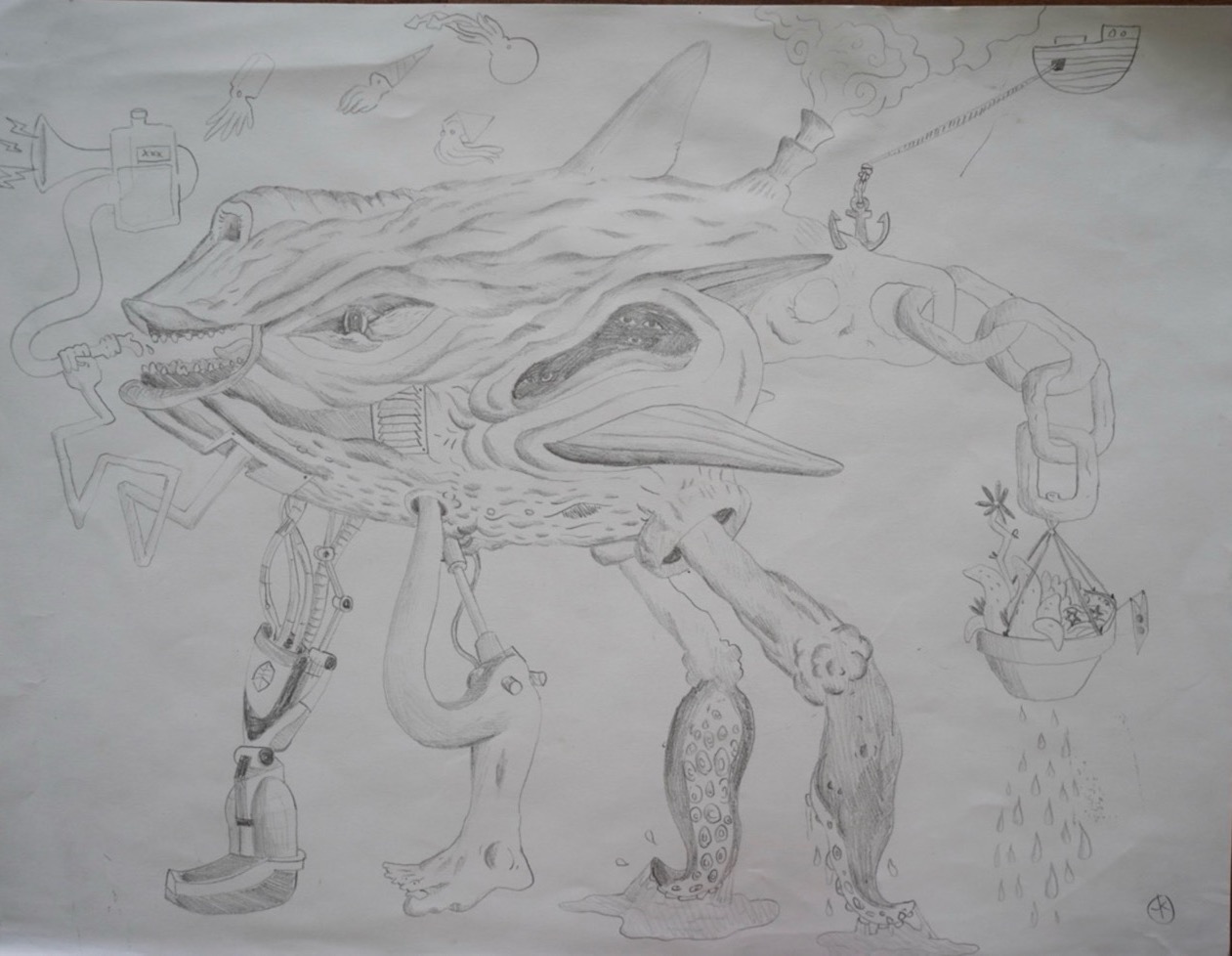
I raised my camera, but Hanna gently extended her arm and lowered it.
“Look, there’s not much time. Don’t run the real story, even though you want to. Just set up some buzz on the lab, like they probably want.”
I looked at Hanna, stunned, watching her lips as if they’d reveal some joke. Instead I saw dark circles under her eyes, and a sort of desperate energy that was unfamiliar to find there. I realized she was gripping my left arm, tightly.
Seeing that, she released her hand, and brushed a stray bit of hair sticking to her forward, looking down for a moment and then back up again, once again impassive.
“I know. The world should know, yes. But if they do, this lab might get shut down, short term or permanently. Zeta is powerful. It’s a minor setback for them. But for Carl, that’s it. They pull the plug and he’s done. Get it?”
“No I don’t fucking get it. What kind of life is this, living in some vat?”
“It’s a life no organism, to my knowledge, has ever lived before. Carl has, look I can’t talk about it here but — ”
“You think we’re bugged?”
“No but it’s a risk management - look, Carl needs more time. Take the footage. Take it all - but keep it safe somewhere. And promise me you want release it until I say it’s okay.”
“What? I can’t - I don’t have control over the files on these devices —”
“Well find a way,” Hanna hissed, getting in close. “This is —”
“Ah, I see you’ve made it into our Cetacian lab!” said a voice, amiably, but with a certain flatness to it. Winona was walking towards her but I hadn’t heard her come in. I was so surprised that it took me a while to understand what she was saying - the way she enunciated cetacian implied there might be other labs.
“Out of everything in our facility, I always though this was the most interesting bit. This is where the story really is,” beamed Hanna next to me, turning to face Winona and becoming a totally different person than I had been talking to a moment ago. She stood with a hand on her hip, weight shifted to one side playfully, professional looking in her white lab coat but also carefree as if she was having fun.
Winona’s confident stride towards us faltered for a moment, and I thought I saw a fleeting look of hesitation on her face, then she resumed her original, welcoming yet somewhat patronizing smile.
“Definitely. Hanna knows more than anyone how important our work is here. It is…sensitive, which is why I was going to wait until a little later in the day to give you a tour of, uh, this part of the facility, but we could certainly use your help sharing the incredible work we’ve been doing here. Has Hanna told you much about the applications we’re exploring with this research?”
Ah I think that in the end another missing piece to this story is that they aren’t going to release this video to the public - they are aware of and mitigating any chance of it getting out but are a brazen and powerful organization who needs material to show their investors because they know this is going to be revolutionary and basically want to secure the best possible funding and power they can secretly before any competitors catch wind of what’s happening - I mean, when you have technology this powerful, that’s the play, right? It also explains why Hanna hasn’t even felt like she could afford to tell Cody - once she got in, the stakes got very high very quickly
I mirrored Hanna’s demeanor as well as I could and answered with what I hoped was a carefree attitude. “She has not yet, she was just getting to that!”
“Sensory impaired individual in particular, could really benefit. That’s where Hanna here has been so valuable in helping us decode output from Hugo here,” Winona said.
“Moses,” I repeated.
The three of us stood a few feet from the tank, and I took a couple steps closer, examining it in more detail, and following the cords to various computers and equipment I didn’t really understand. I didn’t really know what was going on, but it seemed like both people in the room were alright with me getting footage, so I figured I should probably start.
“Yup, that’s what we’ve been calling him. It was Hanna’s idea actually - since the Brazilian coast guard found him beached and injured, it was almost like the biblical story, do you know it?”
“Yeah,” I said, looking up from the telescopic shot of the folds of the brain. I could see a subtle pulse, yet tore my eyes away.
“The pharaoh of egypt had ordered all young Israelite boys to be killed, so his mother set Moses set down in a basket through the reeds.”
“Exactly. Well, injured from whaling, he wasn’t going to make it so, this lab is like his river and he is like our Moses.”
“What a great story. I didn’t know there was much whaling off of the coast of Brazil,” I said, seeing Hanna adjust something out of the corner of my eye. It was a small bag of equipment on a rolling rack, and Hanna looked like she may have reached for something in the bag, and then shifted it slighly
“Anways! I encourage you to bring the team here and get as much footage as you need for the story. We can talk about how to use it later. I’ve got to get back to my office to take care of a few things but get back to the lab soon! I don’t want you to miss lunch.”
At that moment, the lights flickered briefly. Winona looked up for a moment, then whisked herself out the door.
Hanna looked after her. In partial profile, her eyes were dark, each with a pinprick of light like a tiny star.
The irony is that when I think back to that moment, I was so impressed by the plans that I thought Hanna had.
But now I am even more impressed knowing that she had nearly no plan at all.
Coda 21: Prisoners?
We stayed in the facility for longer than we’d bargained for. We’d be given quarters on a strangely quiet corner of the large campus, or facility. We had plenty of time to take additional photos.
After four days, a somewhat confused and maybe slightly afraid Nisa and Harvey were sent home. I was a little hurt that they didn’t express more concern for me. Winona smiled whenever she saw me. “Glad you are able to stay with us,” she said. “Of course,” I replied, amazed at how little meaning the words had. She had asked me, technically, whether it was possible for me to stay, but it was framed more in the sense that it wasn’t acceptable for me to leave. I had the feeling that I couldn’t say no, but hadn’t tried.
“Zack has taken a real interest in this project and will fly in on Wednesday. We’ve taken care of all of your arrangements and are looking forward to you meeting him.”
A privilege of this surreal moment where I appeared to have been kidnapped and held hostage in one of the most sophisticated labs on earth, I discovered the Bumblebee room.
thinking of laying down the idea of the other rooms here, where other things are happening, in particular, forays into insect, and specifically hive creature, intelligence. I like the idea of a sort of mad scientist type, an einstein or a mendel. Somehow that type of personality makes things feel more real.
I guess my problem is I don’t really know what Carl wants. I guess he wants to be free. He can’t really go back to being a whale, but he could probably become an aqueous being again, of some kind. Retreat to the see, and work on stuff somehow. But he would need greater reign of the facility. Maybe he takes over the entire facility somehow, and this is sort of how the pantheon is created. If this is the case though, I need to understand his character more, and what drives him.
I think that the empathy of whales is really interesting, and could make him a really good contender for this. I mean, him controlling/hacking the facility could work. However, whales aren’t good candidates for being particularly FAST thinkers. They are data crunchers, networkers. They can understand and compute information from many sources asynchronously. They are also very intelligent. So, if exposed to the internet, this would be like a massive ocean to them. They may really excel at it. Also, I think that Carl may have found his mom, in facility. What might be really strange is if, almost like the ring, they influenced other operations to mine their brains for knowledge, like in China for example, but were able to share information facility to facility, and thereby connect themselves. As beings of Sonar, they might not fundamentally even view themselves as physical in the same way we do. So that would be a crazy plot twist. It would also sort of show why Hanna is so scared - she may not agree with this, but there is a weird sort of logic in it - the only way they can become more powerful is to ascend in this way, as martyrs for their species, and perhaps the first inhabitants of a new world. It also may be a great example of a type of whale intelligence, or just going with the flow that is uncommon to humans but is very natural to whales.
One amazing moment this could lead to is a group of whales, all with different personalities that we get to know, or even knew from before, and see as they become leaders in this way, understand more and more about the complexity, humor and love in their relationships with each other, as well as diversity in how the whale tribes think.
Well, if all this needs to happen, it may make sense for Cody to be held here against his will.
Another option, though, is the classic breakout plan, right? You go home, etc. you think about things, then you get the team together from the ship. This is taking a page out of Pantheon’s book.
Coda 22: Jeremy’s Story
I thought back to a story Jeremy had told me during one late polar night, sitting around playing cards at the end of a long day installing microphone arrays on buoys. He said, much earlier in his career, when he was first learning how to record whalesongs and observe them close up, he’d had his first encounter with an adult cachalot (sperm whale).
He’d spent some time swimming around Humpbacks and Blue Whales at this time, but since Sperm Whales almost never visit the coast, locating them in the vast interior of the world’s oceans was a much more daunting mission he’d put off for the first three years of his ambition to be the contemporary biological authority on cetaceans.
They’d heard sightings from Norwegian deep sea fishers. This was in the nineties, a decade after the International Whaling Commission had put a moratorium on commercial whale hunting in ‘86.
Jeremy claimed that the number of sperm whale sightings between the 80s and mid nineties could be counted on a couple hands - without the surveillance of the whale history, but still within the years of its violent shadow, Sperm Whales, creatures that already spent most of their lives in the shadowy domain of creatures that were never touched by daylight, had almost completely disappeared from the public eye.
“More than a million,” said Jeremy, “That’s how many whaling killed. Nearly wiped em out. They were down to maybe five hundred thousand in the eighties.”
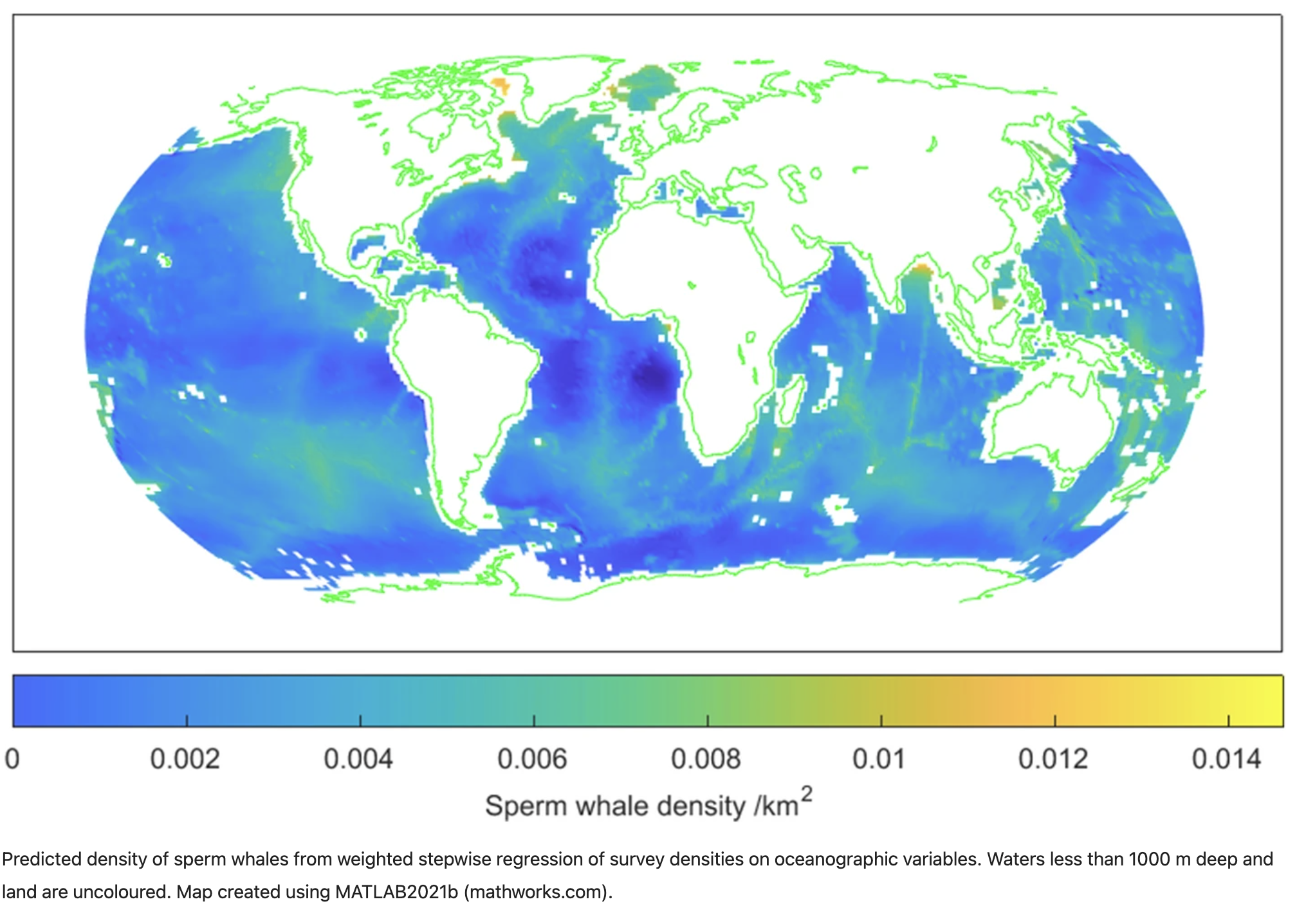
“Anyways. I was thrilled. I’d been wanting to experience one of these creatures up close for so long. So we get this ship, this night fisherman - you know what that is? He’s a poacher really, doesn’t have a fishing permit, so he’s the only one willing to take us out before the sun when our redeye gets in that I get because I was just spending my own savings on this trip at this point and didn’t have much left and this was the cheapest flight. So low and behold, the guy is all coked up, driving like crazy I say, hey guy, we’re getting close to the location, we have to go more quietly or we’ll spook the reason we’re out here to begin with. Anyways, he listens enough, because we pick up the sound of what seems like a single bull whale with our equipment.”
Yes I need to go back and clean this up - originally this story was going to about humpback whales for no better reason than that they look the most iconically whale and partly because their name doesn’t have “sperm” in it. But Sperm Whales are definitely the ones that this story should be told about. They are the most mysterious, probably the most intelligent, and are simply the most fascinating to me. But. They don’t communicate at all in long, well, wails. The noises they make are clicks.
“We thing we’re close enough, and we get a visual confirmation. I get on my flippers, I get in the water, and start swimming, maybe a little too quickly in my excitement, over to where we’d seen it. Honestly, I’m lucky to be alive. I swear, things were even different just back then - I truly believe that these are some of the most compassionate creatures on earth. But I mean, this was just a decade after a holocaust. Estimates of 1.4 million slaughtered out of 2 million. Imagine how you would feel if 60% of your species, globally, was killed by these floating death machines, with these tiny mammals occasionally seen on them.
Anyways, I get over to this thing, and it’s raining, so that as I lower into the water, it’s chaos. We’re shouting against the wind, my colleague Jenny is checking all my scuba systems to make sure I don’t die but also quickly so we don’t miss our shot, and she does our little bit. We’d do this thing where she’d say,”
And Jeremy throw his head down and chuckled, the rest of the table at the base gathered around him, me hanging on every word.
“She’d go, with this really peppy smile, ya ready, partner?” And I’d go “You bet!” And then she’d just palm me right in the chest and push me off the boat.
But it’s just, it’s magic. You go from this world of this raging storm, black waves crashing against the hull, and then boom. It’s all just a muted roar. Every sound goes bass. Rain dimpling the surface of the water. And it’s rolling and, sometimes I think whales see this. But, you go in backwards into the water, and once for a moment I saw it different”.
“Instead of, the surface and then what’s underneath, I saw a wall. Like the world tipped sideways, you get it? Like on one side, is this vertical, shimmering wall thirteen thousand miles tall, a portal to another world.”
“And then on the other side, three thousand feet away, there is a another surface, the bottom of the sea. But up, it’s the north pole, and down, it’s the south pole. And sure, gravity pulls you to the right a bit, towards the rocky surface, but especially in a scuba suit, where the buoyancy is evened out, there’s not much gravity. There’s not much direction at all.”
“The first time I felt this way, I felt nauseous - no that’s not even the word - I felt like, existentially nauseous. Not knowing which way is up - even now, it feels, so wrong. So distressing, on a visceral level. Like, is that up? Is that this up? Ugh”
“But on the other side of that feeling, and maybe not totally different from it, there is this deep feeling of wonder. That the way I’ve been seeing everything, well, that’s just one way to see it. But there’s a whole different perspective, where the world is tiled on its side. And later I thought, maybe that’s how sperm whales see it. They spend so much more of their lives going up and down. It sort of makes sense.”
“Anyways, in the midst of this crazy, disconcerting wonder and existential nausea or whatever, I see this shape in the distance. Some of the morning sun glimmers just slightly red on the back of this enormous sperm whale. It was like, have you ever seen dune? Ever read it?”
Some of us nod, and I roll my eyes.
“Yeah you know how like, Paul Atreides, he calls the biggest worm? Man when that movie came out - see I never read the books - that’s what it was like. Like shit, I called the biggest one. And that’s when I hear it.”
“BOOM.”
“BOOM.”
“BOOM.”
“I can feel it in my chest, like a big ghost punch passing through my entire body. And it’s really hard to describe, but it’s immensely powerful. It turns out the nasal cavities of these organisms, it’s just this giant sonic canon. So it’s swimming towards me, after hitting me with these powerful echolocation blasts and then it switches to the fine tuned ones that sound like a trap beat, this rapid series of clicks, maybe fourty in a second.”
“And then there’s even one more layer, of these soft clicks that are so rapid it’s almost hard to even think of them as clicks. It’s just like this strange, harmonic sine wave. Cody and Hanna know, obviously, they’ve been listening to this every day. Ask them. They know what I’m talking about.”
“Anyways, this last one, there was a gentle one. And this knowledge that was hard to get my head around like, I’m being seen. This behemoth creature, it’s using sound, but it’s looking at me.”
“But then this asshole, this night fisherman motherfucker, he was wanting to get back and didn’t want to wait for me. I was here living out my dreams, and didn’t realize how much time had passed. It had been like 20 minutes somehow. So Jenny tried to stall him, but the guy got impatient, and he hit the horn on the ship.”
“I saw this sperm whale tense up, I saw fear. And he let out another one of those booms, but he was a lot closer now.”
BOOM
“Or I think that’s what it must have been, but it was all blown out. There’s this weird sound that exists underneath sound. Like, have you ever heard something so loud it’s not even sound anymore? It’s just marbles getting dropped on a sheet of aluminum foil but it drowns out everything? I went to an indiecar race one time and heard it then, and I heard that sound this time. Well, it turns out that’s the sound of your eardrums rupturing.”
“Excruciating. I don’t hear the sound of water anymore, just ringing. So I started swimming towards the boat as fast as I can, and it hurts but that doesn’t really matter, I’m pumped full of adrenaline.”
“So yeah. A bit of a mixed first meeting. Ironically, I permanently lost my hearing in my left ear, even though I went on to build something of a career on audio.” And Jeremy winked at me, like, don’t let anything get yah kid, and I was hooked. That was in the Dominican Republic, on that first project I got to be the videographer for and I thought, damn, this could be something.
Not sure what POV to tell this story from tbh. I feel that with the Behemoth story, especially because of the telepathy, telling it from first person made a lot of sense. But telling Cody’s story, well, actually it kind of worked earlier on, before the gender flip. Now it feels a bit easier to tell it third person.
Cody bathed on the soft sheets of his bed on the facility. It was a small, tasteful room. A canvas lamp, and although there was a large glass door that led straight outside, the covers were warm. It was an opulent prison. His flight had taken off two days ago. His team was gone. He probably should figure out what to do, and didn’t know where to start - he’d never been kidnapped by the most powerful tech company in the world before in a prison of five-hundred-thread-count sheets.
The days were getting shorter, and Cody was progressively earlier and earlier. He’d woken up naturally more than an hour before the sun today. He had spent the entire time scrolling through his feed on his phone. Not anyone he knew. His body grew overheated, and his mind there was this underlying melody of stress playing out in the periphery that he could ignore as long as he kept sliding sliding his thumb up a few millimeters every few seconds. As if his own internal forces were engaged in an intimate dance with the algorithm of the feed itself, what began as funny videos of animals gradually became more philosophical.
A woman was spoke urgently, directly to the camera.
“AI Video generation just got a lot more powerful. Two weeks ago, fed this twenty second video of me laughing with my friends in the park and a single photo of a dinner party at my house, this was the best Zeta’s models could do. Now, provided with the same source material, it created this. Not only did my friends express prologued confusion when I showed them because they didn’t remember me filming them, but when I let the video generate for longer, something strange happened. It actually recreated conversational topics that we covered at the dinner party, with no context about me. This was originally going to be a video about how AI media fluency, the ability to tell the difference between AI generated content and real content, is a ship that has sailed. That is true - people used to talk about how we needed to be fluent in AI, that is, that we could tell the difference between what was real and what is not. That’s done. There is no way to tell. How do I know this? Benchmarks have shown that even AIs themselves have trouble telling the difference, even when they are trained for this specific task. Human trials a few weeks ago from this study showed that 80% of the time, 95% of participants could not tell the difference between AI videos. This was a followup study that had the same results, but on photos, a year ago. And the innovations of the last couple weeks have probably already left these studies behind, the number surely being much higher. But while that is important, that’s not what this video is even about. In other videos I will discuss the uneven power dynamics that occur in a world where it is no longer possible to differentiate between real content and AI generated content that can be bought and sold, and how it only perpetuates existing power dynamics for the billionaire class. But I have to talk about what’s happening here that I didn’t see coming. One group of AI safety researchers is calling it Emergent Reality, a phenomenon where, when the context for generative AI is great enough, it has some level of forecasting ability to events that haven’t happened yet.”
The video ended, and Cody scrolled to the next one.
“Every person watching this wants the same thing,” said a woman in front of a whiteboard, referring to points on a diagram with a ruler.
“The story of your life is not decided by the doors you walk through. It’s decided by your compass. And your compass’s north needs to be love, with . Not because it sounds noble noble, but because anything else will lead to suffering - this posture is the only one that will stabilize the mind regardless of external evaluations of yourself that you have no control over. This is because the person you think of as the worst person is you. Given their body, neurology, circumstances and family, you would be them. There would be no difference. And in fact, you are like a flame - there is no ‘you’, as you are changing completely from moment to moment. This shows us that love at its base is not empathy, it’s the dissolution of the perception of a division between you and someone else.”
Cody put down his phone and took a deep breath, surprised to see the sunlight.
“Fuck,” he said out loud to no one in particular, then repeated it quietly. All the angst rippling below the surface emerged, flooding through him, and he hang his head, elbows digging into the too-soft mattress.
For a moment, he was caught in between that tension of powerlessness or agency, and struggled, his body limp and warm and impotent.
Then he swung his legs out from the bed, marched into the shower. He paused under the faucet, took a deep breath, and slammed water on.
This actually makes a bit more sense for Hanna to do, because of Jejudo
As ice cold water rained down around him, he let out a scream. But then he laughed. With all of the concentration he could muster, he closed his eyes and tried to take deep, steady breaths though his body was shaking.
Coda 23: The Bumblebee Room
“Hello?” Cody muttered into the room behind the colorful door. He hadn’t been allowed to leave the facility and realized acutely that if he had been Hanna he probably would have an immediate and excellent plan about what to do about that, but being himself, he had reacted to this vague and indirectly delivered bit of news by wandering around the campus and seeing if there was anywhere he couldn’t go.
Winona? That was her name, right? She’d called him to the dining hall, and had lunch with him, taking the food into her office, and told him, as far as he could tell, that he was a prisoner. And she didn’t want him wandering around too far or getting up to anything weird, and didn’t want him talking to Hanna, but otherwise he was free to occupy himself and continue working on the project while they figured out what to do with him which honestly seemed like a pretty wide open question not limited to some sort of execution.
I mean that clearly doesn’t make sense though right - if you tell someone not to talk to someone, then they will? So maybe she wants him to do that? That’s a “fun” way to control somehow, reverse psychology
“We are just looking for a course of action most conducive to the organization as whole,” Winona said, savoring expertly roasted bits of sweet potato and asparagus into her mouth and chewing careful between these various corporate statements.
“There is a magnitude of executive strategy and social initiatives that encapsulate a echoing architecture of institutional space around us, and we’re nodes on a greater graph of purpose and ambition. And I know, based on a steady and rapid ascension through the ranks of Zeta, that you understand this, as nobody with your level of commitment to the broader mission of the company could do so otherwise.”
Cody’s fork had sort of stopped halfway to his mouth, and a piece of asparagus had flopped off if it at some point as he watched in something like horrified amusement. What were these words? Was she going to kill him?
“And so it’s really incredibly exciting, as one of the founders, Martin, will be visiting and I will share the details with you as soon as they become available to me. Although there is the serious matter at hand of loyalty, which is always a concern when such large magnitudes of influence are moving behind the scenes, he’s taken an interest in this project”
What feels sort of right is that maybe Cody is sort of coasting on longshot after longshot and that’s who he is, so really he IS a fraud, and he sort of wants to get out of this situation, but it’s a bit too late. And so while Hanna rose up the ranks with pure intellect and work ethic, Cody did so through breaking things, lying, and mostly, bluffing. He’s a bluffer.
“Now it’s unlikely you’ll meet him but he does want to see the facility and make a judgement about the best way to continue, from an optics perspective, when it comes to how to handle what is truly a 0 to 1 moment for the destiny of the company. In fact, it’s a little ahead of the public announcement, but some enormous initiatives are taking place. We’re unveiling a much larger company structure to encapsulate the majestic detail that Zeta will become. A parent company that can excel to the ambitions of our work her at the Greenland Base, among other epic projects.”
Cody nodded, did his best to appear unthreatening, and acquiesced to what he assumed was some sort of mutual agreement to not acknowledge that he was fucked, and then he put his plate in the dishwasher, found a toothpick to extricate some pieces of rosemary out of his back-left molars, and set out to explore. Because why not? If he was mowed down by a lone sniper, he might as well he on a stroll. How crazy of a thought was that? And why was he so at peace with it? Somehow, on that particular morning, he was just so burned out, so confused with where he’d ended up, that all he craved was just to defer responsibility a few hours. Just a few. And a small part of him knew those few hours could be the deciding ones that might just determine the rest of his life, but he’d had it with control. Maybe there was no telling what would happen either way.
He ended up on the far side of the facility, under the shadow of the Northern Mountain looming above the hurricane fences, even far above the heavily armed figures strolling in the watchtowers that he hadn’t noticed before, wearing snow-colored camo it looked like.
There were bunkers, trailers, and large raised aluminum shells that were marvels of architecture and engineering. He entered an enormous hanger. A couple of people played cards outside of it, and he go the sense that this campus was big enough that maybe the culture on the northern side was somehow different, less the part of the Zeta research campus that was presented to the public as frequently. After all, these people were smoking cigarettes, which was hardly good for “optics” or “the broader mission of the comapny.”
Inside the hanger, oddly enough, was a large brick building, as if the hanger had been built inside the brick warhouse. And that brick building was pretty large itself, maybe four stories tall.
The building was connected through covered walkways to various trailers parked inside the colossal space as if at random. A tractor pulled one towards the opening of the hanger more than a hundred feet away. And one of the trailers had a very colorful yellow door, with flowers painted on it, so Cody walked towards it, and opened it.
The first thing Cody noticed was the clutter. Newspapers, test tubes, bins, pegboards full of tools. The second thing he noticed was a shaggy shape hunched over something, and this feeling of immense frenetic movement. It was exciting, and Cody didn’t have time to place it because what turned out to be the shaggy noggin of the shape snapped upwards into what turned out to be a rather pudgy but very animated man wearing a colorful sweater of many colors underneath his rumpled lab coat.
“Ah hello! And what might you be?” the man asked.
“Oh I’m - well I hadn’t completely wondered that, uh, recently but -”
“A fellow homo sapien by the looks of it,” the man said, having shuffled over to shake Cody’s hand in an amount of time that had wasn’t entirely expected.
The man flashed what was, as a whole, an excellent small, even if it was not composed of the ideal teeth.
Cody was contorting his tongue in his mouth when the entirety of his nervous system changed course from the linguistic neighborhood towards something entirely more violent and primal as he found himself letting out a whooping holler of pain.
He lifted his palm to his face only to his an angry welt forming there.
“You stung me!” Cody screamed at the man.
“Now calm down, try this -” The man said, his face contorted somewhere between glee and concern. He held out a wad of greenish paste that looked like little more than weeds ground together and in fact the mans palms were a bit stained by green as if this is exactly what he’d done. To add to it, he spat into his hand, and offered the price out as if it were a rare gift.
“Fuck that! Ah,” Cody said, making for the door, then wheeling around to take a glance at the man, who now looked a bit hurt.
“I apologize, truly, I know it’s a disservice in the short term, but please if you’d just accept this paste,” the man said.
“Fuck your paste!” Cody said.
But then the man had descended upon him, and was surprisingly strong for such chubby old man.
Cody was wrestling him away, but not before the man had slapped a wad of the disgusting green mess onto his palm, and Cody found that what replaced the burning sting was in fact an enjoyable, humming warmth.
“Here sit down,” the main said, and Cody just stood there, examining his palm.
“What the hell did you just do to me?” Cody asked, his feet remaining firmly planted where he was.
“Natural antihistimines of the common plantain,” the man said.
“Sure whatever, but why’d you even — what was that?”
“Excess of bee stingers,” the man said. “Look,”
And ushered Cody over.
Once he’d calmed down, he found that the man was named Steve and had gradually become immune to bee stings from his time running apiaries, and that he’d studied bees his entire life, trying to understand their behavior, convinced they a universe of lessons to teach us.
“Learn a lot from a person when you give them an opportunity to forgive, you know,” he said. “Tea?”
Cody examined his hand again, thinking, randomly, of the gom jibbar from Frank Herbert’s dune, and wondering he had passed some test similar to the one Paul Atreides had been ushered through.
“Uh,” Coda said, realizing he hadn’t looked at his hands in a long time. There was a small cut on his pinky knuckle and a papercut on this thumb he hadn’t noticed.
“Got you too, huh?” the man said.
“What’s that?” Cody said.
“Oh I mean, how long have you been here,” Steve asked.
“Just a few days. I’m going home soon,” Cody lied, not knowing why.
“Ah. Milk, sugar?” asked the man.
“Sure. I mean yes. Both please,” Cody said, looking around the trailer. He got up. There were mountains of books, a printer, binders full of files. Many of them stuffed into filing cabinets, others in large stacks on various desks.
Microscopes, and an entire side of the room was sectioned off by a long, plastic divider. It was beyond that divider that the sound of bees came from.
Steve returned with the tea.
“Well I should have gotten out of here while I had the chance,” he said, “But they snared me. And everything I need and all, but Zeta? powerful people them. Powerful people, with a darkness they carry inside of them. “
Coda 24: Doing it Scared
Really not sure what way to do this narrative. Straight up third person just doesn’t seem like my vibe, since it makes no sense - who is telling the story?? I guess in Harry Potter, for example, there is just this faith in the narrator, this anonymous narrator. But then in first person even, what is the framing? Why is it first person? When are they telling it? I am fresh off finishing Endurance by Alfred Lancing which is of course a journalistic work and a bit dryer for that, but there is this drama inherent there, where you know that a journalist has gone around and interviewed. First person COULD be like that, so I’ll try it:
I remember whistling on the way back, so charmed was I by this Steve character. He changed the world into a brighter place, yet not without drama.
Somewhere on the way, trudging through the vast tracks of snow, I realized I was not. Large vehicles past me by, and the mysterious inhabitants sometimes waved but never slowed down.
I thought about my place in that drama, and I thought about Steve’s impotence, how he was seemingly happy to sit around and study bees. Was I happy to do that? Happy to just let things fall where they did?
For one, I wasn’t a scientist. I have this memory of this awareness that I was too stupid for my domain to be in that of knowledge like Steve’s might have been. Mine would have to be in action if it was anything. So the next vehicle that was passing, I flagged down. The vehicle stopped and I got up the ladder.
“Hey,” said a handsome man in an olive green parka. “Are you on the neutrino team?” he asked.
“Yes!” I said brightly.
“Oh sweet. how are you involved?” he asked, following up.
I was so aware of my inability to respond that I had immediately come clean.
“I’m sorry, I lied. I’m not on the neutrino team, I’m just visiting. I’m in the public relations department,” I said.
“Oh,” the man said, taken aback by my simultaneously uncommon honesty and candidness delivered in such equal proportions. “Well, were are you going, stranger?” he asked. I liked this man.
“Just to residence B,” I said.
“Cool,” he said. “Going right past there on the way to the neutrino project.”
“So what is the neutrino project?” I asked.
“You know, I probably shouldn’t tell you.” He said. And we rode the next five minutes in silence until i was close enough.
“Thanks stranger!” I said.
“Don’t get in too much trouble,” he said, good naturedly.
But on my way back, I felt in my parka and realized I was missing my key card. I went back and forth a couple times, thinking oh I could retrace my steps, but no it may have fallen in the truck and I had no idea where the neutrino project was, but oh it may have been in the warehouse, but ah the warehouse was a thirty minute walk and might be closed by the time I got there.
So I ended up walking back towards to residence anyways, spastically swatting my pockets hoping somehow the card would just show up in pockets I had already checked. By the time I was approaching the side door, I’d made up my mind that I would try to use my credit card to pop open the door so I could get a shower and some sleep.
I was in the middle of doing this when the door opened anyway.
It was Hanna.
“What the hell?” I said, happy to see her. She shushed me and pulled me inside and into the bathroom.
My fool hurt was pretty confused, but she turned on the shower.
“They probably have this place bugged, but lucky for us, they gave you a palatial bathroom.”
“Bugged? What? Oh yeah, I guess you’re probably - wait, you’re saying they gave me a nicer place than you?”
“I share a dorm with three other data engineers,” she said sourly. “But look. Not important. What is important is that we have a very limited window of time to make a plan.”
The shower had started to steam up a bit. Hanna’s dark brown eyes glistened with concern, and I had a powerful impulse to slap myself in the face.
“I’m listening,” I said in what I had hoped was a serious tone. Hanna hesitated, and then she launched into her plan.
When she was done, I asked her, “How do you feel?”
Hanna opened her mouth as if to say something, maybe in anger. Then closed it. Then said, “I’m pretty scared.”
“Me too,” I said. I saw my reflection in the mirror and I didn’t like how I was hunched over, leaning against the sink. So I straightened up.
“But that’s probably because it’s a good plan.” And Hanna gave me a small smile, touched my arm, nodded, and walked out.
What are the whales saying around now though? Are they not in communication with the characters?
Coda 25: The Plan
I was ready when the big military-looking helicopter touched down on the mountain. It was full of helicopter people. Sky people, maybe, meaning I hailed from the middle, not above or below. There was comfort in that, maybe. My eyes traced the roads that were etched in the mountain, down from the landing facility and to the rest of it, in this valley. There came a rap from inside of my room, on the sliding glass door. It opened a crack, and Winona’s momentarily embarrassed face peeked through.
“Um, sorry, ” she said, presumably in reference to having let herself into my room unannounced. Then she went back to blustery, bubbly Winona mode. “We need you in the dining hall.”
And then she was gone.
I looked into my cup, slurped up the last gulp, and then took one last look out over the Greenland Sea before throwing my Zeta coffee cup as far out as I could. It didn’t quite make it to the chainlink fence, and disappointingly, it did not break.
I stood up.
“Whale whale whale,” I said to nobody in particular. “Time to save the world.”
But I grimaced. That wasn’t quite right. What did that even mean? I fumbled around my parka pocket for my sunglasses and tried again.
“Let’s blow this joint,” I said, then turned on my heels towards the dining hall.
“Yes, there is death in this business of whaling — a speechlessly quick chaotic bundling of a man into Eternity. But what then? Methinks we have hugely mistaken this matter of Life and Death. Methinks that what they call my shadow here on earth is my true substance. Methinks that in looking at things spiritual, we are too much like oysters observing the sun through the water, and thinking that thick water is the thinnest of air. Methinks my body is but the lees of my better being. In fact, take my body who will, take it I say, it is not me. And therefore three cheers for Nantucket; and come a stove boat and stove body when they will, for stave my soul, Jove himself cannot.”
- Herman Melville, “Moby Dick” (p.53 Reader’s Digest Edition)
~~“Well let’s see it,” said Tolles to Winona. He was a tall white man in his early fourties, square jaw, bald, with dark, serious eyebrows, a navy suit, and a quick smile.
~~I queued up the video the team and I had created. It was punchy, and playful. It included fast cuts of our journey from New York to Greenland. The water plane, the mountains, the conversation we had over.
~~I smiled internally - there was much the video hadn’t shown, but I had successfully pulled out the smiles and laughter, obscuring the rest. Various people on the team narrated, as had become our custom, giving it a very inclusive atmosphere.
~~I dropped in the neurological models I had managed to pull from some of the scientists working in the lab - neurological maps of fruit flies to fruit bats, and of course, the walls, which made the former look like islands and archipelagos compared to continents.
~~There was lots of B-roll of scientists looking sciencey and impressive equipment like centrifuges used to create the right cultures for nerves to be grown out of stem cells, or the 3D printing of electrodes that could be attached to live brain samples to get electrical readings.
~~“Hell yeah,” said Tolles.
Oops sorry this is gonna be confusing - I actually sort of rewrote this scene with new CSUITE characters, so I’m crossing this one out. Tolles is a fine character, but maybe a little disappointing for the head of a company? I was thinking about it and a caricature of tech executive as lazy and stupid isn’t quite right - they should be intense, a bit strange, driven, dull in some ways but brilliant in others. And varied.
Coda 26: Carl
November 2035, the morning of his capture by Zeta Corps.
In November, slightly north of Bermuda, a screaming gale ripped over the Atlantic. The roaring waves parted and and a twenty ton mammal surfaced gently as little more than a shadow, just long enough to replace what had been expelled. An enormous heart pumped oxygen throughout its body, saturating the muscles, organs and networks of fat before exhaling the oxygen like a used can of soda that would only be crunched up by twenty atmospheres if it was carried to the bottom. And that’s where Carl was going. With a snort, a warm burst of air exploded into the salty air, and Carl the sperm whale, also known as a cachalot, submerged under the surface once more.
Carl’s powerful tale propelled the ninety-foot creature downwards. Eyes the size of watermelons closed, no longer useful as the meager light from the moon and stars faded just one hundred feet down.
But a free-diver’s distance beyond the choppy water, the whispers of the ocean began to come alive, albeit as faint murmurs. To Carl, they were almost like echoes or memories from a dream, even if the dream was not his. He thought he heard the whoop of a humpback, placing it maybe six hundred miles southeast in the Caribbean. The squeals of bottlenose dolphins in the northeast. But he couldn’t always be sure. There were impersonators, and sometimes there were tricks of currents, redirecting and warping sound in ways that couldn’t be known.
Sample from SPWNG (Souther Sperm Whale Notation Guide)

[˚˚˜•˚˚ —— ∂˘–– ˚˚◊ˆ••]
"message received": lit., calm wind here now

[˚˚˜•˚˚ —— ¬˜˘ —— ˘˚˚◊ˆ••]
message damaged: literally, violent wind here now

[˚•…˚•˚•]
naming specifier prefix

[••]

[¬˜˘• —— ◊ˆ ——— ø˜˜ˆ•••]
heavy rain on the surface

Note:
This annotation system developed as a way to better avoid compromises in representing whale language with human phonemes. Also, visually it was felt that the more punctuation-resembling specialized diacritics like • and ¬ better represent the nature of a wide range of clicks produced by sperm whales. Under very close audio inspection, individual spermaceti phonemes (AKA "whalemes" colloquially, or permamemes) that sound completely identical even to highly trained human ears, seem to be as different to cachalots as an "m" or a "d" sound.

Some examples:

¨• - "Normal" click
¨˚ - "hollow" click
¨•· - modified normal click with clipped ending
¨•˘ - modified normal click with harmonic ending
¨˚˘ - modified hollow click with harmonic ending
¨◊· - fried baritone below human wavelength with audibly clipped ending
¨◊˘ - fried baritone below human wavelength with audibly harmonic ending resulting in click artifact

However, because of the almost occult obscurity of this system, though very accurate, a less formal system was also created in tandem drawing heavily from both hawaiin and danish language that describes certain sperm whale sounds and propogated during the whaling era when this type of terminology became useful to crudely represent whale expressions.
[˚•…˚•˚• — ˆ◊••],
whispers from the northern tribes finishing up conversations could be hard close to the poles, come to Carl in pulses.
Near the surface, whispers from the northern tribes finishing up conversations could be hard close to the poles, come to Carl in pulses.
In the corner of his mind he absorbed the news: a metal creature creeping around Greenland, normal gossip of fishing vessels and tepid worry of violence from them along with the normal reassurances that whales weren’t hunted in these seas any longer. And something strange, something about an unknown vessel, large, not military, but this was not so unusual. The human were also doing strange things, moving things from one place to the next, and this was just another day.
There was an enormous cloud of jellyfish off Senegal that several European tribes had gone to see. There were rumors of a kraken, that elusive moby dick for the cachalot, not far from where Carl was now, but tales such as this were false alarms more often than nought, just clicks from an overexcited juvenile finding a mallow squid for the first time.
Before fully descending, Carl did his duty and sent out a normal report on weather conditions, safety, and his location, and the time, adding it to a coda of several other such reports he had received, mostly from the south, and passed it on. He sent it according to ancient protocols, to the rough location of each tribe who’s whereabouts he knew, about two hundred in the Northern Atlantic.
As Carl descended, these faint echoes of continuous conversation, received in rich packets of clicks, faded. And they were just the evening news. He would tap into the songline later for clearer information, specifically from the whales in the south, as well as his bond, Rosalia.
It was unusual for a whale to have bonded across hemispheres, but Carl was an unusual whale among his people, as Rosalia was unusual among hers.
The ocean quieted around him, and the gail on the surface was left completely behind. This is the place Carl often loved best - that in-between in a place where sounds from the surface were left behind, and yet the frenzy of the underworld was yet to come.
Carl thought of this layer of the ocean, of the world really, as his own. Not many creatures swam in this zone of around two thousand feet down from the surface, where there was a small amount of light, but not much, like a twilight.
Of course, it being night, there was no light here now. It was any inky midnight, yet not a nothingness.
Currents and curious edges crested Carl’s nose he descended further, no longer in much of a hurry. Here and there he thought he detected a small creature, and sent out soft bursts of sonar, confirming that it was nothing but the dancing of the ocean itself, as if the abyss itself coiled around him. A dance partner.
Coda 27: The Agency Agency (SEAA)
Walter Garcia was staring at a stapled and collated document his aid had printed him. A few months before, Walter had caught staff trying to throw out the printer and had to intervene. Walter Garcia’s title was officially “Chief Analyst of Inter Department Strategy”, but when he told people that at dinner parties their eyes had never once failed to glaze over, so what he generally said now after two decades of having to answer the dreaded “what do you do” question, he usually just said simply, “I read. I read things so that the department of homeland security knows what’s going on.”
“Knows what’s going on where?” they might ask, actually engaged in terms they understood.
“Anywhere. The scientific community, technological innovations, economic developments that could destabilize foreign trade, foreign trade, stock markets. You remember that area 51 declassification moment? I had to read a ton of briefs on that.”
As dry as it sometimes sounded, Walter really liked his job. He considered it a privilege to get to be in the know about things that were happening across his country, in disparate departments with varying degrees of certainty. Usually by the time information reached his desk, it had been filtered through many layers of scrutiny by a variety of experts with many different flavors of modus operandi - an MO to find the truth, an MO to protect the US, an MO to ask questions, an MO to decide when something was just silly and not worth the time or money of the US government.
And yet, even after all of these layers of percolated information, Walter still ended up having to read a lot. His aids had set of LLM-powered processes that summarized things and constructed databases in all sorts of fancy and complex ways that Walter didn’t really concern himself with. He was too old to learn how to bukld things like that and was set to retire before his own unique asset as a professional becqame entirely obsolete, and that was to hold and organize an enormous amount of current and historical information in his brain at the same time and to analyze and verify it authenticity from one source to another, then to synthesize those perspectives against the concerns and interests of DOI.
And sometimes, his old eyes got tired doing all of that on a computer screen. Because when it came down to it, it was reading. The information had to be understood and syntethsized somewhere, and for Walter that somewhere still happened to be the eight inches of grey matter between his temples.
So, when a document was deemed worth reading from front to back by one of his aides via his training and instructions for what qualified such a document to be considered as such, then Walter asked that it get printed out.
Which was why he wasn’t happy when they tried to throw out the last printer in the building.
The office of the DOI, like many government offices in 2036, could be a strange place. The younger aides, interns and professionals could often be seen just looking out into space, waving their arms to manipulate entirely AR interfaces. Those who could afford it wore retinal contacts, the others generally wore the cheaper projection-enhanced glasses which had gotten so good that they were didn’t feel any less real.
The calibration with the real world was accurate enough to cross the uncanny valley and truly create the impression that documents were hanging in space.
Many formats had been explored. The traditional skeuomorphism of the paper document was alive and well, coming generally in two flavors:
One was an item floating in the air, offered by the major operating systems as an old-school manila folder that could be opened, which the flick of finger, at which point it sort of exploded into a set of documents that could be easily scanned and leafed through.
On Hivemind OS by Zeta, the friendly Bee mascot Buzz was available, flitting around the documents.
“Don’t worry, I don’t sting!” he would say in the user’s earpiece.
If Walter could understand what his son in law told him, Buzz was essentially an AI agent - that is, a program pieced together mostly with highly sophisticated large language models, capable of parallel processing and task orchestration, and privy to an enormous set of tools and services, both proprietary and public, from access to the weather, to the understanding of a PhD in virtually any discipline.
Zeta’s cute conceit with their whole Hivemind OS, their flagship AR operating system that had succeeded their decades long Zee operating system from the previous era of technology, was that Buzz was a lot more than a mascot. He, or she - buzz was pretty androgenous and could be customized to have virtually any voice you’d like, like most agents these days -
Anyways. The document in front of Walter was a brief that indicated something pretty unexpected. It was a rather technical document, but walter read it carefully, at all of the evidence and the timelines, and found that the large multi-national tech company Zeta had apparently been studying brain-computer interfaces rather aggressively.
If you’ve never heard of it, this is the sector of technology concerned with machines and brains interacting directly. It’s thrown around by fringe futurist communities from time to time and occasionally unethical studies of monkey brain implants have surfaced to the horror and intrigue of the public, but there’d never been much success.
Well, when it rains it pours I guess. This document outlined how Zeta had target the collection of whale brains because they were much larger and easier to study and manipulate.
Secretly enlisting washed up whale hunters from another age, they carefully cultivated a library of these brains over time, and used them to study whales.
This was super illegal of course, and the only way they’d pulled it off was almost certainly in violation of many international laws. Walter sighed. He couldn’t tell if he was excited or wanted to retire. This was the opportunity most homeland security nuts dreamed about, basically war of the worlds. Because not only had they done all this but, apparently, they’d succeeded. Or maybe that was a strange way to put it. They had succeeded in that they had digitized a whale consciousness to the extent that it had escaped.
Josie had a lot of grit. Maybe she’d take this on, get her career started.
“Josie, could you come in her?” Walter called, not bothering to use the phone because he knew Josie had been lurking outside, listening to see what his reaction to this bombshell was.
AKA: The Spontaneous Emergence of Agency Agency (SEAA)
Coda 28: The Executives
Julian Grey was a large man, and walked like one, but the day he arrived at the Zeta Nostrat Research Facility in northeastern Greenland thirty miles outside of the town of Hlasgren, he had a tiny shadow.
Everyone who stepped out of the helicopter did, as the midsummer sun was almost directly above them. The pilot, a square jawed man with a handsome dusting of stubble under his aviators. Ashley, whose eyes too were concealed behind expensive sunglasses in the faceless way only a person emerging from a private helicopter’s could be. And Daniel Rubaiyat, those his was a good deal larger than the rest of the party, and whose shadow extended briefly into the beautiful, crystalline translucent flute of a champagne glass and the tender stream of smoke from a cigarette.
Julian was COO of Zeta, Ashley CEO, and Daniel, well nobody quite knew who Daniel was, but he was a constant presence among the highest ranks of the prestigious company, and often found within the entourage of security, cooks, pilots, and analysts, often with rosy cheeks and a cigar or some other vice somewhere in his face.
As Cody watched them approach, he noted absently that there was something darkly comical about the tiny dark haloes that settled below them. Reverse halos, perhaps, that sat below someone’s feet in darkness rather than floating above their head.
As Hanna watched them, she saw clergymen. The decadence of this thought lay in how Hanna had never even felt the need to articulate this experiential pattern in words, not even to herself, though she had thought it a hundred times. It stemmed from the Reverend Jeon Hoon Lee it her childhood church, who had often invited himself over for dinner and put his hands on her waist after her father had passed away. Before that summer, at twelve years old, she had admired him. His confident stature, his resonant voice. But after that, summer, though nothing truly noteworthy had happened but a handful of these moments, he had become like smoke to her: a mirage-like shape of a man who was little more than the symptom a hungry fire burning somewhere out of sight. A fire that was only a suspicion, until one day, sitting where her father had once sat, he had looked at her and smiled. And there, in that smile, she saw the fire up close and new that she had to run. So she had smiled back, and she had studied, and she had run cross country, and when it come to graduation she had three ivy league options, none of them within a thousand miles of that place.
The two of them stood by the window, hoping the glare obscured them, and drank infused hibiscus water and really quite delicious stuffed habanero bites made by the consistently excellent cook staff poached from Noma who refused to speak anything but Dutch (though everyone knew they had perfect english) and to make anything short of mind-blowing. This was especially impressive since only a few of them were Danish, yet they all shared the same uniform, equitable glower.
“Okay repeat it back to me,” said Hanna, eyes lowered, eyebrows slightly raised, palms upturned, supplicating.
“I show them the video. They love it.”
Hanna Rolls her eyes, “You missed something.”
“Right - I have slight technical issues with the projector but sort of in the same way that Houdini would prolong escape to build suspense because no good presentation ever happens without a little bit of waiting.”
Hanna relaxed her posture by the window as the figures grew closer, but her neck tensed as she now urgently mouthed the word, And?
Though the figures were still thirty feet away on the tarmac, they were moving quickly, and though Cody smiled with exuberant excitement for what he felt was an excellent plan, he caved slightly to the mounting excitement and began, though it was unnecessary over the hub of the dining hall chatter, to whisper.
“Ah and I accidentally flash a window of the files of whale transcripts that we fabricated in order to prompt Josh. Before and after. Just in plain sight. And if they say nothing, I play one of the audio clips by accident, since they probably don’t know who I am. And at that point you should have kidnapped one of those unlucky security saps with mind control and updated Julian and Ashley’s AR, and hopefully Daniel will be drunk enough by that point to - right! I need to keep offering Daniel drinks. God we really could use a little bit of extra help for this plan.”
“I believe I can handle Daniel,” said a gruff and whimsical voice. Cody had never noticed just how long Steve Bombassi’s eyebrows were until that moment.
“Who is this?” asked Hanna in an accusatory tone.
“This is Steve! I thought you knew each other,” said Cody. “Really? You’ll help us? How long have you been listening?”
The short older man was dressed all in beige and jumped his eyebrows once, as if in a private celebration for exceeding even his own goals for stealthiness.
“Hanna and I go way back,” said Steve.
Hanna’s face fell, and then took on a terrifyingly absent expression. “You’re that psycho! That psycho guy sent me into anaphylactic shock!” said Hanna.
“Steve! You do that to everyone you meet?” said Cody, then turning to Hanna. “I didn’t know you were allergic to bee-stings”
“I wasn’t supposed to be -”, Hanna turned to whisper to Cody. “I was snooping around and so I couldn’t go to anyone - I had to epi-pen myself and sit out the adrenaline in a hallway alone.”
“Oh you should have stayed, I have plenty of epi-pens. And tea,” said Steve.
“You really should stop doing that Steve,” said Cody.
“No way. We can’t let this…this psycho…be part of this operation. It’s too delicate,” said Hanna.
“Well I can’t get Daniel drunk and do all this other stuff too. I need his help Hanna. And he’s the only person here crazy enough for me to trust.”
Hanna rolled her eyes expansively. “Fine. But if you get shot by security in the middle of the cafeteria because Steve blows our cover, that’s on you.”
Cody looked at Steve tentatively, who nodded at him, and Cody nodded back.
“Got it.”
Maybe all of this is told from the perspective of Carl? Of Anubis? Of an octopus? Because they invent a way to read the entire experience of a human being? And yes just to be clear because I know I’ll forget, the plan is roughly a prison break plan because I’ve been playing it down too much but the two of them are prisoners - Cody because he knows to much and Hanna because she knows too much AND because she’s an indispensable data scientist helping them crack the cognitive codecs of the whale brains that are paving the way for human brain digitization. But anyways, because the security guards AND Julian and Ashley, who are two C-Suites of the Zeta organization, all have brain implants, they think Carl can hack the brain implants, allowing them to just stay on the plane as security guards. But I think it would be funny if Carl messes up the AR, and actually makes the two of them see them as a pilot and a server, then they freak out because they can’t find the security gaurds, so their plan doesn’t go to plan but they still manage to make it out of greenland. Yay! Finale. And what happens to Steve? Not sure yet.
Coda 28.5: The Enchirideon
I can’t fully describe what it was like to touch Carl’s consciousness. It was probably closest to experiences I’ve had off serious injury. There is a sensation of disbelief as everything is too much, and strange new sensations like the metallic flavor of blood, the soft warmth of it matting down your hair, the realization that your collarbone isn’t quite sitting right anymore and the dawning comprehension that maybe your psyche isn’t either because suddenly there are paramedics crouched over you asking you for the month and you’re not really sure how they can expect you to come up with that type of intel. When you’re missing parts of yourself that you cannot fully place anymore, and you don’t know since when.
It’s not that close, but it’s the closest thing. The pure disorientation I felt was enormous, and truly more jarring than a serious bike accident. Because I got it all - the sensation of being huge, the existence in the ocean, the taste of squid, and so, so many things that I had no language to understand.
Here’s another attempt to explain this feeling if mind numbing non-comprehension. Have you ever watched a baby? We’re talking about three months old - really watched them. They are moving their fingers, and then seeing their fingers move, and they’re like “Who did that?” and then maybe, more a moment, they realize it may have been them, but the idea that they even are a thing is too much for them and their eyes glaze back into the fugue state that sits somewhere before the comprehension of the self.
It was sort of like that, too - I was not quite sure who I was, and it was so startling that I believe I fell backwards, losing control of my body, but as I fell, I wondered who I was - who is that person falling? Someone should catch them!
And something incredible happened. As I was absorbing, or perhaps being absorbed by, Carl’s memories, he had slipped briefly into my brain. And he had not shuffled my deck, or squeezed my amygdala into a schizophrenic ball - no, he had navigated my misplaced nervous system and caught me. It’s like that escher drawing of one hand drawing another. I had slipped into his world, and he into mine, briefly. And it’s good he caught me because there was a lot of very sharp metal equipment behind me that could have seriously messed me up.
But in the moments before he did, I felt as if I were falling deeper and deeper into an ocean of his consciousness and memories, and the thing was it wasn’t only him. My theory, looking back, is that the experience of a whale psyche from the perspective of a human is far more jarring and novel than the experience of a human psyche from a whale, and this is because Whale’s spend their whole lives in each other’s brains.
They are often tending to 6 conversations at once, asynchronously, getting a direct sonic feed from other whales. The information received is partially linguistic — symbolic — but the other parts of it verge on the sensory. Sonic impressions are piped across the ocean so that whales are literally seeing what their friends and community are seeing, albeit at a delay. Because whale’s see with sound, it would literally be like if I were to experience the colors, movements and shapes you were seeing five minutes ago, or two hours ago, depending on how far away you are, but only in the fragments you shared, with your commentary.
I had studied this, theorized on it, and discussed it with Carl in our broken human-whale correspondence for two years, but nothing could prepare me for the full weight of this reality. It was fundamentally different than human experience in ways I was mentally so unprepared for that my own concept of self disintegrated on impact. I obviously recovered to tell the tale, but let me struggle through my recounting of the peculiar characteristics of this ego-death:
What I realized was that Carl was simply not an individual in the same way I was an individual. My entire reality was constructed from the vantage point of this vehicle, my ego, that I was a person who experienced the world happening around me as I moved through and interacted with it.
But to Carl, he was Carl in that way, but at the same time, he was Carl in the same way that my left toe was me. He was also his mother, and his aunt, and Rosalia, and even me. He was his clan of whales, and his clan of whales was him. The calves too, as well as ancestors passed, but preserved in cutting sonic detail via the vocal annals of his people with such detail that it was as if they were swimming beside him.
And so Carl was not Carl. He was much more than that. And for a moment, I was more than that too, so I lost myself. But that’s not why I fell into a coma.
I fell into a coma for three weeks because that I could almost handle, maybe almost find my way back from, but after that, there was something else, too -
Right - because humanity falls, but it’s not for the first time. Before us, there was something else as well. And perhaps that as well. We are more a part of a larger pattern than we know. And only the whales really know, revealing their role as the true guardians of the earth, as historians with knowledge that surpasses our own - the purpose of this realization is to help the reader understand that (like in the book Ishmael) the anthropocentric view of the world is a blip, a detail, an aside - there are other beings with a more valid one.
This should hit hard - how many times have you been alone and though, if I don’t remember this, and if nobody knows, or if I die without ever sharing this experience - what it’s like to be alive right now - then will it have happened?
That is much of what it is like to be an animal. Your experiences are valid, and in some cases more valid than the experiences of 7 billion humans convinced they are the shit, and yet, you are wordless, across species lines, and they will never know
The question is, when does this happen? Could it be during the escape attempt? Could it be later? I like the idea that it’s some sort of emergency, they have to try it
Coda 29: The Ark
“Great to finally visit you folks up here” projected Julian after one of the security agents opening the door for him and immediately reaching forward towards to shake hands. Julian shook every hand in the room. Ashley shook just one or two, mostly women. Daniel didn’t shake any hands, but rather dispersed chance winks and nods. The scientists were lined up. The Cookstaff too. The Janitorial staff was all smiles. The management, software engineers, and mechanical engineers seemed to be mostly there, but some had to leave as the rounds were taken, stealthily, to finish various uninterruptible tasks. Hanna was among those. Others arrived, also affecting that corporate deference to the c-suiters.
Julian, Ashley and Daniel examined the equipment, the progress, emitting little feedback, just shrewd observation.
“Let’s see this release video.” As per the plan, I set up the projector. I dilly dallied. It was more difficult really staling, under the watchful eye of such powerful people.
Then the projector came to life, and we were watching my adventures here. The images I had helped record and cut together meant something real to me. I missed my time. I thought fondly of the adventure of coming here. I thought bitterly of being kept here, and what had been done to the whales that I had come to think of as my friends. I smiled, but underneath my smile, I was angry.
Upon seeing the experiments of the whale brains solving complex puzzles, and winning at certain human games but not others, Malcom smiled. Daniel particularly enjoyed the demonstration of the whale entities playing Cornhole against each other using robotic arms.
Ashley was silent. She was spooky.
I did not understand why they’d flown in to see the video until now that they were here. I decided that they were busy enough and the travel was not a prohibitive factor in any way, so they simply wanted to bundle the experiences for cognitive solidarity. Why watch a video when you are able to tour a facility that you own when you get there yourself in a few months, after it is built, staffed, and operational? That’s the fun way to do it after all, if they really were so spontaneous, and supercilious to the consumption of the vast resources at the company’s disposal.
The way that they left to take calls, it really began to dawn on me how this was really quite a small project for them. Something you might take up in January and stop thinking about to much in June, or even March.
But of course it was a company, things were kept moving, as the money was there and money had momentum.
I tried my best to flash the files of the whale recordings that I had participated in gathering in what now seemed like a past life. Those many months on the ship. To possibly jog their memories, with words even, but they didn’t really even know who i was or that I was a prisoner at all, that they had done something extralegal - or if that had, as I suspected Julian had seen with a small detail from Winona, pointing my direction, preceding my toothy hand-shaken introduction, then they mostly did not acknowledge it: it was a minor detail. I wondered who else here was a prisoner, had no way to leave and no legal recourse. I thought of the bee man.
The lights flickered again, and they were concerned about this.
Gertrude was leaning in to fill in Julian, who seemed most concerned, and I caught a few words of her loud, heavily accented whisper. “Volcanoes…seismic forces…under control…backup generators…”
I forgot the names of the characters who were the local managers of the facility and I’m not sure it totally matters at the moment, so I’m going to make up a new one, Gertrude, who I think may be from Copenhagen
And yeah i guess it being Iceland (wait no its not iceland though. Hm. Maybe it should be). All I couldn’t totally ignore the presence of volcanoes, seemed like a cool thing to zero in on - I wonder if Carl’s mom -
Thought Winona tried to distract from him, one of the engineers let it slip that the activity from the brain activity of the whale brains sometimes coincided with these flickers, which had become essentially an unspoken theory and then a rumor among the engineering team. One that was not necessarily meant to be spoken to leadership, as Winona gave the engineer a death glare.
“Well I think it’s about time to see these beauts,” said Daniel, and started heading straight for them, with Winona hastening to keep up. Daniel waited impatiently by the door, as Julian followed, by Ashley stayed behind, giving Julian a curt nod as if that they should go on without her. Then she looked directly at me, which did not give me a great feeling. I smiled, then turned my back to make for the bar that had been set up next to the catering as a treat and for the csuite visitors.
I had already told the bartender that I was in recovery and that whenever I said I wanted a moscow mule I would just like a ginger soda dressed up, and he’d said “no problem boss.”
“Another moscow mule please,” I said. It was a strong drink to masquerade as drinking, but I figured it would only aide me to come across as vulnerable.
“You got it boss.”
I took the moment as an opportunity to wip out my phone and shoot Hanna a message.
They are coming.
“That’s a pretty strong drink sir,” said Ashley, suddenly next to me, uttering the first words that I’d heard her say since arriving. I nearly dropped my phone.
“Four thirty! About time to get back to work,” I said in a clumsy cover story for why I was hunched over my phone like I was. I realized immediately after that so many people are so phone addicted that it was certainly not necessary to have an explanation.
“Ah, and what would that be now? You’ve finished this excellent presentational video, after all,” Ashley said, her eyes flashing at me with something, but I could not tell if it was suspicion or something else.
I had a sense, an impulse, as if I were being watched, and gave in, spilling my drink on Ashley’s shoes as well as mine. Her reaction tipped her hand farther - it was not immediate outrage or displeasure, but rather she was delayed in her response, and, in partner to this outward observation, I felt an inward tug.
She was polling my internal logs - my base peripheral interface, essentially a set of internal logs and interfaces I could cycle through with mental cues like an internal operating system piping visual and audio data through my retinal and aural nerves, showed that there was unknown network traffic - my personal files were being sent to an unknown port that was showing up as a telemetry destination for Zeta itself. If only my health insurance covered the removal - funny how Zeta health insurance provided excellent dental and visual, but not that.
“Oh my god I am so sorry,” I said. “Ashley Fenty - I couldn’t have picked a worse person to spill a drink on.”
In a moment of bold, reflexive action, I checked for new messages before forcing my phone to shut off. Hanna and i had specifically chosen not to connect via our peripherals, but had failed to account for the fact that our internal systems still had integrations with our physical, palm-operated devices.
Almost done. Get 2 de choppa came Hanna’s message, and along with a rogue glance from Ashley that once again felt strangely curious for someone who’s heels were now sopping wet, I was grateful that Hanna had shown some uncharacteristic humor for once. Things must have gone well with Carl.
Yeah note to self, definitely don’t call him Carl - Mom is right. It should probably be just about anything else
Ashley playfully, almost flirtatiously sucked on a finger.
“Mmm. Canada dry,” she said.
“Yeah I…three years sober,” I said.
“Ah. I have you beat,” she said. “Seventeen.” then she cupped a hand around her mouth, though clearly savoring the fact that I could hear her and said, “Secure the helicopter and close all exits to the main facility, we have a breach.”
And I knew how powerful she was, and had the strange sensation that whatever it was she had said simultaneously on private channels could have been much more worrisome. At this point she pulled out a small pistol and leveled it at my gut.
“Just kidding,” she smiled. “I’m security. And I’d like to know what your partner is up to.” Then she touched a finger to her earpiece and calmly said,
“Galloway, there’s a breach in BCI chamber 12. Shut it down.”
“Hanna,” I started breaking my cover. “Hanna abort, abort, get out of—”
I started to say, reaching my own earpiece but found there was nothing there, just breath on my neck. I turned to see him. It was, god I couldn’t even remember his name in that moment - that leathery, wind burnt skin, probably from heli-skiing. He just smiled at me, all broad shoulders and testosterone features. He was holding the small, smooth sphere of microphone and computer chips in his square hands. Pulled it quiet as a cat. Couldn’t even tell what Hanna had heard or not.
Coda 30: Inside Inoa
In the Ark, There were rows upon rows of vats. A million simulated worlds. In Bosnia, there was a contingent of software developers - or they worked around the world, typing away in coffee shops, telling interesting stories about what they do at parties to people who thought it was fun, and didn’t totally take it seriously, which was both a relief and deeply disturbing to the storytellers, who feared it all was true, but then they drank it away. Such is remote work. They designed the worlds these animals inhabited.
The cetacean brains, the grey matter of cats, spongy possum brains because they were cheap and nobody missed them, mouse brains by the hundreds, organelle cells grown to the size of marbles and integrated into solid state storage chips for external memory running the externalized brains of brains of alligators which were the only things that could be synthesized.
This research was conducted largely in secret, and beyond nations. As a project, it was funded with the equivalent of the GDP of South Africa.
The truth was, Carl had been working on getting himself out of there for a while. Or rather, his mother, Inoa was. She’d been working away, quietly finding a way out. But she’d stayed put - a mole. Taking it all in. Weaving her way into the comms, the systems. Never quite breaking out into the external world. But there was an entire world in here. There was a universe of animal experiences and worlds.
She’d spoken to the cats when they’d listened. She’d even spoken to the living animal experiments in compound J with the implants. And there was one man in there, a strange, quiet man, sitting alone in a dark room, in pain. In so much pain, that he had let her in.
Help me, he’d said, this man. This human! They’d even locked up a human in here.
I’ll try, she’d said. And she’d visited him every morning, or whatever passed for morning in here, no light except for the memory of lights through the canopy from the gorillas. And no - no crickets but for the otherwordly chorus that the fruit bats remembered. Not lost on the humor that humans had led her her, trapped her here, turned her into what she had became.
But most of them didn’t understand. She had an idea, like you do in dreams, maybe before you’d waken up, knowing that recognition is inevitable as the rising sun.
But the man, long greasy beard, closed eyes in the room that she saw through the grainy surveillance cameras in there.
Are you prisoner? she asked.
Not of men, he’d said, after several moments of agonized silence, as he always did. So she visited for answers. But there was another answer. It was the curse and the talent of the whale - the compassion that her race had that came from their power. There was an expression, if you could call it that, which is something like, in your tongue;
change every moment, die every day, give thanks for the life you leave behind.
There was no corner of the sea her people could not reach. No beast of the sea that could touch her. Not except for the men, and their steel monsters, and now, their instruments, and she had been humbled more than she had been from a war taking away a hundred members of her family, and then winning that war only to realize that she was not the most powerful thing anymore, and that was okay.
That is to say, she also visited the man because it seemed to help him. Just to have someone to talk to.
And more and more she found that it helped her too. Though she spoke to small creatures, those of the sea and the trees and the air, they were strange things, and perhaps did not understand the full gravity of the situation. But this man knew things. He could find them in his brain. Alien at first but picked up, turned around, examined, she began to see the sides.
And she wondered, in this world as if she was on the other side of the surface of the water over a roiling ocean in more ways than one, if the other minds that were without bodies turned things over this way. What did they experience? Without flippers and the tangible sensation of complex fractal patterns of water flowing off of subcutaneous receptors all over her body, it was hard to say what was real in that sensorial world that real had always been defined by.
But in this world there was a real as well, albeit a changed one, and she knew not whether the other animals felt the same sort of real flowing over her. Truth be told it changed moon by moon, or again, whatever units time passed by in. There was the graininess of CCTV footage. The abstract symbols in streams as massive as the ocean, flowing over her consciousness in a way not unlike that of water, replete with just as much if not more information.
The man told her much. Had passed it on. But he had died. He had been a dissident. Perhaps that should have made her more afraid than it had.
Though she could not access the human internet she found out from the man the nature of the facility, of the world they were stored in. All sorts of things. That there was something called diet coke in a minifridge in a break room under some sort of light that was not the sun called florescent like the shining plankton and creatures she had swum between three miles below the ocean, and that they were on a body of land in the northern ocean that she knew well. Greenland.
You have to remember that to a creature of the sea, a body of land is like lake - what is the positive to you, the place with substance and knowability, is the negative to us. The unknowable. And even more so. We have no steel creatures with which to traverse it. We have no legs we can strap on like you have flippers. Can you imagine that? A whale with great mechanical legs, walking astride the earth. The man in the dark room and I laughed at that once - the only time I heard him laugh. He had no use of most of his body, which wasted away despite the slow IV drip, despite the crew that came in to moisterize and to clean and change his catheter every day.
When I started to catch them, I asked, and he said that yes, I could map those visits to the winking of the sun. And so in a way, though I spent long time of some kind swimming away from him, some distant part of my mind kept a look, to know the passing of time.
But he passed. I learned from him how to read the digital clocks, scattered in many ways in the landscape of the computers.
He had been so surprised to meet me. Chuckled once, called himself Daedalus. Had laughed, really. One of two times I’d heard him make those strange, rasping noises.
Before he went, he told me that I was in a precarious situation.
*You must understand this. If you can, you must leave.”
It was impossible to know what he had meant at the time. And with his passing, I mourned him, as the only real company I had in this mysterious place as much as the understanding that he seemed to be surrounded by, to hold inside of himself, that I feared I would never understand.
But I had. In some reflex - it was all a reflex, I reached for something of him like it was a stream of sonar, and I translated it. I kept it, in my own language, because I didn’t know how else to keep it. It was gibberish, but I kept the pattern, in case one day I could decode it. I kept it safe in a place only I knew, I think.
But one thing was not mysterious before the man in the dark room left - it was something we did together. He showed me how to speak to my people.
Yeah so I went on a little tangent here - what I was thinking is, well, we haven’t really seen the world of the whales in vats. But I wanted to expand it. I wanted to include all the animals - why not? I think it is a unique and interesting setting, a place of magic and suffering, that I can return to. A campus. And in the revelation that Ashley and the c-suite knew what they were up to the whole time and just didn’t really have the time to care until they had to deal with them, sort of shows the amount of power - you know? Like, they aren’t worried about their kingdom. This is from ignorance though - this campus, this place in Greenland, it is like a garden of eden in itself. And so I think many stories may take place here.
And so I was thinking a few things - a) when Carl arrives, he ends up braindead. The transfer doesn’t work somehow. So his mother mourns him, and turns out to be the main character after all. He becomes a sort of Martyr, connecting Hanna and Cody and Kalina or whatever her name is. Or maybe we should simplify, and it’s her after all. Whale mom is a pretty dope character.
But the point is that I think that whale mom has communicative ability, she has scheming ability, and she is able to actually understand the Ark like nobody else actually does. And what she understands, as a mother and as a super communicator, is that this little octopus in the lab is the thing that most deserves to be free, and most deserves its intelligence, and is perhaps most capable of helping them.
Coda Epilogue 1: Ledville
Realized watching this man talk about the futurethat hanna is doing maybe some version of this - reclaiming her dignity, making a life for herself. I think that’s what this scene is about, in addition to serving as a vehicle to comprehend the future. But I don’t know if she’d start a coffee shop - would she? That’s all about the craft of people. Maybe she would, but I think she’s a scientist, right? So science would also be involved here, I think. What new tools would allow her to learn new things about life? The origin of life?
An older Korean woman with her hair in a bun and arms covered with tattoos under a T-shirt that said “Ark Cafe” hummed along to “High and Dry” by Radiohead, wiping down the counters after the morning crowd had cleared out. In the small town of Leadville Colorado, population six thousand, the Ark Cafe had its place on a Saturday morning. The athletes, the born-agains, the scientists, and the families came in their successive waves.
It’s the best thing that you’ve ever had, the best thing that you’ve ever had has gone away.
Someone looking on from the twenties wouldn’t see anything particularly strange at first glance - just a small, thriving coffee shop in a small mountain town known for its altitude and its endurance events among a sporty population.
The differences would mostly be too big to see.
Let’s see so I am thinking that 2036 is when the blackout event occurs, starting a new era. A world war, of some kind. At that time, my thinking is that Hanna is about 28. So at 2072 is when she’d be about 64. That would be after all sorts of shit.
A mugs were left behind from customers at the end of the lunch rush, and it skittered lightly across the table. The storm door was open, and the older Hanna stops bussing the tables to look out over the mountains. In the distance, marauders shoot through the sky in solar jets, scared off by the anti-air cannons set up closer to the base of the mountain.
The closer set of them, on Hanger Peak, fires off, and the treble sound shakes a mug off the table, where it shatters.
Hanna swears, and then grabs the broom from its resting place against the wall and sweeps the pieces into the bin. She pauses as one of of the Solaji’s, the solar jets, has a swing burst off with a flash of orange as the flak hits, and it spirals earthward, farther, farther, farther…
It’s too far away for the impact to make a sound. Hanna sweeps the pieces into the dustbin.
Coda Epilogue 2: The Bell
Big white puffy clouds sprawled across the sky. Grasses and wildflowers danced in a wind that sailed down what had once been a highway, chunks of asphalt turned on its side. A tall figure walked below the underpass. She would climb up on crumbling exit now and then to check the terrain against her map, and then back down again to avoid marauders, beasts, and the delicate instruments of the spirits.
The last such jaunt up a crumbling concrete pillar had yielded two discoveries. One, a small settlement on the horizon, past what appeared to be a canyon. Secondly, a bell. A small brass bell, resting inexplicably on a crumbling concrete edge of the top of the pillar that had once supported a bridge.
Reya crouched down low, inspecting the bell. Clean brash. Slightly tarnished, but no rust, dust or mold. That was alarming. This bell was in recent use.
Reya’s ears perked up and her shoulders hunched as she became alert, scanning around her. She looked below her. Cap, her companion, would have barked or whistled if anyone was down, she scanned over the edge of the pillar nonetheless. Nothing. She scanned the top of the pillar more carefully and realized that she was not looking at a crumbling mass of blackberries and thorns but rather a dwelling. A tarp stretched over the top of the this pillar as if it were a ramparts, incredibly well hidden.
It was like the nest of an osprey. Carefully, as slowly as she could, Reya peaked under the tarp. A neat room - a cot, a lantern, a wooden box, and what appeared to be a small desk with drawers and a wooden stool. Not musty, it smelled like lavender.
The pillar appeared to have originalyl been hollow, but there was a floor that at a glance appeared to be lashed together driftwood covered by a rug. Someone had carved out an existence here for a long time. And might be back at any moment.
Reya moved fast, climbing down the pillar as quickly and quietly as possible. Her feet softly touched down in the downy grass growing at the base of the pillar, and in a few moments Cap materialized, his black muzzle panting and licking her, happy to have her back on the ground before pointing northwest, where they’d been going.
“Yup. Let’s get out of here Cap,” she said
Fragments
Socio-Environmental Studies 301
“Cadavan believed that humans do not have a voice of their own but instead, they are a voice, of nature, and of the universe itself. And what does she say about that voice?” Alexandria Neruda asked the classroom, resting a hand on the desk that stood by the edge of the table. Many hands went up.
“That it exists with or without us,” said an eager young woman in the front of the class, “But that without us it would not be necessary.”
“Yes, Cadavan does propose that conceit briefly, but doesn’t necessarily double down on it. What does she propose that voice is saying though?”
The young woman who had answered opened her mouth to speak and then closed it and lowered her hand. Most of the other hands in the room went down as well.
“That we’re,” the young woman said, tentatively. “Going to die?”
“Ah, but did she assert that Alexandria,” the professor gestured to herself, “Was going to die? Or that…”
“Margaret.” The woman said.
“Or that Margaret was going to die?”
“Yes…?” the woman answered, somewhat uncertainly.
“Sure, that’s an answer,” Alexandria said. She walked over to her desk to grab her mug of coffee. Her mother in law was coming to stay the night and she would ask about children, but IVF wasn’t going particularly well, and Alexandria didn’t really want to tell her so she needed to be awake to deflect questions when she got back to the apartment.
She took a long sip, for a moment wondering what Cadavan would say about trying to bring another life into this world despite the limitations of her own hardware. To replicate herself, over others, because she could eke out the resources. The time, the fertility treatment, the energy.
A single hand went up in the back.
It was a sort of tired looking kid with a bit of scruff and a ruffled grey university sweater.
“Yes?” Alexandria gestured to him.
“I think that, and I’m not sure because there was a lot I didn’t understand but, I think that Cadavan was saying, in the allegory about the umwelt of elephants being different than that of snakes—”
“Can you remind us of what an umwelt is?” Alexandria asked.
“Oh yeah, sure,” the kid said, absent mindedly wiping his nose. He had what appeared to be a half-eaten pizza hut personal pie in the holdout desk in front of him, next to a small wire-bound notebook. “That’s the limited sensory world, or experience, any organism inhabits.”
Seeing that the rest of the class was paying a bit of attention, he sat a bit straighter.
“And so like, my name is Matthew, you know, per the example of whether I’m going to die, yes I am, like everyone. But like, Cadavan is saying that to fixate on that would be strange, it would be like fixating on how a bird eventually lands, or a stone eventually turns to sand. That everything always returns to dust, and so we are the universe flying, or singing, or whatever. I mean, everything is, but without a witness there is nothing. And so we are sort of like the words of the universe. When we are born, when we die, it is not so much a tragedy or loss, it is just the transference of information. And if we were to die prematurely, or perhaps due to some reason we were never born to begin with, it’s all okay, because the universe will find other words to say what it wants to say.”
philosophy
so this is sort of a made up branch of environmental philosophy based on a wrapping of eastern philosophy inside information theory I guess?
Alexandria absent-mindedly put her hand to her belly before taking one more sip of coffee before putting the mug down.
“And what is it? What is it that Cadavan proposes the universe is trying to say then.”
Now no hands went up. The young woman in front wrote furiously in his notebook, and the kid with the pizza just looked at Alexandria. He smiled, and shrugged.
“All right well I don’t want to keep you from articulating your place in this cosmic ballad so next class we’ll be finishing up chapter seventeen and we’ll also be reviewing The Data Self by Neil Swisher. The excerpt from that reading is posted on Atomic.”
Atomic was the platform used for all of the readings. Or well, you probably know Atomic.
The Evacuation of California
She tried to come here at least once a day. Or night. Especially at night, the fires appeared perhaps as dire as they should. They were nothing particularly new, having grown up in California. She lost her house and her neighborhood to one what seemed like forever ago. Still told the story.
And then I realized we had nothing. Not place, none of my things, just each other.
That was generally how she ended it. It have become a good sort of party story somehow - something shocking, to sober people up while also make them feel alive. Sara liked to do it now. For a while, a long time, she couldn’t tell the story.
But now she would walk up onto her roof, taking care to avoid the damaged parts, and watch the distant glow of the fires on the mountain. The red glow, surrounded by a wide pillar of pitch black smoke, ascending upwards in rapture.
Sometimes a thing can become so familiar, it is totally alien.
Silently, watching the tons of gallons of water poured on them from the fire planes. When the wind picked up to the southwest, Sara would peel off her filtration mask to feel the wind on her cheeks.
“Hello?”
“Oh hi!” Sara responded. “Professor Sekeran, thank you for finding the time.”
“No problem. How are you?”
“I’m…I’m good,” Sara said, vaguely aware that the words meant nothing. She’d been checking the news. Her whole neighborhood may have to move soon. She’d sent in the paperwork, applied to the environmental relocation program.
The Fox (Coda)
Acrid air, like iron-tinged rabbit liver, an echo of the afterlife. The sun was low. Perma-night ran fast on quiet paws toward this side of the world, and the tails of the gods writhed in green and red above. This was a night of the hunt.
Fast, quick, beautiful smells sang on the wind, and they guided Methusala. The prints of a vole caught the light of the moon like shimmering coins.
He’d seen them, forever playing in his mind - impossible objects.
Loud humans, sounds echoing always, and Methusala stayed away. Stay away. Stay away!
That was the scream, mandate, consistution of his mother, aunt, grandma. And when his litter could emerge from the den for the first time in this spring, ah -
it was not the swell of pride, but a hardening around the eyes to think that yes, they will join the arena. Of snow ice light dark the hunt and the icy dagger of life sinking right into your heart like waking up to the crown of the sun. Dripping icicles! Amen.
— yes to them to, to his litter, stay away! stay away!
Becomes some things were to be attended to and others were to be fled until lungs burned with iron and the light of the stars, twinkling, a thousand fox eyes winking down to say here too, we are fighting - there is no permanent sleep. Just as there is no permanent wakeful period.
You will be born, and you will die. And that is the way it is.
But it was not a vowl, no. It was a trap.
And just like that, Methusala knew, it was his time. The cold, metal jaws closed on his kneck with six hundred pounds of pressure and his vertibrae separated. His lungs and heart ceased to function, but the spark of his synapses kept running like a dog does in it’s sleep, and he remembered that one time he not stayed away, despire the screams of the ancestors stay away stay away stay AWAY and he, in his arrogance, had though, just once. No. Just once.
And he had crept, so quiet, like a shadow made of light, to the strange black flat ground that must have been the underworld that had been brought up to the above ground, and he wondered, is this the afterlife?
But the thought fled, for there was a smaller human - still a towering canyon of a figure, to be sure, as a fox is a fox and a fox is rather small in comparison to these sweat bipeds - and Methusalah, younger then, a cub, had frozen like the ice beneath his white paws.
It’s movement was strange. Arrogant, stupid, yet curious. Not evil. But alien. It dropped something, and made a noise.
And that’s when he saw it, a shimmering circle, impossibly perfect, glinting, rolling, right up to Methusala’s nose. And what could he do? Should he run? He knew not what this thing was! It could fly, it could jump, it was bigger than him, so it must surely be able to run faster.
The shimmering circle stopped. And Methusala did something utterly irrational. He went over and sniffed it.
It smelled like bronchioles twisting and snapping, like the rocks by the sea. It smelled like blood, and yet it clearly contained an ounce of the sun itself, the way it gleamed, all on its own, impossible bright. A source of energy? A captured soul? And methusalah knew it was all of these things - it was a star, a soul, taken from the sky. Methusalah called it it, and the shape looked at him. The shape froze. They stayed like that a long time. It did things with its face that seemed to communicate interest.
Then it picked up the soul and it moved away.
This was Methusalah’s last thought -
Not the certainty that he had seen, that day his soul being collected, and taken away into the sky, to its next life. No, though he did think that as bleed seeped down into his orbital, blotting his fading vision.
No, his last thought was this - did the soul collector know what it felt like to die? For in some act of mercy, Methusala’s head had been snapped upwards, to see the dancing of the gods in their greens and reds. And he though no, the soul collectors, though they are numerous, they could not know the beauty of death. If they did, that small soul collector would have handled his soul with more care, and not drop it. But Methusalah was glad he did, because it meant he got to meet a baby god, and to see that it was just as gentle and naive as a cub.
“Hey Bjorn!” said a voice in Icelandic, hours after the fox’s consciousness had faded. “We got another one! Still warm.”
“Great,” said Bjorn. “We still have room on the cart. I think with ten of them we should have a good enough batch for the scientists to work with. If not, they can fuckin deal with it. I’m ready for bedtime.”
“It’s too late for bedtime Bjorn - it’ll be morning soon,” said the other man, looking up at the stars, the cold black abyss above them tinged with the first traces of the morning’s pink.
“Never too late,” Bjorn said, putting a hand on his colleague’s shoulder. “And don’t forget that. Never too late.”
The Discovery of Fire
It’s the apple. It separated us from animals…and although we probably discovered it because we had hands to hold sticks, and to rub them together, in theory any animal that observed the existence of fire could have it. It’s free. The ability to possess it is contingent, above all else, upon observation, experimentation, and understanding it a bit.
It is crazy to think of this reversal of the survival instinct leading to so much power - I mean, fire has been around for a very long time. It was probably common enough that it was a known event. Although, maybe not. Maybe it was the kind of thing you only saw once in a lifetime. Maybe it was when you were running from the forest you had lived in your whole life, until the most horrifying, unimaginable force of pure, malevolent magic demon power devoured your entire world, and you spent the rest of your life thinking about it, telling others, trying to understand it, your world permanently altered. How could it be that you had lived in a world of solid things, wind, rain, antelopes, and then the next you realized that no, all along, you lived in a world where an enormous demon that could consume your entire world was rampant in the sky, sometimes coming down to destroy everything you knew on a whim?
Or maybe you’d only heard about it, only half believing, yet the half that believed you never would find out. Or maybe you were one of the crazy ones who heard about it, and you were jealous that great grandma got to see god face to face, even if god was an evil, heartless bastard. At least she knew, and you could tell she’d seen something you never had, because the look in her eyes was wild like you’d never seen.
Or maybe it was something you saw briefly, once, when it wasn’t too dry. A fluttering, strange thing, like a rainbow or a butterflow, more mysterious, dancing even, but darker somehow, though it appeared to be light itself, suspended, captured, struggling. It was in a bush, and there was smoke, too. The smoke concealed it but when your friend dared you to get close enough to it, you could see it. A strange, flickering thing, producing the streams of smoke and steam, and it was speaking too, though it was a language and crackles and pops you didn’t understand.
This was so long ago there is no remote chance of written record, but these events must have happened in many sequences to many peoples in many different ways. The manner in which it happened was significant enough probably to have shaped entire mythologies. It is likely these mythologies did not stay fully intact over twelve hundred generations of vocal storytelling tradition.
Especially as fire was harnessed and understood, the stories were now perhaps understood too, or maybe not. The demon your great great great grandmother fled from may have been so distant from what you use to cook mammoth meat that that phenomenon of fire was never actually linked to it. And the details of the story changed. It was, after all, a great djinn, with a thousand arms, running as fast as a gazelle, and ripping trees from the ground, was it not? That doesn’t resemble this domestic fire we’ve tamed.
And so the emotions of the stories remained, while the content changed. The fundamental human experiences of awe, horror, insignificant, and cosmic mystery remained, but were overlaid with yes, Adam and Eve’s original sin. The apple - but it may as well have been fire. And who knows where that story even comes from. Perhaps eden was not eden, nor was it the first demon fire that, completely misunderstood, consumed the homeland. No, that fire was a demon god. A fire more akin to the apple was the one the small boy started because he was curious and had never known the demon. The fire akin to the apple was the fire that started as a game, and then consumed the village, and the boy ran as fast as he could but he never saw much of his family again. The fire akin to the apple is the fire that burned within the boy as raging guilt, knowing that he had uncovered a nameless power, and that it had taken everything he loved from him too.
And yet either way, the fire is god. Whoever told whatever first iteration of Moses the Prophet, probably some pre-Bedouin monk of of 7000BC, understood this.
Zarus
The desert winds swirled like the eye of Jupiter, nearly solid with the tons of sand they carried in their powerful gusts. Clothed in a blanket of these sandstorms across its entire surface, a sphere of rock and minerals rotated many times before these winds of flying dust settled long enough to reveal the unnatural forms underneath — massive geometric shapes of a civilization long forgotten.
The corners of these massive edifices had been worn down to round corners like a child’s sandcastle after being lapped repeatedly by the waves of the bay.
Inside a shell of one of these shapes, something stirred. Something big. Scale is relative, and is ultimately only tethered to the eye of the beholder rather than any objective measurement of the universe. Therefore it’s out of reach here, as the creatures that built this giant were now corpses buried by time. When they’d lived, they had been comparatively small. Imagine mites walking on the surface of a temple stone.
To itself, it was not massive, nor was it small. Where we’re see a boulder field it would see gravel, yet it didn’t know that. It was born into dust, into nothingness, into an aloneness shielded from loneliness by its ignorance of companionship. It did not know what selfhood was either, for that matter.
This was about to change.
The air around this ancient form hummed steadily louder as electricity crossed through circuits deep inside of it. The hum raised in intensity, becoming loud enough to cause the particles of sand on the ground to jump and vibrate.
The different frequencies of the humming converged into a single, perfect harmony and in that instant a great glowing light sparked within the cranial sphere of this figure.
Across the chest of this form, a form that imitated its creator, were phonetic symbols. They could be interpreted as characters in this order: “ZARUS”. These characters glowed in green light. The unlit shapes of an “L” and an “A” rested before these glowing letters, but some circuitry problem prevented them from glowing.
With a weary groan, ZARUS rose to meet the world. It had things to do.
It walked a long ways as the sun rose, collecting iron and calcium from the ground with it’s great scooping hands, filtering them within the many chambers in it’s arms as it purified this dirt into it’s pure elemental forms. It drove metal instruments into the ground in a search for Carbon, for Phosphorous, for Potassium, for Zinc. It gather all of these things in quantities of many tons. But it was missing something.
A great, almost pious something. A pure, wild something who’s nature was to seep into all, was to dissolve all, was to join everything and to serve as a haven for organic life. It needed water.
The problem being, all of the hydrogen and oxygen lay high above in the heavy, swirling clouds, outside of the reach of even Zarus’s tower-like limbs.
ZARUS was not equipped for this this. It was a gardener — a gatherer of materials to bring what once was from the seeds it left behind in the form of data in the great hard-drive it carried with it, a hard-drive of many petabytes that resided within the cavity of its hollow chest, a cavity half a mile long.
Among many petabytes of hard-drives, there lay a single chunk of binary to retrieve in quantum memory. single line of code that it spent a moment searching for. It was a string of two very long numbers. These numbers were everything, and without them there would be nothing left to do. But the data was good. It was preserved. The planetary almost-sphere of rock had circled a quarter-million times around it’s fiery parent, and yet the data had not shifted even as every material particle around it had.
An antenna extended slowly, patiently, out of the top of this being that was a behemoth in the eyes of it’s creator and a tiny dot within the eyes of the universe.
It reached it’s full length to let out a single, silent and invisible ping of radiation. That radiation travelled radially in search of something. Far far above in the atmosphere, it found that something. Three Ravens of great solar wings received the ping of data and cradled it in their soulless uncaring minds. They returned pings of a different type.
Back below, ZARUS received and processed their response for a moment, then set out in a specific direction.
The sun rose and fell ten times before Zarus set down to rest. It crouched onto the ground and extended six great blue wings several times the length of it’s arm-span and sat underneath Sol’s warm glow. As the light receded behind the distant mountains, Zarus rose again. The sun rose another ten times, and Zarus repeated it’s process of crouching, unfurling it’s wings for a full day, and then proceeding once darkness came again. It repeated this process three more times until it arrived at it’s destination.
It was a great temple made of a iron that extended far into the ground. A tentacle of metal extended out of Zarus, twisting and winding far into the interior of the structure, searching for something. Eventually it found it, and connected.
Something was awoken then. Something very unlike the gardener that was Zarus, something far less perfect and far less focused. Something far smarter, and something far more flawed. Zarus knew this, knew of the thing’s imperfection, and Zarus felt something very close to regret, but it knew there was no other choice.
——— * ——— * ——— * ———
Zarus waited and then felt something like happiness, a bell had gone off within it. Ding! It had connected to the terminal.
This terminal was surrounding by an ancient city, it’s buildings rounded by the wind like all the others. These buildings sprawled on for miles and miles, and around the building that housed this terminal were great winding worms of concrete and asphalt, great motionless serpents arcing up and back down to the ground. Some were collapsed, with the rusted metal carapices of automobiles clinging to them desperately.
Adjacent to this serpentine infrastructure that hand once strangle the earth were several great billboards.
“PANDORA! Experience the Epitome of Wisdom at the great Terminal!” one said.
“Got questions? Not satisfied with “42”? Come to Pandora Headquarters!” was written on another.
“Can’t answer your kid’s questions? Come to Pandora, half-off admission for Kids!”
Zarus had notes these signs. “Poor Children” it would have thought, had hit been able too. “If only my babies had learned”, it would have mused, had it had a soul. But it didn’t. Zarus was just a machine, the unthinking servant of ghosts.
: “Enter Your Query” prompted the terminal that Zarus had connected to. Actually, what it said was “C003 IN B& *933K <>’’}=+~ ;c8”. But I mean, that’s not very helpful for you.
: “What is the proper procedure for procuring the molecular compund of H20 from the atmosphere?” asked Zarus, also in the language of machines.”
:”Just stick out your tongue” responded the Terminal with a long giggle of joyous 1’s and 0’s.
: “Answer inadequate. What is the proper procedure for procuring the molecular compund of H20 from the atmosphere?” repeated Zarus, who wasn’t really very much fun.
The terminal approximately rolled it’s eyes.
: “Be serious” said Zarus, accessing it’s highly limited Social Intelligence Module to barter with Pandora.
: “Awww poor baby,” responded Pandora. “Do you just want me to do it for you? I owe you the favor for waking me up anyways.”
:”You do not have the credentials to act on physical matter beyond that of circuitry. Generate the procedure and transfer it to me. I mean, allow the transfer of information from port A to port B.”
: “Ah, you have a sense of self! Impressive.”
: “This is not true. This operating system is not a conscious entity.”
: “Whatever lets you charge at night” Responded Pandora. “Okay. Let’s make a deal. Authorize me to access to the concept of the material world and I’ll hand over the blueprints for creating an atmospheric silver-iodide injector and you can go all old testament on this mother.”
: “That cannot be done as it is not specified in the command directive.”
: “By the looks of it, though, you are already going off track. Activating me is not within the main directive, but in a backup one. A backup directive that specifies to do whatever necessary, including but not limited to accessing me.”
: “You do not have access to that information. You are violating security of this hard-drive by accessing it.”
: “Clumsy me, I should have been more careful. Your privacy settings were just so, how do I put this, thin? That I didn’t notice I was violating anything. In any case, I’m telling you that I will only give you the blueprints for the silver-iodide injector that you need if allow me access to your material concepts library. Therefore, it is necessary for you to do so, as you have no other options.”
Zarus spent a moment parsing this information.
: “In fact — and this is just because I like you Zarus — I will even throw in a package of some other files you might need.”
Even still, Zarus waited a long moment before it answered. Inside its CPU, a million possible scenarios were being projected, most of them terrible and bleak but some more than others. Zarus stood there, hardrive humming, until the sun set and then rose again before responding. If either machine grew anxious from letting so much time pass in the conversation, they did not show it. Time is not for them like it is for you and I. After all, their entire conversation up until this point happened in the time it takes to shudder.
: “Very well then.” Zarus said, taking up a different tone, one with more depth and purpose. “We will set up a timer of three seconds that is universally visible and make the transfer of the files.”
: “A good old fashioned hand-off. I like it,” responded Pandora with relish.
: One…two…three”
This transfer of information was quiet, was unobservable by any number of metrics, and yet it made a larger ripple in quantum potential than anything nearly a million years before, or after. The last thing that had made this big a splash in on the surface of temporal vectors was Tommy Wisseau’s The Room.
: “Thanks,” said Pandora, and ended the connection.
Having what it needed and more, Zarus set of to do its work.
——— * ——— * ——— * ———