Will AI make knowledge workers obsolete? Perhaps the answer is neither a “yes” or a “no”.
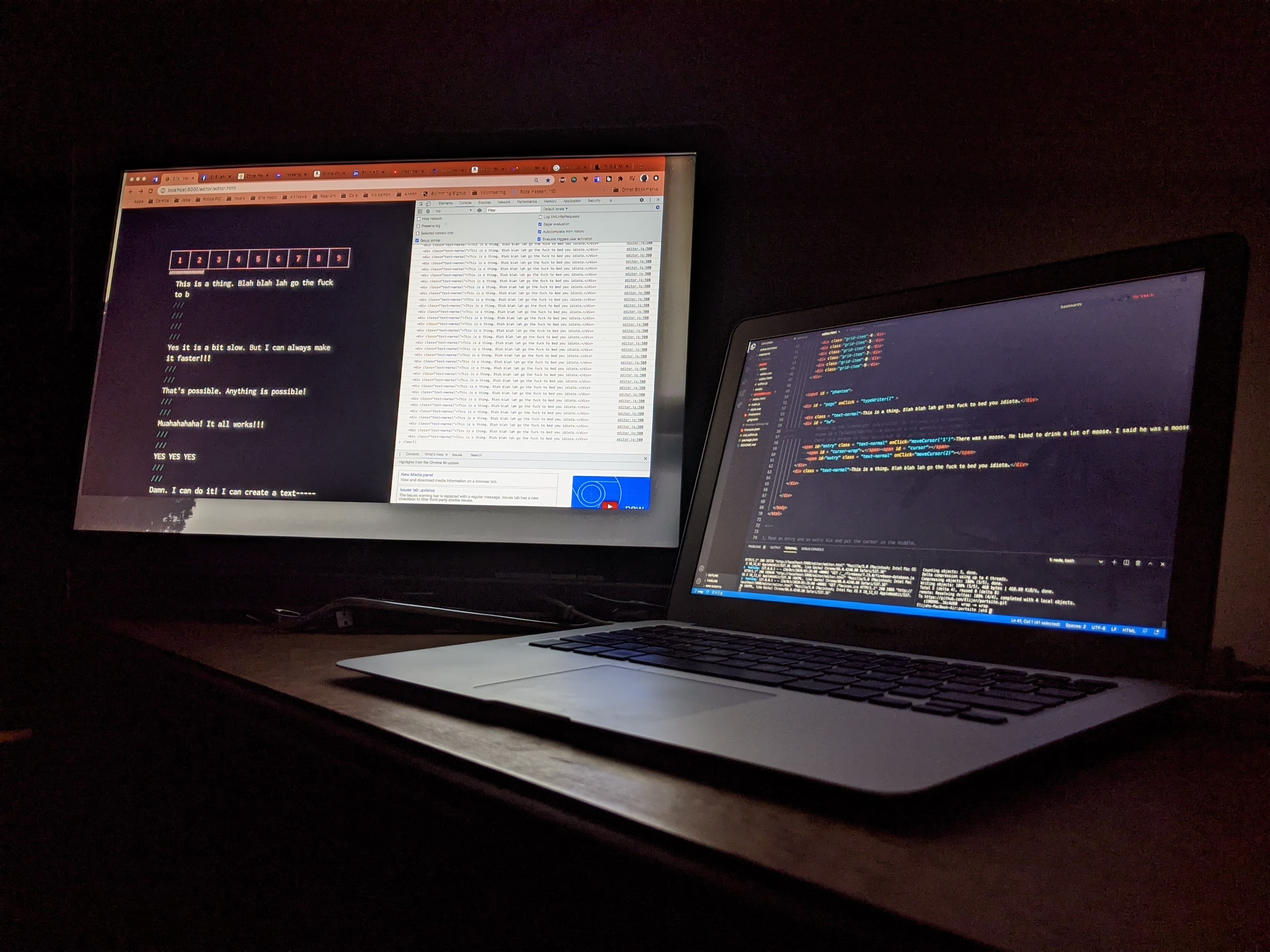
An exploration a few years ago writing the hotkeys on a WYSIWYG editor
In hindsight, I could have graduated art school early. Instead, I signed up for a volley of interdisciplinary classes. Among them were “Web Design 101” and “Programming for Artists”, which marked my future and the way I saw the world.
On the first day of Web Design 101, I sat with business, art and english majors and learned about HTML, Javascript, CSS, and how they were responsible for much of the webpages we used every day. It was exciting in a theoretical sort of way, so I was caught off guard when our professor, smiling, ended class with the following assignment: “Submit your first website tonight, and I’ll see you Thursday.”
I stared down a blank text editor in a cold sweat that night. In hindsight, looking up a few HTML tags on MDN feels trivial, but in that moment it felt utterly impossible.
It might as well have been magic.
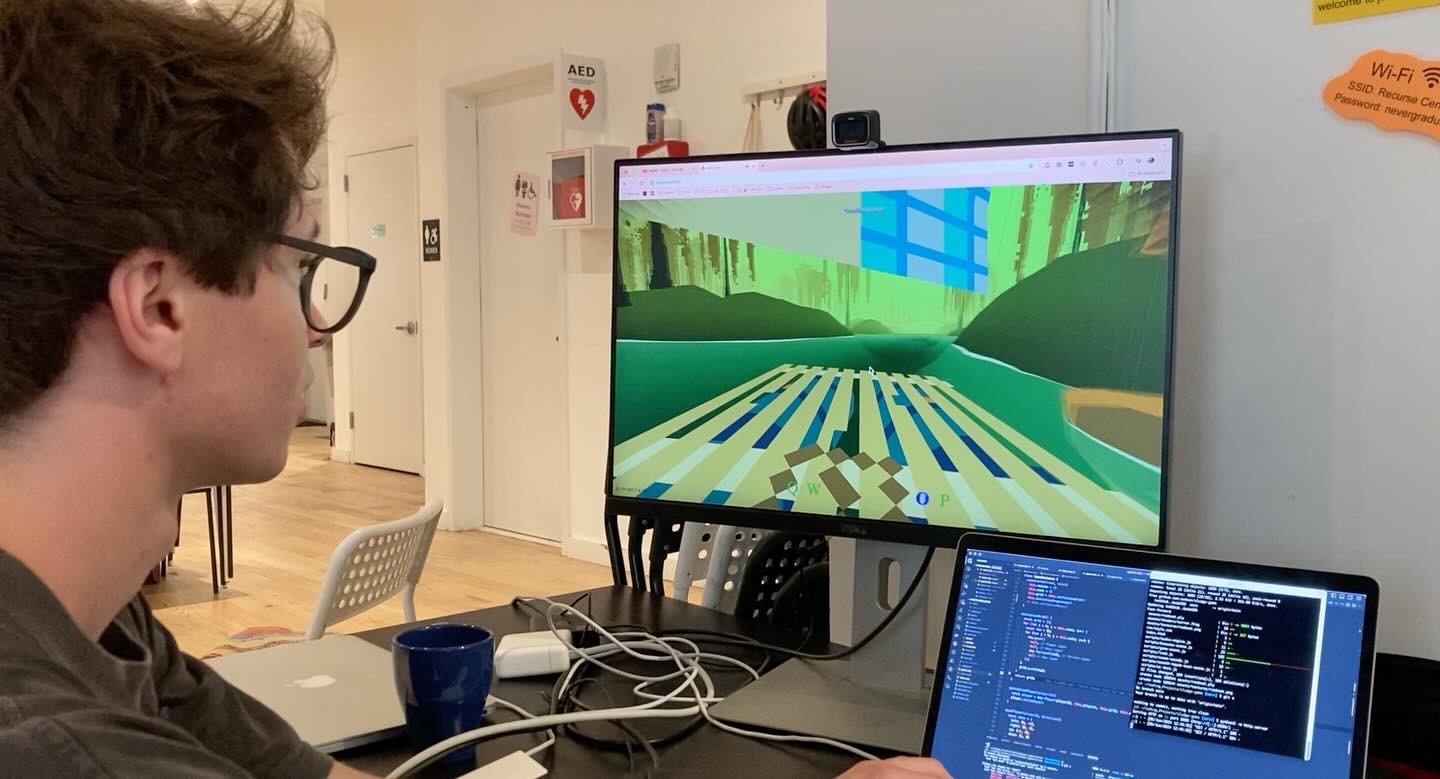
Writing a javascript game at the recurse center, 2025
In a way, that’s exactly what it was, and I think that very magic is the defining element of industries that are currently being redefined.
Fast forward a decade, and the arrival of commercially available transformer-based LLMs brings with it a debate; are the human beings in this industry replaceable? I hear this question all the time. In fact, I was asked it this very morning.
Each industry contains a contingent of professionals who embrace the changes AI offers their craft and their future. And in each industry, a rival faction quietly faces them down, armed with conviction (or hope) that the changes they see are overblown hype, or perhaps a total mirage.
I’m simplifying. For one, each contingent is subdivide by at least one more dimension, the dimension of willingness. I visualize it roughly as a punnet square:
| Excited about AI promises | Bummed about AI promises | |
|---|---|---|
| Belief in AI promises | Willing Believer | Unwilling Believer |
| Disbelief of AI promises | Agnostic Luddite | Resolute Luddite |
| For better or worse, when I read ubiquitous editorialization of AI-fueled economic transformation, or lack thereof, I sort them this way. I think I do this to try to understand the incentive belief in this conversation, trying to understand whether each forecast is sincere, or a result of some ulterior motive. |
I imagine the real sweaty human being behind the circular LinkedIn mugshot who posts some diluted version of their opinion only to log off, lose the smile, and drop their head in their hands.
I imagine Larry Ellison snorting a line of coke off of his toothbrush before putting on the flannel Jammies he reserves for his Northern Hemisphere yacht, and thinking “Wow, AI is the best. I wonder if I can vibe code a simulation of me eating the heart of Montezuma”. He’s got sort of conquistador energy, no?
Meanwhile, there are developers like me, tinkering around with new tools, spending one month going back to writing code by hand, another leaning heavily into a Claude subscription. Noticing things have changed, and wondering how thoroughly the economy of knowledge work has.
Meanwhile on the luddite side, there are many who say this could be the worst thing to ever happen to humanity and yet in some elaborate conceit, they are the ones working the hardest at the AI labs. They seem to be reading off the same cosmically funny yet pathological script OpenAI did when they named their company around their initial vision to “save humanity from AI” only to become the epitome of extractive close-source, proprietary tech capitalism focused narrowly on its own continuation at any cost.
These different positions make for a fascinating, silly, uncertain and troubling world. I’m not here to weigh in on a debate. Will AI lead to enormous loss of jobs? Has it already? These are great questions that economists are better suited for than I.
Most fascinating might be how long these questions have been hanging over us with no definite answer, only a subjective set of perspectives whose constant evolution seems to indicate that there is no set nor final destination. Yet, if previous economic revolutions tell us anything, it is that the dice are often weighted by the powerful hands that hold them.
It’s fitting that in an age defined by the supposed replacement of human thought, the value of a single human opinion feels as needed and scarce as ever.
Here is my question - what makes some jobs seem so much more vulnerable than others?
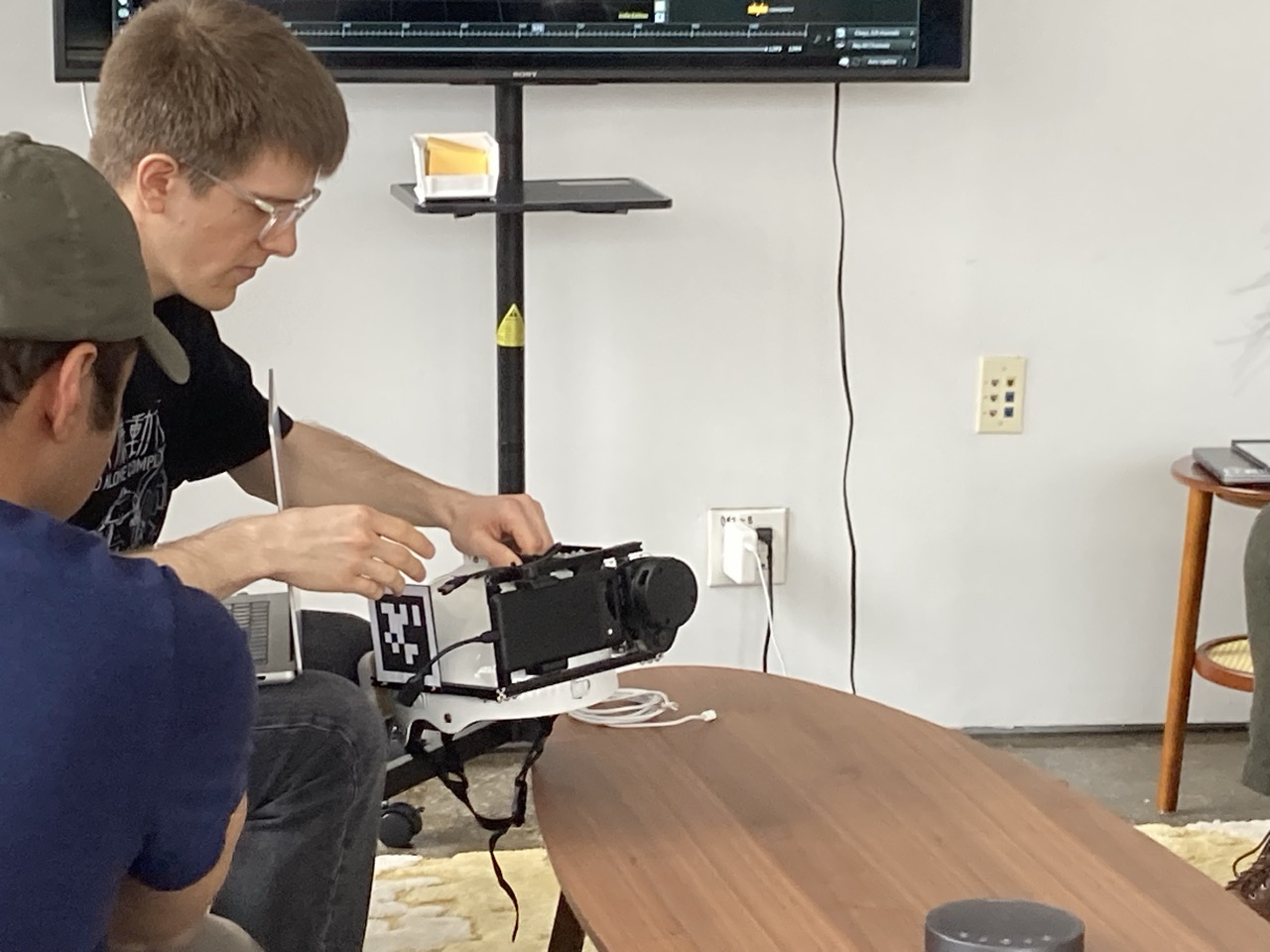
Demo of a helmet-mounted lidar scanner at Side Project Saturday in Downtown Brooklyn
With a smile, a friend of mine recently said “It’s ironic that it seems as if AI is coming the hardest for the nerds,” implying some sort of Frankenstein’s monster situation.
Another friend described a commute he’d had on his way to work where he labored to make sure that chemical weapons weren’t available versus commercial AI chatbots. He’d had the pleasure of sharing a subway car with recently. It was an older man, immensely enjoying what seemed to be lean on the subway and jamming to his JBL. He was bragging about all the kids and grandkids he’d had with various women while the passenger next to him tried her best to ignore her and just read her book.
“Now that guy,” my friend said, “Isn’t worried about AI taking his job. Whatever it is.”

Designing a prototype for an interactive keyboard glove on a breadboard in Python
In that same conversation, someone else at the writing group, also a software engineer, said that he was interested in “marrying a nurse”, because it seemed like the vocation that would evade the clutches of automation the longest.
And in fact several people I know have left the engineering field to become a health worker, either for a more direct (positive) impact on the wellbeing of humans around them, or simply because it was a better deal. More certain, more tangibly valuable.
I could go on, but I think that in software engineering communities it is clear that LLMs are remarkably good at writing code, and unlike say, the entertainment business, the argument that “they can’t do what we do” just doesn’t feel quite believable anymore. The activity that everyone thinks of when they think of software engineering, writing code, truly can be done incredibly well by Claude or Codex at this point. The conversation around job replacement in tech has turned more to understanding the less tangible activities and qualities engineers have that AI is still not great at, of which there are a surprising number.
But why software engineering? Why is AI coming for the nerds instead of the nurses?
My answer is that human beings always have magic and always will, but the current “magic” is always changing. For a while, it was software. How does the internet work? How do you create distributed systems? This take is of course directly inspired by Arthur C. Clarke’s famous “third law” for for sci-fi authors:
“Any sufficiently advanced technology is indistinguishable from magic.”

Earscratch break from shipping
I think there may be a caveat though, which is that magic stops being magic when it’s included on a freemium plan. When part of it is understood, the magic mischievously moves, deeper into the obscure reaches of the collective understanding of humanity. And when a field is totally understood, it disappears entirely.
And so I think there is a fundamental question for knowledge workers and non-knowledge workers, and it is “do you want to be a wizard”? Do you want to base your livelihood on popularly celebrated obscurities? If so, then the magic to chase is probably machine learning and the mathematics that props of AI research and safety.
If you are content with less powerful obscurities, then you are free to seek out new genuses of previously undiscovered parasitic wasps, becoming more of a druid - less of a Saruman, or a Gandalf, and more of a Radagast. No tech companies that manufacture drones will ever be named after Radagast.
And if obscurity and magic are entirely with appeal to you, that’s okay. Become a nurse. Become a journalist, if you don’t care about money at all. Or a cook, or sell shoes. There will always be magic, and we will always worship it, but that doesn’t automatically mean it’s important, or that there is any more integrity to it.
In conclusion, I think that roles in knowledge worker industries like software will continue to change and evolve a lot, but not disappear. The ones that will change the most are the ones that are the most “magical”, because of the roles in which obscurity provided their value. While that obscurity is made less valuable by new technologies like LLMs, what will be left over is the harder work that isn’t sexy or mysterious.
I think of healthcare, an industry that I think continues to benefit from excellent engineering, as a prime example. Electronic Health Record systems, for example, contain a great deal of policy-related and architectural inefficiencies. Engineers will be needed to improve them for many decades to come. This won’t always be “disruptive”, or state of the art work. It will be solidly built APIs, long-running and delicate partnerships formed carefully within the industry, and careful conversations conducted with the recipients of a straining health system. In other words, it won’t be magic. The magic will move elsewhere, as it always does, decade after decade. But in its wake, work that is crucial for society will remain in all industries.